A year after a much-hyped summit in Alaska raised hopes of a diplomatic breakthrough, the war in Ukraine grinds on — and the odds of a negotiated peace appear slimmer than they did in the immediate aftermath of the meeting.
“There’s no deal until there’s a deal,” declared US President Donald Trump at a press conference in Anchorage, the largest city in Alaska, on this day last year.
The line landed as an intentionally open-ended promise — not unlike the remarks Russian President Vladimir Putin delivered from the same podium moments earlier.
In the run-up, many analysts had believed the encounter between the US and Russian leaders at an air force base outside Anchorage could mark the first major step toward ending the conflict.
Mr Trump had been warning he would impose heavier sanctions on Russia if it refused to commit to a ceasefire.
That set up the central questions: could Mr Trump persuade Mr Putin to negotiate directly with Ukrainian President Volodymyr Zelensky, or would the Kremlin leader soften any of his conditions for ending the war?
Those questions — and a raft of competing scenarios — dominated discussion in the days before the leaders met.
But with neither Ukraine nor Europe represented in Alaska, anxieties ran high in Kyiv and across European capitals that Mr Trump and Mr Putin might strike an arrangement over Ukraine’s head and pressure Kyiv into accepting an unwanted peace.
In Ukraine, many saw the Russian leader’s invitation to the US as a betrayal and believed little good could come from the talks for their country.
Ultimately, the summit yielded little, if any, tangible movement toward ending the war.
Now, twelve months later, there is still no “deal” — and a peace agreement looks more distant than it did right after the Alaska meeting.
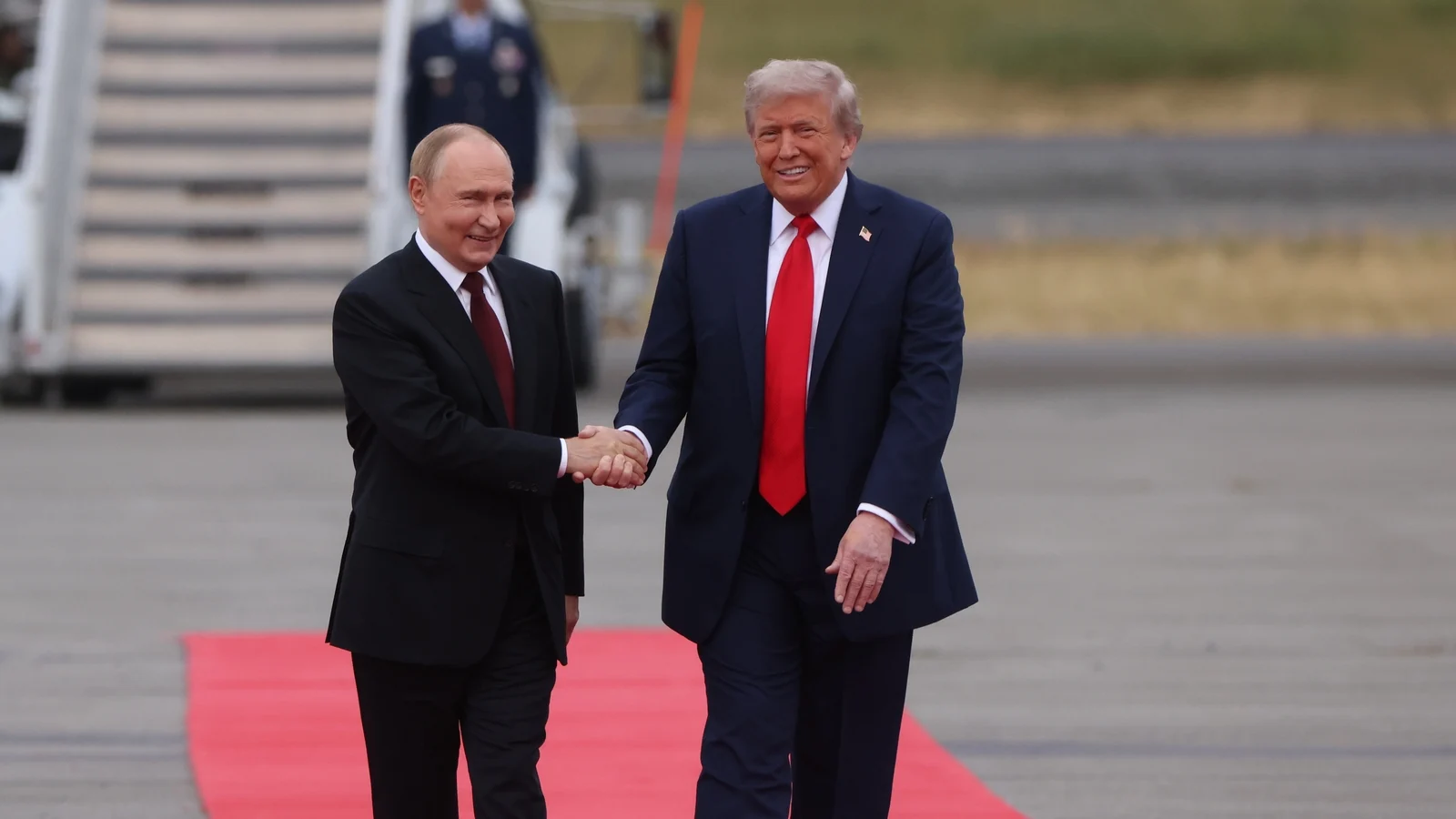
US President Donald Trump, Russian President Vladimir Putin and
their delegations ahead of the summit in Anchorage
Before the summit, the Trump administration had largely matched the shared Ukrainian and European view that a ceasefire should come first, creating space to pursue negotiations on a durable settlement.
Yet soon after leaving Anchorage, Mr Trump executed a sudden reversal. In a post on his Truth Social account, he said he now preferred moving straight to a peace agreement.
Mr Putin had rejected — and continues to reject — a ceasefire across all fronts. Whatever he conveyed in private in Anchorage was enough to convince the US president to abandon the ceasefire-first approach.
Ukraine and European leaders pushed back hard. To them, shelving a ceasefire looked like a US attempt to force Kyiv into territorial concessions.
In the months that followed, Mr Trump’s change of course had an unintended effect: it helped galvanise Europe’s military backing for Ukraine and reinforced the European argument that only a ceasefire could open the door to serious peace talks.
Mr Putin offered no concessions in Anchorage and, crucially, elevated his demand for control of all of Donbas as his main condition for ending the war.
That stance helped shape Kyiv’s response. Ukrainian diplomacy increasingly centred on securing US security guarantees before it would even contemplate discussions about Donbas’ future status.
What those guarantees might entail has never been spelled out by the Trump administration.
The nearest Washington came to explaining its position was last January, after a Coalition of the Willing summit in Paris, when US special envoy Steve Witkoff said US security guarantees for Kyiv “would be the strongest anyone has ever seen”.
A Coalition of the Willing summit was held last month
Ukraine still wants those guarantees, but meaningful engagement on the issue ebbed after the US began its war against Iran last February.
US officials also held their last trilateral talks with Russian and Ukrainian officials in February in Geneva — just 10 days before US strikes on Iran began. Since then, no talks between the two warring sides have taken place.
Mr Putin, in Prof Pavel K Baev’s view, misjudged the moment in Alaska. The Russia foreign policy expert at Oslo Research Peace Institute said the Russian leader “overplayed his hand”.
“It wasn’t exactly a bluff that was called. It was more a demand too far, which even Trump recognised as impossible to meet,” Prof Baev told RTÉ News.
“I think that for Trump, Putin needed to make more concessions and not insist on territorial gains, which proved to be impossible on the battlefield and politically as well.
“Putin could have made a further step towards agreeing on a ceasefire at least. That was for Trump, I think, the key point, and Putin missed that opportunity to make a deal with Trump, who generally lost interest,” said Prof Baev.
Just three days after the Anchorage summit, five European leaders, along with European Commission President Ursula von der Leyen and NATO chief Mark Rutte, arrived at the White House with Ukrainian President Volodymyr Zelensky. Their message was pointed: Ukraine could not be sidelined in any process to end the war, and security guarantees had to be part of the discussion.
If the Alaska meeting produced any upside for Kyiv, Ukrainian officials argue, it was the wake-up call it delivered to Europe — that supporting Ukraine required more than statements of solidarity.
Over the past year, most European countries have increased military and financial aid for Ukraine, helping to fill the gap left by the Trump administration’s near-total withdrawal of military support.
Agreements between Ukraine and European countries on cooperation in drone production and air defence systems have become more common since.
The cumulative effect is that Ukraine is now less vulnerable to US pressure to accept an end to the war on Russia’s terms than it was in early 2025, when Mr Trump and his officials often cast Ukraine as the side expected to concede.
The Americans didn’t deliver Ukraine on a platter for Putin as he had wished.
“Before Anchorage there was not such close cooperation between Europe and Kyiv on the path towards peace. Now, it is water-tight,” Volodymyr Dubovyk, the Director for the Centre of International Studies at Odesa Mechnikov National University, told RTÉ News.
For months after Alaska, the Trump administration urged Ukraine to treat Donbas’ territorial future as the central question in any settlement.
Mr Zelensky and senior members of his government resisted, holding to their position that explicit security guarantees must come first.
Eventually, US pressure eased as the Trump administration concluded that Kyiv would not simply surrender Donbas.
Mr Dubovyk said Anchorage mattered because Washington and Moscow both learned that their leverage had limits.
“The Americans didn’t deliver Ukraine on a platter for Putin as he had wished,” he said.
For at least six months after the meeting, Mr Putin, Foreign Minister Sergey Lavrov and other senior Russian officials repeatedly invoked what they described as the “spirit of Anchorage”.
The phrase reflected Moscow’s claim that an understanding had been reached in Alaska on a pathway to ending the war.
US Secretary of State Marco Rubio, who attended the summit, has said no agreement was made. There is also no written record of what was discussed.
In recent months, however, Mr Putin has stopped using the “spirit of Anchorage” line — an omission that may indicate the Kremlin recognises the framework has shifted, or that the US is no longer engaged.
Even as the frontline has remained largely unchanged over the past year, the character of the air war has shifted markedly.
In the past two months, Ukrainian deep strikes inside Russia on oil depots and e-commerce warehouses have triggered petrol shortages and hit Russia’s valuable retail sector.
Ukraine, meanwhile, is described as being in a stronger military and diplomatic position, although Russia has answered with increased ballistic missile attacks and the use of devastating glide bombs on frontline cities.
Smoke rises from a warehouse owned by a Russian e-commerce giant near Saint Petersburg
after being hit by Ukrainian drones on 24 July
Mr Putin’s uncompromising posture in Alaska has also narrowed his options. Having drawn firm red lines, it is now extremely difficult for him to pivot toward accepting a ceasefire.
Such a shift would be read as weakness — a political posture Russia’s president has long tried to avoid.
Mr Putin’s room for maneuvering is now “much narrower” than it was a year ago, Prof Baev said.
Anchorage also pushed Ukraine and Europe into closer alignment, though European leaders still do not share a single view on whether direct engagement with Mr Putin and his officials is wise.
Some media outlets have reported that Mr Witkoff and Jared Kushner, a US envoy and Mr Trump’s son-in-law, are planning to travel to Kyiv and Moscow later this month.
If the trip goes ahead, it would be the first visit to Kyiv by Mr Witkoff and Mr Kushner since the current Trump administration began.
Still, in Ukraine, expectations remain low. Few anticipate a near-term breakthrough, and there has been no indication that a revised US peace proposal is being prepared.
The reported plan for the two US envoys to visit Kyiv, Mr Dubovyk said, “looks like an attempt to return to what was there before, an imitation of peace talks”.
One year on, the Anchorage summit reads not only as a US diplomatic failure, but also as a strategic miscalculation by Mr Putin in dismissing a ceasefire outright. Over the past 12 months, his forces have achieved only small gains in Donbas — and at a heavy cost.
At the same time, the meeting helped accelerate Europe’s diplomatic and military support for Ukraine, support that has proved vital to Ukraine’s survival.