The Day the Courtroom Fell Quiet: Gerry Adams and a Civil Claim That Ended Abruptly
There are mornings in London when the air itself seems to hold its breath. On one of those mornings, the High Court on the Strand hosted a drama that had been building for decades — a legal confrontation that was always as much about memory as it was about law.
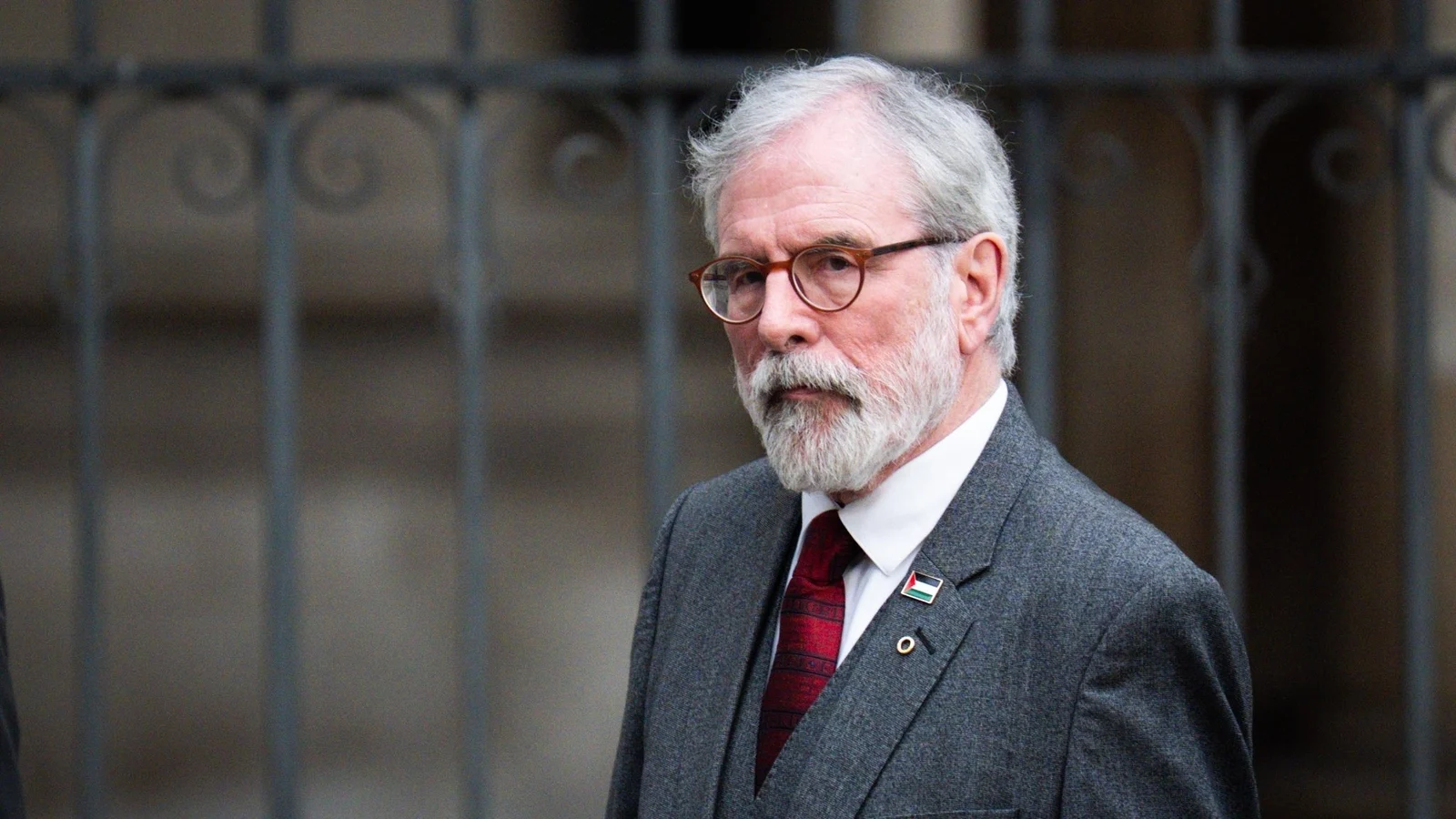
After two weeks of testimony, paperwork and headline-grabbing claims, the civil damages action against Gerry Adams — the long-time Sinn Féin leader who has long been entwined with the story of modern Ireland — was discontinued. The case, brought by three survivors of Provisional IRA bombings on the British mainland, was dismissed on the final day of the trial with “no order as to costs.” The plaintiffs, John Clark, Jonathan Ganesh and Barry Laycock, had sought the symbolic sum of £1 each, arguing Mr Adams had been a leading figure in the Provisional IRA on the dates of the attacks.
A charge in civil garb
The courtroom had been presented as a place where history might finally be sifted into adjudicated truths. Barristers said they would assemble a “jigsaw” of witnesses and documents to show that Mr Adams was “directly responsible for and complicit in those decisions” to detonate bombs in 1973 and 1996. If legal arguments were woven with dramatic intent, they were met by an almost equally dramatic defence: Mr Adams sat in the witness box for two days, stating, in plain terms, his denial.
“I had no involvement whatsoever,” he told the court. “I categorically rejected all of the claims being made.” He said he attended the trial “out of respect” for the victims and to defend himself “against the smears and false accusations being levelled against me.” He repeated a line he has long held close: that he supported the legitimacy of republicanism and a peaceful, democratic route to Irish unity — the route now embodied in the Good Friday Agreement.
Then, as the wheels of litigation churned toward their appointed end, something shifted. Late developments related to whether the claim amounted to an “abuse of process” unfolded overnight. The plaintiffs’ lead counsel, Anne Studd KC, returned to the bench and announced the claim would be discontinued. Mr Justice Swift accepted the parties’ agreed order. In other words: the hearing stopped, the judgment did not proceed, and neither side was ordered to pay the other’s costs.
Faces in a crowded room: victims, politicians and public memory
For anyone who has lived through the Troubles, the reverberations of such court battles are never purely juridical. They are personal. They are painfully human.
The three claimants each carry with them the scars of bombings that reached beyond Northern Ireland to the heart of Britain — the Old Bailey blast of 1973, the Docklands and the Manchester Arndale attacks of 1996. They came to court to seek symbolic vindication. “We wanted the truth,” one legal source close to the claimants said privately. “We wanted names linked to actions.” Whether the courtroom was the right venue for that search has been fiercely contested.
Sinn Féin’s leader, Mary Lou McDonald, condemned the civil action as a “charade” and framed its collapse as proof of a wider political misstep. “I think this was really a broader attempt by the British establishment to put Irish Republicanism in the dock, and their attempts failed,” she said, in a statement overflowing with political resonance. “Gerry went to London to defend his standing and his reputation… the case has collapsed, and that speaks for itself.”
Across Belfast and Dublin, reactions varied like the shades of a stained-glass window. In a north Belfast pub where the television had been turned to the trial, the proprietor, a woman named Mairead who has seen more than her share of headlines in her lifetime, said: “People want closure. But we also want to move on. It is not enough to have a court stop a story in mid-sentence.” Her voice carried the weary patience of someone who remembers curfews and bomb scares as part of daily life.
Legal minds weigh in
Legal commentators were sharper in tone. Edward Craven KC, counsel for Mr Adams, argued the case rested on “high-level assertions, unsupported by detail” and that the claim should be dismissed as an abuse of court process or for being brought too late. The notion that courts might be used as a stage for “public inquiry-style” proceedings — searches for historical truth rather than adjudications of civil liability — was central to the defence.
“Courts are designed to resolve disputes now; they are not a substitute for comprehensive historical inquiry,” said Dr. Fiona O’Reilly, a legal scholar specialising in transitional justice (University affiliation withheld). “When decades have passed, memories fade, documents are lost, and questions of fairness arise. That’s part of why judicial systems have doctrines like abuse of process and why other mechanisms — truth commissions, public inquiries — are sometimes better suited to these questions.”
What this means for truth, memory and reconciliation
Beyond the procedural mechanics lies a broader cultural question: how does a society confront the violence of its past without reopening raw wounds — and without allowing history to ossify into a set of immutable accusations?
The Troubles claimed more than 3,500 lives across Northern Ireland and beyond between the late 1960s and the Good Friday Agreement in 1998. Thousands more were injured. The Good Friday Agreement itself was a seismic pivot toward peace, creating political avenues for conversations that had previously been fought over with guns and bombs. Yet the appetite for historical reckoning has not been sated.
For victims and survivors, formal apologies, inquiries and courts are not interchangeable. “I don’t want a headline, I want answers,” said a Manchester woman who lost a brother in 1996 and watched the trial from the public gallery. “If the law can’t give me answers, who will?”
For politicians, the trial’s end comes as a reminder that the past is never quite done with the present. For the Irish government and British institutions, the task of reconciliation keeps asking awkward, open-ended questions about responsibility, reparations and recognition.
- Fact: The Good Friday Agreement was signed in 1998 and is the cornerstone for the Northern Ireland peace process.
- Fact: Over 3,500 people were killed during the Troubles, with thousands more injured and displaced.
- Fact: Civil claims can be used to seek symbolic damages, but courts must balance the pursuit of truth with principles of fairness and the limits of judicial process.
So where do we go from here?
The discontinuation of this particular case does not—cannot—close the story its protagonists brought to the bar. The plaintiffs’ longing for answers remains. The accused’s insistence on his innocence remains. The public’s hunger for a coherent national narrative remains.
What it perhaps underscores is the need for layered approaches to justice: legal avenues, yes, but also truth-telling forums, archival projects, community dialogue and memorialisation that can hold multiple, sometimes painful truths at once.
As you read this, consider: how does a society honour victims while allowing for political and social reconciliation? Can the same institutions provide both? And if not, who should? The answers are not tidy, and they will not be fast. They will, however, be essential for any nation that wants to remember without being chained to its worst days.
Outside the High Court, the pavements of London were busy with the small, ordinary acts of life — commuters, coffee vendors, tourists unbothered by history for the moment. Inside, the court had closed a chapter without writing its epilogue. History, as ever, will keep turning its pages; the work of reading them with care has only just begun.