The day the edge gave way: Niscemi’s cliffside exodus
They say you can hear a town breathe. On the morning the plateau unclipped itself from the plain below, that breath turned into a gasp.
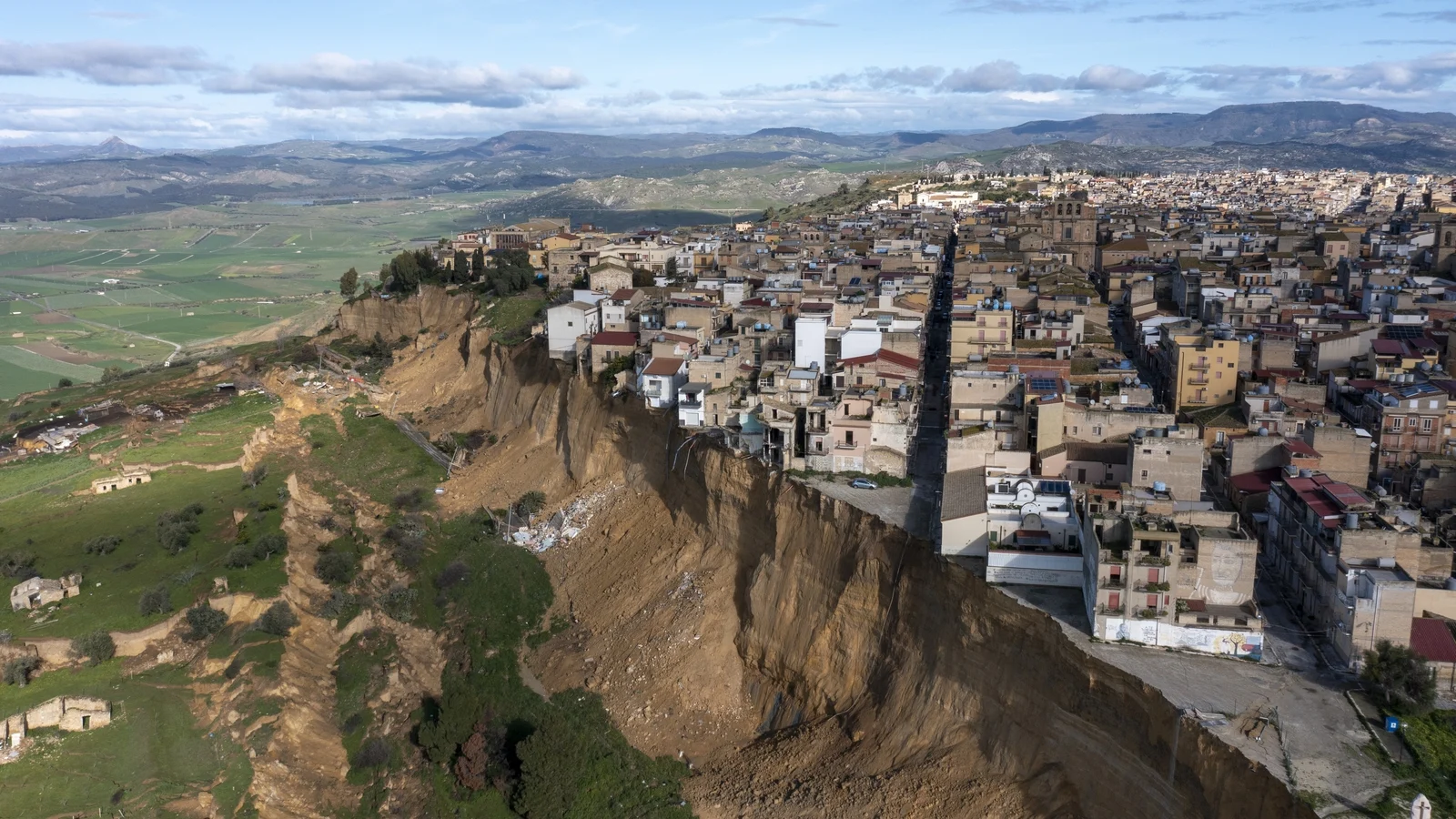
In Niscemi, a town of roughly 25,000 souls tucked into south-central Sicily’s honeyed landscape, families stepped into the street and watched whole chunks of earth slide away. Houses that had stood for generations were suddenly perched on a new, terrible horizon. A car dangled over the void like a child’s toy abandoned mid-play. Garden walls cracked into puzzle pieces. The church bell, which had marked births and funerals for decades, tolled once and then fell silent.
“Let’s be clear: if a house is on the edge it cannot be occupied,” Fabio Ciciliano, Italy’s civil protection chief, told reporters at the scene, his voice equal parts command and counsel. The message was simple, but the consequences were not. Authorities ordered more than 1,500 people to leave their homes. For many, the evacuation felt sudden; for others, it felt overdue.
Evacuation and official response
Emergency tents and buses arrived within hours. Social workers set up triage points to register families and coordinate temporary shelter. The government moved as well: Prime Minister Giorgia Meloni’s administration declared a state of emergency for Sicily, Sardinia and Calabria, the three southern regions hammered by the same violent storm system that opened Niscemi’s wounds.
The cabinet approved an initial 100 million euros to meet urgent needs — food, shelter, immediate repairs. Local authorities, however, estimate the damage across the affected area could top 1 billion euros once rebuilding, business losses and repairs to infrastructure are counted.
“There’s no sugarcoating it,” a municipal official, answering on the condition of anonymity, said over coffee in the square. “We’re looking at a permanent relocation for some neighborhoods. People don’t just lose walls; they lose memories. You can patch a roof, but you can’t move a childhood.”
Lives uprooted: voices from the plateau
There are names and faces behind every statistic. Francesco Zarba, whose family has lived on the plateau for generations, spoke bitterly when he stood on the temporary safety line and watched surveyors measure the slope.
“I have been told that I have to leave. We had the first landslide 30 years ago, and no one ever did anything,” he said. “They knew the ground was tired. They knew the water was eating under our feet. My wife cried when she packed the recipes.”
Maria, a widowed retired teacher, wrapped her shawl tighter against the wind and described putting photographs into a plastic bag as if they were precious seeds to be planted elsewhere. “We have this little piazza where everyone meets. In summer, the street singers come. For me, it’s not the house; it’s the piazza’s sound I will miss,” she said. “I feel like we are being reshuffled by forces we don’t see.”
A young volunteer from Catania arrived with thermoses of coffee. “You can tell people are angry, but mostly afraid,” she observed. “They ask, ‘Where do I go? Who will fix the slope? Who pays for this?’”
Why the plateau failed: water, geology, and a warming Mediterranean
At the heart of the catastrophe is a deceptively simple culprit: water. Officials say the plateau is gradually collapsing toward the plain below, a process accelerated by water that has been saturating the subsoil. The violent storms that swept the region released intense bursts of rain, but they were simply the trigger for a simmering problem.
“This is a slow-motion geologic event that reached a sudden, catastrophic moment,” said Dr. Elena Russo, a geologist at the University of Catania. “When soils become saturated over long periods, the cohesion that holds slopes together vanishes. In urbanized landscapes, human activity — poorly maintained drainage, altered land use — compounds the risk.”
Scientists have repeatedly warned that the Mediterranean is warming faster than the global average, changing rainfall patterns and increasing the intensity of storms. Italy has seen a rise in extreme precipitation events in recent decades, and landslides and flash floods have followed. What was once statistically rare is becoming part of seasonal reality.
Local color, ancient land
Niscemi’s plateau is not just a geological feature; it is a patchwork of olive groves, citrus orchards, terracotta roofs and narrow lanes where neighbours trade small kindnesses. In the lower streets, a barber swept hair onto a mosaic floor, and in the cafés people argued with friendly heat over football and politics. The land remembers the toil of families and the rhythms of harvests.
“You can’t separate people from place here,” said a local priest, who arrived to offer quiet comfort. “Even our saints’ festivals are shaped by the land. When the ground moves like this, it feels like the center of our stories is shifting.”
What comes next: money, policy and migration
The million-euro question is both fiscal and moral. Initial government funds are a start, but rebuilding safely will require sustained investment in geotechnical studies, drainage, reinforced coastal defenses, and — crucially — the political will to act before the next storm. Local authorities warn that without substantial, long-term investment the cycle will repeat.
Beyond infrastructure, there is the human toll. Relocations often lead to social upheaval: schools empty, small businesses close, and the cultural fabric that knits a community frays. Across Europe and beyond, climate-related displacement is emerging as a quietly accelerating phenomenon, reshaping demographics and social supports.
“This is not just a Niscemi problem,” Dr. Russo said. “It is a litmus test for how we adapt to a new norm. Do we shore up coasts and slopes piecemeal, or do we reimagine our relationship with fragile landscapes?”
Immediate needs and long-term choices
- Short-term: safe housing, psychological support, rapid geotechnical assessments, and compensation schemes.
- Medium-term: reinforced drainage, slope stabilization, and urban planning that respects geological maps.
- Long-term: national investment in climate adaptation, early warning systems, and community-led relocation planning.
Policy talk aside, communities must be centered in these decisions. Residents like Francesco and Maria want assurances that relocation isn’t erasure — that their stories will move with them, not be placed in archives. They want a say in where and how they restart.
Where do we go from here?
As Niscemi’s people arrange their lives around temporary addresses and uncertain futures, one thing becomes clear: modern disasters are rarely single events. They are the intersection of weather, geology, policy choices and long-term neglect. They test our institutions, our compassion, and our imagination for a just response.
So as you read this, ask yourself: what would you want your leaders to do if land beneath your feet began to slip away? And what would you want history to remember about how we treated our neighbors when the ground fell out from under them?
In a land of enduring light, where seasons have always been a promise, Niscemi now waits — a community suspended between memory and rebuilding, asking not just for money and engineering, but for a future that keeps people and place together. The work ahead is technical, political and moral. It is also deeply human.