Bondi Beach, a Light Doused: How One Night of Celebration Became a Reckoning
Bondi Beach is a place of ritual — dawn swims, fishermen with their lines like punctuation against the horizon, teenagers with chipped Vans and sun-bleached hair. On a Sunday evening in early December, that familiar rhythm was broken. A Hanukkah festival meant to mark light in the darkest days of winter turned into chaos when gunfire ripped across Archer Park and into the sand where more than a thousand people had gathered.
By morning the numbers were grim and specific: 16 people dead, dozens wounded, and a community reeling. Officials said the attack appeared targeted at the Jewish event. Two men — a father and son — opened fire with long guns, witnesses recalled. The father, a 50-year-old man who had held firearms licences since 2015, was later found dead at the scene. His 24‑year‑old son was critically injured and remains in hospital. Police confirmed about 40 people were treated in hospital; among them were two officers in serious but stable condition. The victims’ ages spanned generations, from a child of ten to an elder of 87.
The Ten Minutes That Changed a Beach
“I thought they were fireworks at first,” said Morgan Gabriel, a 27‑year‑old Bondi local who had been on her way to the cinema. “Then people started running up the street — screaming, phones ringing, shoes and blankets left on the sand. Ten minutes felt like forever.”
Those ten minutes, witnesses said, were both horrifying and oddly cinematic: people diving for cover behind palm trees, families sprinting toward side streets, and, amid it all, strangers pulling others to safety. One video went viral — a bystander wrestling a gun away from one of the shooters. That man, later identified as Ahmed al Ahmed, a 43‑year‑old fruit shop owner who served previously with police, was shot twice as he intervened. He survived after surgery; an online fundraiser for him has now topped A$350,000 (€198,539).
“He didn’t hesitate,” said Mohamed Fateh al Ahmed, speaking through a translator. “He saw people lying on the ground and he had to act. He has always felt he must protect others. Today we are proud — he is a hero of Australia.”
A Nation’s Conversation Reignited
Prime Minister Anthony Albanese visited Bondi Beach the next day and planted flowers on the sand. His voice carried the weight of national mourning and a challenge: tougher gun laws. “Licences should not be in perpetuity,” he said, bluntly stating what many were already whispering in op-eds and living rooms — that existing rules had gaps. He announced he would take reforms to National Cabinet, urging state premiers to act.
“What we saw yesterday was an act of pure evil, an act of anti‑Semitism,” the prime minister told reporters. “The Jewish community are hurting today. All Australians wrap our arms around them.”
Officials said the father held licences for six firearms, which police believe were used in the attack. Surveillance footage and cellphone clips showed what appeared to be a bolt‑action rifle and a shotgun. Police Commissioner Mal Lanyon said investigators were still building a picture of motive and background: “We are very much working through the background of both persons. At this stage we know very little.”
Faces, Flags and a Makeshift Memorial
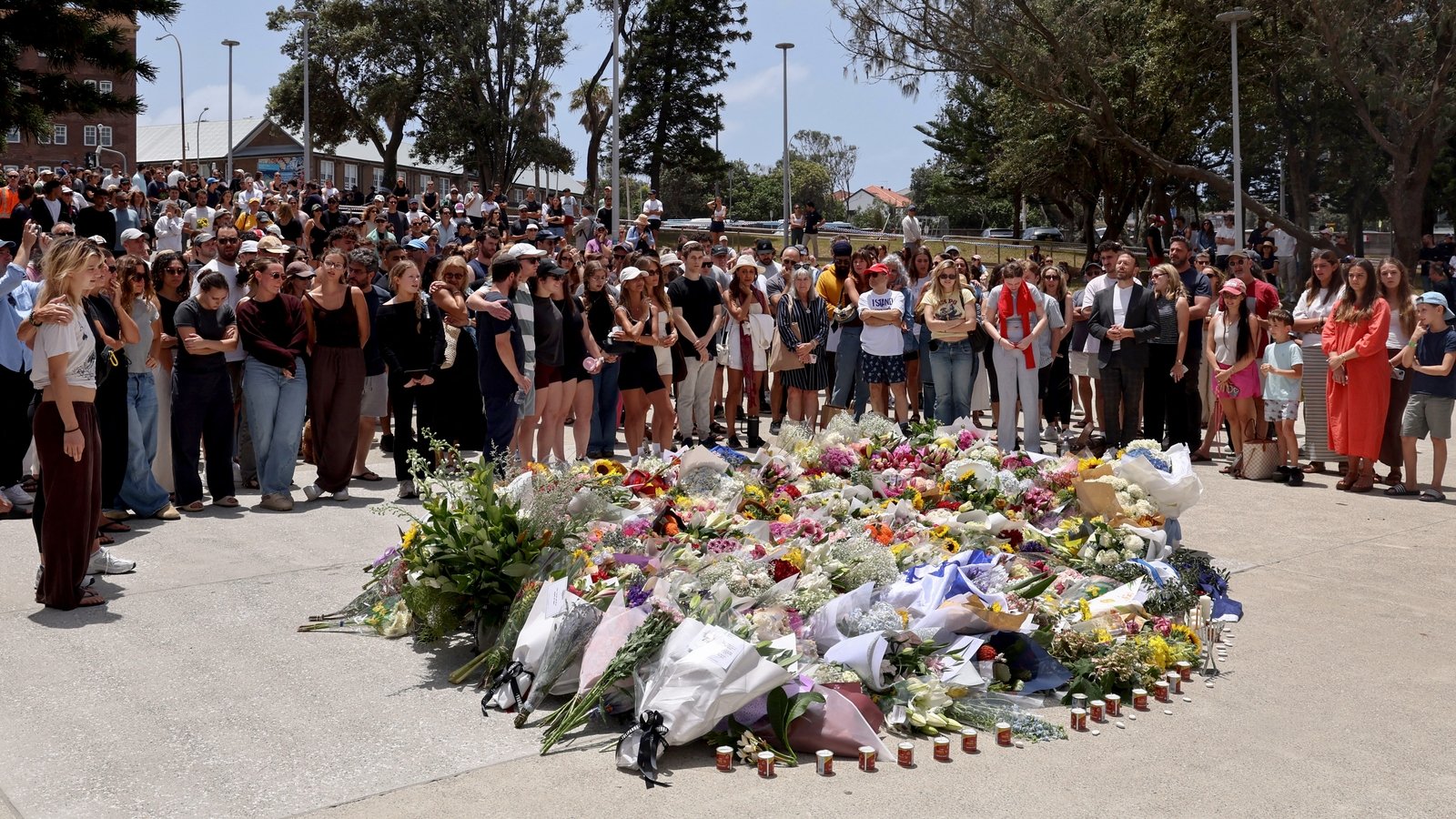
Within hours, a line of flowers, candles, and Israeli and Australian flags formed a makeshift memorial near the Bondi Pavilion. Mourners left scarves, flip‑flops and thermoses — items abandoned by people fleeing the beach — and lined them up for collection. An online condolence book filled with messages from Australia and abroad: “We are with you,” wrote strangers in different languages.
Private Jewish security volunteers joined police at the site. Elders, children and teens came to lay flowers; for some, the ceremony was also an act of defiance. “Light defeats darkness,” Albanese urged the nation, asking Australians to light candles in solidarity — a line he repeated, invoking Hanukkah’s promise of small, persistent lights against long nights.
Heroes, Questions, and a Community Bruised
There were quiet acts of courage everywhere: fishermen offering their boats to ferries, café owners handing out shirts and towels to those who lost their footwear, and medics working until late into the night. Yet the city also asked tough questions. How had men with licensed weapons been radicalised? How long had they been under observation, if at all? Should firearm licences be renewable rather than indefinite? Could stricter caps on ownership help prevent future attacks?
Home Minister Tony Burke disclosed that the father arrived in Australia in 1998 on a student visa, while his son was Australian‑born. The attack lands amid an uptick in anti‑Semitic incidents across the country since the Israel‑Gaza war reignited last October. In August, Australia expelled Iran’s ambassador, accusing Tehran of directing at least two anti‑Jewish attacks. International leaders also weighed in: messages of condolence arrived from capitals, a reminder that this is not just a local tragedy but part of global currents.
Gun Control in the Shadow of Port Arthur
Australia’s relationship with guns has long been shaped by Port Arthur, the 1996 massacre in Tasmania that killed 35 people and led to sweeping reforms — a national buyback, tighter licensing, and limits on semi‑automatic weapons. Those measures were hailed worldwide and have correlated with a steep drop in mass shootings.
Still, Port Arthur is decades ago. Societies change, radicalisation finds new arteries in social media and fractured communities. “Laws are only as strong as the systems that enforce them,” said Dr. Laila Hassan, a criminologist at the University of Sydney. “We must look beyond possession: risk assessment, mental health, community support, and surveillance of extremist networks matter.”
Australia’s firearm homicide rate has been among the lowest in the OECD for years — estimated at around 0.1 to 0.2 per 100,000 people — but as experts note, a single mass shooting alters a nation’s sense of security. “Rare doesn’t mean impossible,” Dr. Hassan reflected. “And policy must evolve accordingly.”
What Comes Next?
There will be inquiries, policy meetings and political pressure. The prime minister has signalled a limit on how many firearms one person can own and suggested licences should require renewals and reassessments. Opposition and states will debate details, and civil liberty groups will watch closely for proportionality.
But beyond the technical measures is a quieter, harder task: healing a community. How do you comfort a child who hid beneath a towel as shots rang out? How do you honor the dead while ensuring their faces become a lesson for future prevention? These are the questions residents keep asking on Bondi’s hilltops as the tide moves in and out.
“We have to remember the people, not just the politics,” said Rabbi Miriam Stein, who has been counseling families. “Yet we must also be practical. Today we mourn. Tomorrow we rebuild and make sure light truly defeats darkness.”
Invitation to Reflect
How should democracies balance individual freedoms with collective safety? What responsibility do we carry as neighbours, employers, online citizens to identify harm before it manifests? As you read this, consider the rituals you cherish — the festivals, public spaces, the ordinary moments — and imagine them safeguarded by conversations that are both urgent and compassionate.
Bondi’s sand will eventually be washed smooth again by the Pacific. For the families and friends of those lost and injured, some scars will never fade. For the rest of the country, an old lesson must be relearned: the cost of complacency is sometimes measured in lives. The challenge now is to turn grief into policy and memory into prevention, so that the lights we kindle in winter are only ever symbols of hope, never the response to another night of terror.