When a Quiet Estate Became the Focus of a Nation
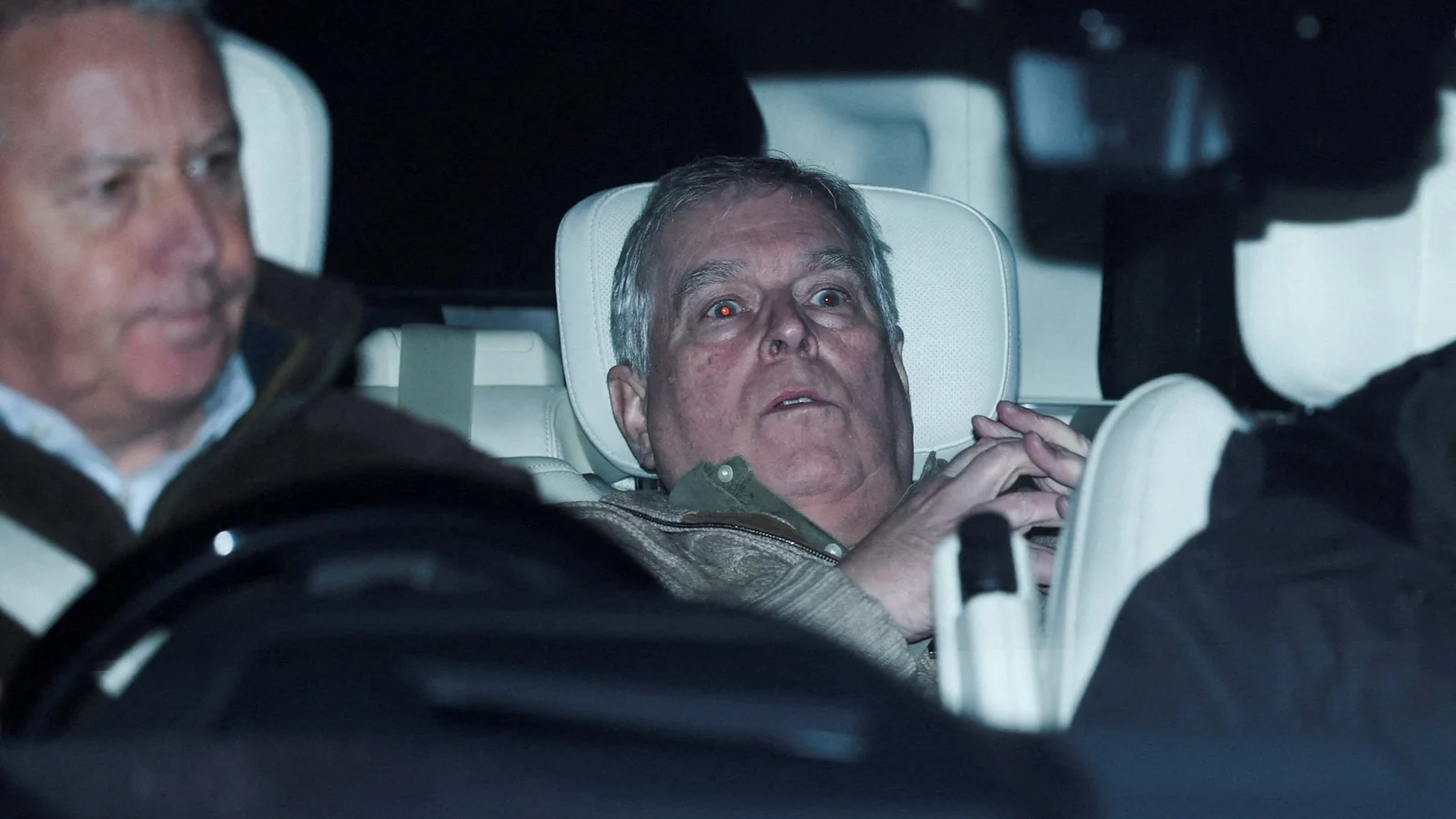
On a damp Norfolk morning, the gravel drive at Sandringham—the royal family’s private haven—became a stage for a scene most Britons had never imagined seeing in their lifetimes: uniformed officers, plain cars with unreadable badges, and a figure cross-legged in the back of a vehicle, visibly spent and pale under the winter light.
Andrew Mountbatten-Windsor, once a familiar presence at state events and charitable dinners, was arrested on suspicion of misconduct in public office and held for roughly 11 hours before being released under investigation by Thames Valley Police. The arrest, tied to documents disclosed in the aftermath of Jeffrey Epstein’s notoriety, has left a country—indeed, a world—trying to reconcile images of monarchy with modern demands for accountability.
What Happened, in Plain Sight
Detectives had already concluded searches at the Norfolk property that sits within the Sandringham estate, but activity continued at Royal Lodge on the Windsor estate—his former residence in Berkshire. Officers were seen at the gates; an unmarked car drew up. By evening, Mr Mountbatten-Windsor had returned to Sandringham, his motor cutting past a ring of journalists, their lenses catching the fleeting silhouette of a man who for decades moved through elite corridors with near-impunity.
“It felt surreal,” said a local photographer who asked not to be named. “You expect tourists and pageantry here, not forensics and detectives. It changes the whole atmosphere.”
A timeline, briefly
- Arrest occurred in the morning; custody lasted about 11 hours.
- Searches conducted at the Sandringham home concluded; searches at Royal Lodge in Berkshire were ongoing.
- Police were acting after allegations surfaced in files released by US authorities concerning Jeffrey Epstein.
- Mr Mountbatten-Windsor was released under investigation, a procedural status that leaves the matter open while inquiries continue.
Documents, Allegations, and a Long Shadow
The heart of the matter lies in a trail of emails and files that resurfaced as part of the legal aftermath surrounding Jeffrey Epstein. Some of those records appeared to show the sharing of reports and briefings about official visits—Hong Kong, Vietnam, Singapore—and even a confidential-sounding note related to reconstruction projects in Afghanistan’s Helmand province.
Thames Valley Police say they are reviewing the material and investigating whether information purportedly passed on could constitute misconduct in public office—a common law offense in the UK that carries serious potential consequences when it intersects with public trust.
“Our job is to follow the evidence wherever it leads,” a police source told me. “No one is above the law. That’s what this is about—establishing facts and ensuring the integrity of public office.”
Faces in a Crowd: How People are Reacting
Reactions have spanned the emotional spectrum: shock, sadness, anger, and weary resignation. A woman selling hot pies outside a market in King’s Lynn summed it up with that particular British mixture of pragmatism and bemusement: “If they’re guilty, they should explain. If they’re not, let it be. But this cloak-and-dagger business isn’t good for anyone.”
A constitutional law lecturer in London observed, “This moment tests not just one family, but the institutions around them—the police, the media, and the mechanisms for accountability. The monarchy is symbolic, but when a senior member is embroiled in legal questions, the symbolism becomes raw and immediate.”
From abroad, public figures have weighed in. Reports relayed comments from the US president describing the arrest as “very sad,” framing the episode within a transatlantic curiosity about the health of the British crown and its public image.
Palace, Politics, and Procedure
Notably, it is understood that Buckingham Palace and King Charles were not informed before the arrest took place. The Home Office was given a short heads-up—about half an hour, according to a statement relayed via the National Police Chiefs’ Council—reflecting routine operational communication rather than a pre-emptive consultation.
King Charles later released a brief statement: the police “have our full and wholehearted support and co-operation” and “the law must take its course.” He continued his official duties, meeting ambassadors at St James’s Palace, underscoring a profoundly delicate balancing act between personal family turmoil and the responsibilities of the crown.
“The optics are complicated,” said a royal correspondent who has covered decades of palace life. “On one hand there’s the very human story of a brother and a family; on the other there’s a national institution that must appear steady and canvass public trust. Those two things often pull in different directions.”
Why This Matters Beyond Palace Gates
This is not simply a tabloid drama or an isolated legal blip; it sits at the crossroads of several broader themes—how societies police the powerful, the transparency demanded of public figures, and the interplay between private relationships and public responsibility.
Consider the statistics: public trust in institutions has been fickle across democracies in recent years. A 2023 survey of public confidence in national institutions in several Western democracies showed a measurable dip in trust towards elite institutions compared to a decade prior. When high-profile figures face allegations of impropriety, the ripples extend beyond headlines to civic sentiment.
“If the point of institutional accountability is to show that no one is insulated from scrutiny, then high-profile investigations must be handled with absolute clarity,” an ethics scholar told me. “Otherwise the perception takes over—and perceptions are powerful.”
Questions to Sit With
What does fairness look like in the glare of media attention? How do you preserve due process when trial by public opinion moves faster than courts? And perhaps most unsettling: what does it mean for a constitutional monarchy when one of its senior figures is at the center of a criminal inquiry?
These are not rhetorical games. They are the very real dilemmas modern democracies must juggle, and the answers will shape the public’s relationship with authority for years to come.
Where Things Go From Here
For now, detectives continue their work in Berkshire. For the man at the center of it all, the outcome is unclear. He has denied wrongdoing in the past, and has not yet issued a direct response to this latest wave of scrutiny.
Investigation, however, is rarely neat. Files must be examined, witnesses may be sought, and lines of inquiry—sometimes ancient, sometimes new—must be followed. Legal processes have their own tempo, one that can feel both excruciatingly slow and urgently consequential.
“We mustn’t let sensation drown out substance,” an investigative journalist advised. “Follow the paperwork, the dates, the emails. If there’s a story here, it’s in the details, not the distractions.”
Final Thoughts
Standing near Sandringham the evening the man returned, the chill in the air felt emblematic: a nation warmed by tradition, now braced for a frosty reckoning. Behind ornate gates and manicured lawns, human lives—family, reputation, duty—intersect with law and the public interest.
How this chapter will be written depends on evidence, judgement, and, perhaps most importantly, the public’s appetite for accountability. What do you want institutions—royal or otherwise—to be accountable for? And how do we balance empathy for individuals with the imperatives of justice? Think about that the next time you pass a headline and feel the instinct to judge. In the end, history remembers both the facts and the way a society chose to respond to them.