A Quiet Courtroom, Loud Questions: The Man on the Screen and a City Still Grieving
The small rectangle on a courtroom monitor was all that stood between a packed Sydney courtroom and the man accused of one of the most brutal attacks on Australian soil in decades.
For five minutes on a frosty morning, Naveed Akram — watched by victims’ families, community leaders and a nation still raw from December’s violence — appeared by video link from prison. He said almost nothing. When the judge asked if he had heard the discussion about suppression orders, he offered one single syllable: “yeah.”
Outside the court, lawyer Ben Archbold told journalists that his client was being held in “very onerous conditions”, and that it was too early to say whether Mr Akram would plead guilty. The next public hearing has been set for 9 March.
What the Courtroom Heard — and Didn’t
The brief hearing was largely administrative: suppression orders, timelines for evidence and the technical choreography of a sprawling prosecution. But the paperwork masks a tragedy that has stretched across suburbs and synagogues and into the living rooms of millions of Australians.
Mr Akram, authorities say, and his father Sajid carried out a meticulously planned attack on a Hanukkah celebration in December. Sajid was killed by police during the attack. Naveed has been charged with terrorism, 15 counts of murder, dozens of counts of causing wounds with intent to kill and allegations of planting explosives.
It is a roster of accusations that reads like a country’s worst wound: among the dead were an 87-year-old Holocaust survivor, a couple who stepped forward to confront one of the gunmen, and a 10-year-old girl. The loss has sent shockwaves through Australia’s Jewish communities — a minority of roughly 120,000 people spread across cities and suburbs — and reignited debates about public safety, hate, and the limits of prevention.
Faces, Names and the Household Sound of Grief
In the weeks after the killings, synagogues filled not just with candles and prayers but with questions that refuse easy answers. “We lit candles in the park outside the shul,” said Miriam Levy, a volunteer who helped organise a community vigil. “People said each other’s names. That’s how we held on — to the names. To the faces. It was how we remembered that these were mothers, fathers, children.”
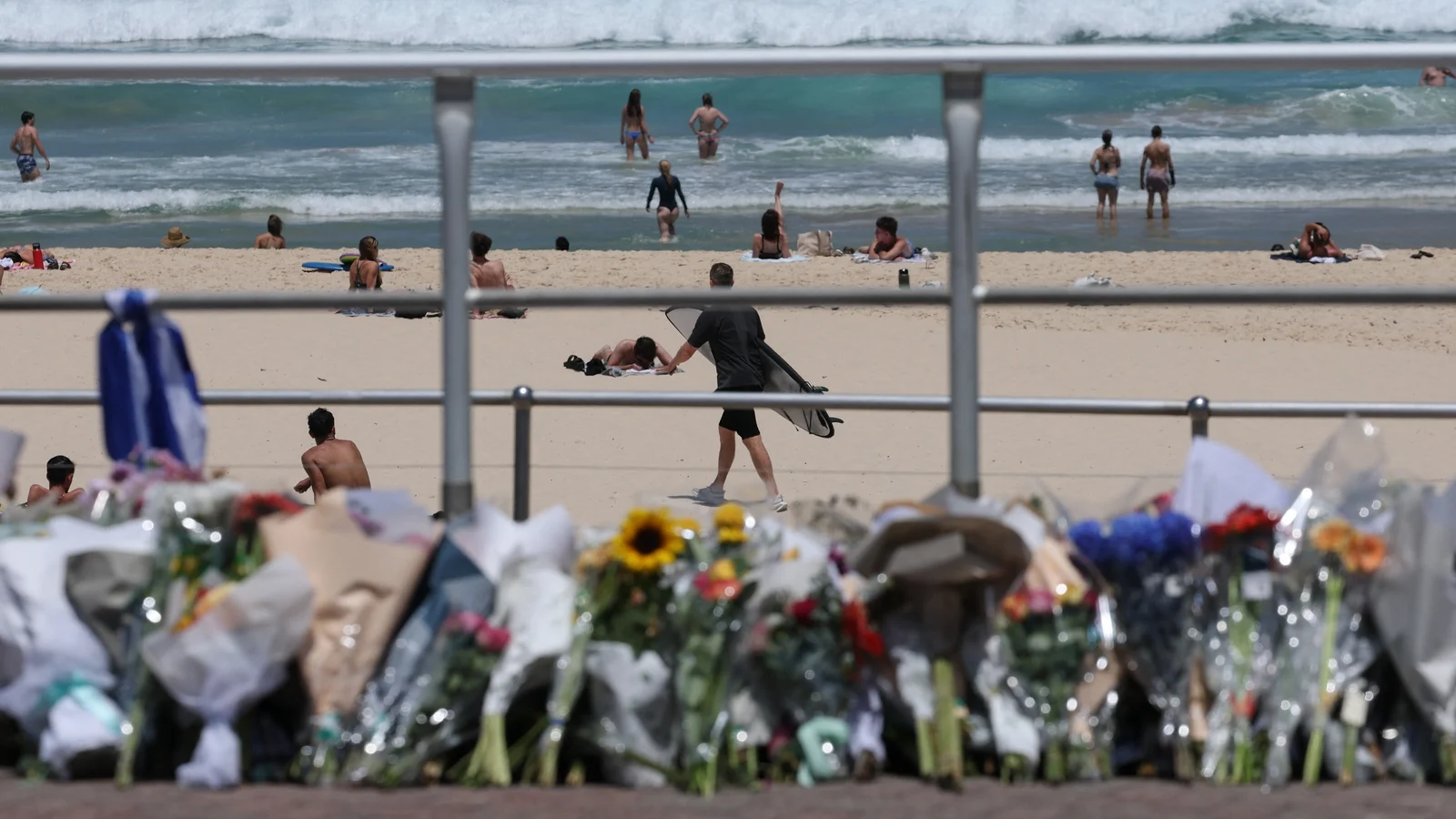
At another vigil on a windy coastal night near Bondi, an elderly man pressed a hand to his heart and muttered, “We thought this kind of thing happened somewhere else.” A teenage survivor, speaking through a friend, described an instinctive urge to protect: “It felt like everything slowed down — people were moving and shouting and I just wanted to get everyone out.”
Red Flags, Reconnaissance, and the Machinery of Prevention
Behind the human stories are documents that sketch a different, chillingly methodical picture.
Police say the pair practised with firearms in the New South Wales countryside, recorded videos in October railing against “zionists” in front of a flag linked to the so-called Islamic State, and even conducted a nighttime reconnaissance of Bondi Beach days before the killings. They had returned to Sydney weeks prior from a four-week trip to the southern Philippines, police documents state.
Intelligence agencies had previously flagged Naveed Akram in 2019. But officials decided then that he did not pose an imminent threat. “Sometimes the system works by constantly reassessing risk,” says Dr Hannah Sutherland, a terrorism and intelligence analyst based in Melbourne. “But it’s a tragic truth that people can slip between those reassessments. The threshold for intervention is high — rightly so in a liberal democracy — but that means early warning signs can be missed.”
How security experts see the problem
- Thresholds and legal standards: Agencies often need clear, immediate markers of intent before they can lawfully intervene.
- Resource constraints: Small teams must triage thousands of leads and tips daily.
- Online radicalisation: Content that isn’t illegal can still be corrosive, radicalising people in plain view.
“This was not a sudden flash of violence,” said Sutherland. “The picture painted by police indicates planning. The question now is what pieces of that picture were seen by whom, and when.”
Gun Laws, Memory and the Promise to Do Better
Australia’s memory of mass gun violence is long and specific. The Port Arthur massacre in 1996, which killed 35 people, reshaped the country’s relationship with firearms — a national buyback and sweeping laws followed. Since then, truly large-scale shootings have been rare, and Australians have often pointed to their laws as a model.
But December’s attack prompted fresh debate about whether laws alone are enough. Ministerial statements since the shooting have promised tougher measures: stricter controls on firearms possession, closer monitoring of individuals deemed at risk, and a national conversation about antisemitism.
“Legislation can do a lot,” said Professor James Hollis, a criminologist. “But you can’t legislate away ideology. Prevention requires community work — early intervention programs, mental health services, better community-police relationships and more careful monitoring of extremist networks.”
A Community’s Reckoning with Antisemitism
The attack also reopened a raw national conversation about antisemitism. Community leaders have reported increases in harassment and hostile incidents in recent years, mirroring trends in other Western nations where Jewish communities have felt a rise in hostility linked to global tensions.
Rabbi Naomi Feldman, who has led interfaith vigils since the shooting, asked a question that has haunted gatherings: “How do we make our streets and places of worship feel like home again?” Her voice, measured and weary, carried on a video livestream. “That isn’t only a job for the police. It is a job for neighbours, for social media companies, for schools.”
What Comes Next — Courts, Questions, and the Long Tail of Justice
The courtroom procedures that began this week are only the first act of what will be a long legal process. Evidence timelines were discussed. Victim identification suppression orders were extended. The accused will next be back before a judge on 9 March.
As the legal machine moves at its own deliberate pace, families will continue to live with the absence left behind. “We will come to court,” said an organizer for the families in a quiet, resolute voice. “But a date in a diary won’t fix the empty chair at our table.”
So where should our gaze fall now? On the man on the screen, on the holes in the system, on the families rebuilding lives — or all of the above?
It is tempting to answer simply: prosecute, reform, heal. But grief and policy do not unfold in tidy steps. They require sustained attention, moral courage and the willingness to look at uncomfortable trade-offs between security and liberty. They require communities to rebuild trust, and for institutions to explain, transparently, what was seen and what was missed.
As the legal proceedings unfurl, and as Sydney remembers, the city asks itself a question that reaches beyond its beaches and benches: how do we make sure the next emergency is not met by the same chorus of “if only”?
In the meantime, candles keep flickering outside synagogues, people continue to leave flowers near Bondi, and the small rectangle on a monitor waits for its next appearance in court — a screen that shows a man accused of violence, and screens the questions we all must answer together.