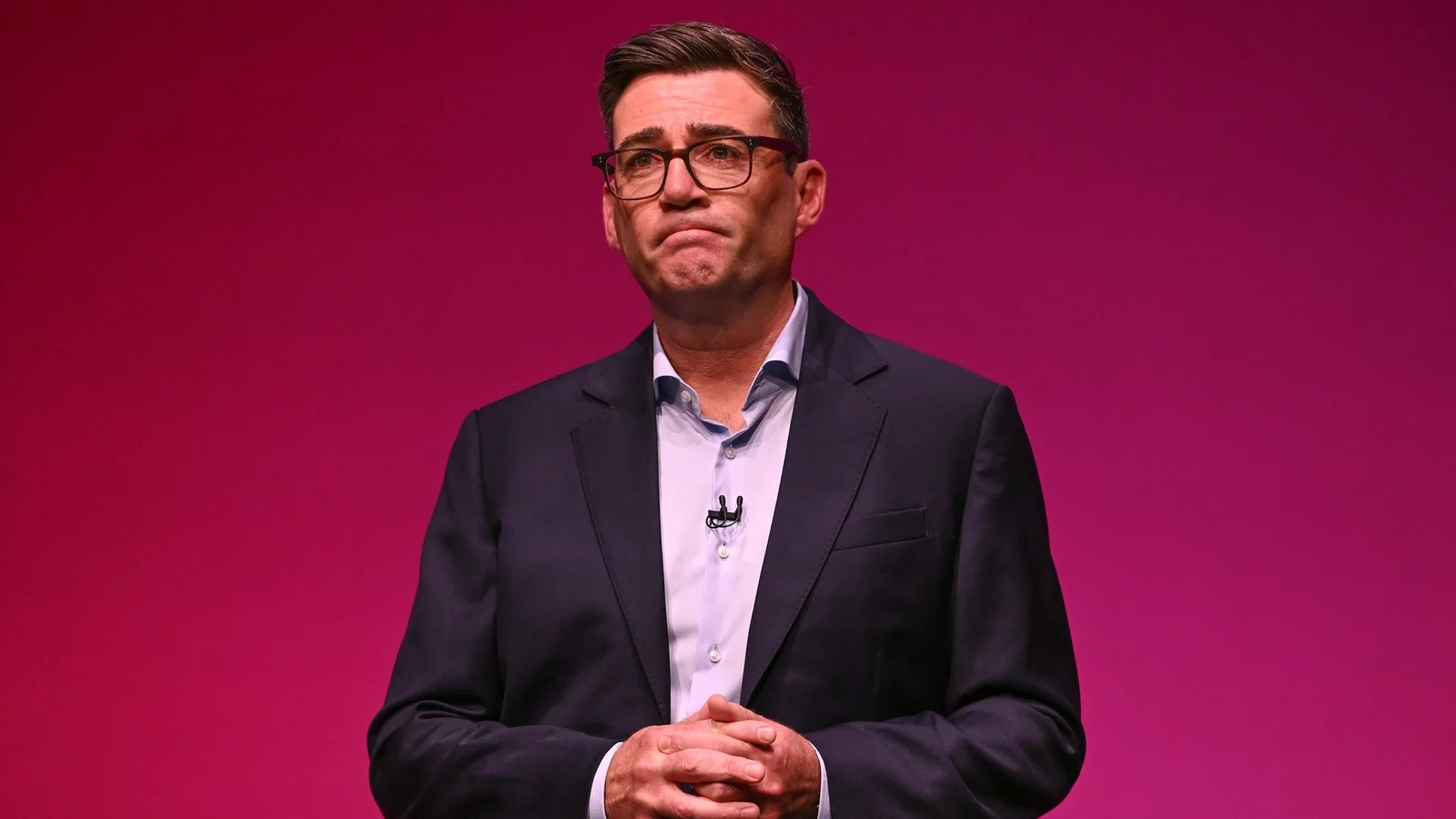
In British politics, it can happen in a heartbeat — especially when you are the Prime Minister, as Andy Burnham discovered the day after his headline conference address to the Labour Party.
The speech drew widespread praise for its structure, substance and delivery.
But within 24 hours, an unscripted detour into football threatened to steal the limelight.
Mr Burnham had booked a round of interviews with TV political editors the morning after conference, inviting them to Everton’s striking new stadium on the Mersey. In the bright riverside light, with the water behind him and floor-to-ceiling windows framing the scene, he faced a succession of questions from journalists.
The prime minister is a lifelong Everton supporter.
He has described the club as one of the three institutions that shaped him, alongside the Labour Party and the Catholic Church — “in that order”.
The Premier League probe found Manchester City got too much cash from its Abu Dhabi owners
Against that backdrop, it was perhaps inevitable that the BBC’s Political Editor, Chris Mason, would raise the major story that had just broken: the Premier League’s confirmation that Manchester City had been found in breach of numerous rules on club financing.
The breaches related to concealing the level of financial support the club was allegedly receiving from its owners — money that, the league said, helped fuel a march to Premier League and Champions League success.
In Soccernomics, Simon Kuper and Stefan Szymanski analysed extensive data and argued for a hard-edged rule of football: the biggest wage bill tends to win the Premier League and the Champions League.
That, at least, was the pattern in the mid-2000s.
To curb the influence of wealth in determining results, football authorities introduced measures intended to restrain spending and preserve competitive balance.
It is those restrictions Manchester City has been found to have breached.
The club is owned by Abu Dhabi United Group, a private equity firm controlled by Sheikh Mansour bin Zayed, a member of the Abu Dhabi royal Family.
Manchester City’s stadium sponsor is Etihad Airlines of Abu Dhabi.
The Premier League investigation found the club received excessive funding from its Abu Dhabi owners, then concealed it in order to gain an unfair advantage over rivals.
The sums cited were vast: £830 million (€976m) — a figure that translates to just over a billion dollars in the US.
That is in addition to the £1.4 billion (€1.6bn) the club spent building its squad.
Acquiring Manchester City itself cost £200m (€235m).
The Premier League said the club ‘systematically broke Premier League rules for nearly a decade’
An independent panel’s investigation found, among other things, that Manchester City arranged “sham contracts” with several commercial partners as part of what was described as a scheme to disguise secret funding of more than £830m (€976m).
The Premier League said the club “systematically broke Premier League rules for nearly a decade”.
Manchester City denies the allegations and has appealed, arguing the findings contain “clear material errors, of law, principle and fact and is unsafe”.
Yet before the appeal was lodged, the prime minister voiced sympathy for the club and its owners, comments that critics said sounded closer to Manchester City’s position than to the football authorities driving financial fair play.
With the findings now public, some fans and commentators have questioned whether the club’s owners can remain in charge.
Mason asked the prime minster whether he believed they might sell — particularly if the club were relegated down the divisions.
“I would be really concerned to lose them,” Mr Burnham replied.
“They’ve been such a huge partner in the building of modern Manchester and obviously the building of Manchester City into the global force that it is,” he added.
Andy Burham said he previously stood up for Everton during its run-in with the Premier league
Manchester City’s owners have played a prominent role in regeneration projects around the Etihad Stadium.
Mr Burnham, who served as mayor of Greater Manchester until June, said: “I do actually thank the City Football Group and the wider ownership for the money that they didn’t just put into the Etihad [Stadium] and the campus around it but also into the city”.
He insisted his own dealings would “of course” stand up to scrutiny.
He also pointed back to his earlier support for Everton during its dispute with the Premier League about a decade ago over less serious breaches, when the club was initially docked 10 points — later reduced to six on appeal.
“Everton was in this position a few years ago and you might remember that I fought for Everton in that situation because I still hold the view very firmly that they weren’t fairly treated in that process,” he told the BBC.
Linking that experience to Manchester City’s case, he said: “I remember people proclaiming Everton guilty at the time and with hindsight, I think more people would say that wasn’t fair, the way that was handled.
“So, it would be wrong of me to leap to one side given the experience that I’d had before becoming prime minister.”
He acknowledged there was “a lot at stake” for Manchester City supporters, for the club, and for Manchester.
But he also said it would be wrong for him to step in.
Even so, the remarks jarred with the themes of the previous day’s conference speech, which carried clear “for the many, not the few” echoes.
Manchester City may command a vast fanbase, but ownership and control sit with a small number of people.
And those wealthy few, the Premier League alleges, used “sham sponsorships” to mask hundreds of millions of pounds that helped fund the trophy-winning team.
The Tory’s Louie French said government should ‘keep politics out of football’
The Conservative Party quickly seized on the controversy.
Tory sports spokesperson Louie French said the prime minister was “publicly backing the owners even as the investigation continues” and raised the question of whether “political pressure” was being brought to bear on the Premier League.
He urged ministers to “keep politics out of football and ensure the Premier League’s independent commission can do its job free of outside influence”.
Mr French said: “The club face unprecedented allegations and fans are horrified by what they are reading in the papers, yet Burnham is publicly backing the owners even as the investigation continues.
“Fans will rightly ask whether political pressure is being applied here and how it relates to the owners’ well-reported investments in Manchester.”
The row also revived a familiar political line of attack: that a powerful city leader had grown too close to deep-pocketed developers who happen to own one of Manchester’s major sporting brands.
But, critics noted, this was no longer about a mayor defending his patch — Mr Burnham is prime minster now, a role that attracts far more scrutiny.
The Liberal Democrats also weighed in. Their sport spokesperson Anna Sabine told the Guardian that “Andy Burnham must come clean and publish details of every meeting and conversation he has had with City Football Group, Abu Dhabi United Group or UAE government representatives, going back to his time as mayor and that includes any hospitality freebies received”.
She added: “When the prime minister leaps to the defence of a club’s owners within hours of a verdict, people are entitled to ask what their relationship is.”
Downing Street moved quickly into damage-limitation, with a spokesperson stressing the prime minister had been clear “the initial judgment is serious and there can’t be any suggestion that anyone is above the rules”.
The spokesperson added: “He also stressed that it is an ongoing independent process.
“It is essential that it is allowed to run its course and the outcome respected.
“Wherever wrongdoing is established, those responsible should face the appropriate consequences.”
The Independent Football Regulator is waiting until the league’s process is over before deciding what to do next
On the same day, pressure came from within Labour too. Meg Hillier, a backbencher and Chair of the Commons Treasury Committee, wrote to the Revenue Commissioners to ask whether they recognised the significance of the Manchester City case for any potential tax implications.
And a quango entered the fray.
The chair of the Independent Football Regulator (IFR) — established by the Labour government in 2025 — said the case raised “serious issues”.
David Kogan said the IFR “has powers to assess the suitability of owners, directors and executives and we will use these powers where appropriate”, while “taking account of the findings made by the leagues”.
He said the regulator would wait until the Premier League’s process concludes before deciding what steps to take.
That means the Manchester City saga looks unlikely to fade soon — and neither does the political attention now following the football-minded prime minister.
A former chair of Manchester City and the Football Association told BBC Newsnight he was “concerned” by Mr Burnham’s remarks about the club’s breaches.
David Bernstein, who led Manchester City from 1998 to 2003, said: “It is absolutely vital that this independent regulator can perform independently and without political interference.”
Asked what guidance he would offer Mr Burnham, Bernstein said: “I would suggest he’s got other fish to fry and this is something that politicians should be seen to be staying well away from.”
Adding complexity are the wider property projects backed by Manchester City’s owners in the city.
At the centre is Manchester Life, a one-billion-pound plan to build 6,000 homes in east Manchester.
The agreement was signed in 2014 — three years before Mr Burnham became mayor of Greater Manchester.
Manchester City Council has a profit-share arrangement with Abu Dhabi United Group tied to the development.
Abu Dhabi United Group also co-developed the Co-Op Arena music venue, a £365 million music venue.
And in June it won planning permission for a £300 million entertainment zone at the Etihad complex.
Abu Dhabi has been a major partner in reshaping Manchester, a city now defined as much by gleaming residential towers as by the smokestacks of its industrial past — a redevelopment story Mr Burnham has helped promote and benefited from.
Indeed, the idea of “Manchesterism” has been coined to capture a key strand of the prime minister’s domestic agenda.
It centres on partnerships between local government and corporate capital to deliver projects.
Control, rather than outright ownership, would sit with the public sector — even as private firms still find room to profit.
In his conference speech, Mr Burnham suggested that “Manchester way” approach could soon be applied to Britain’s privately owned water companies, the electricity grid and transport.
But the Manchester City affair has underlined a political reality: public-private relationships can become liabilities as quickly as they deliver results.
They can be navigated more easily from the office of a big-city mayor — and far less easily from the desk of a prime minster of a big country, under a relentless opposition and an even louder media.