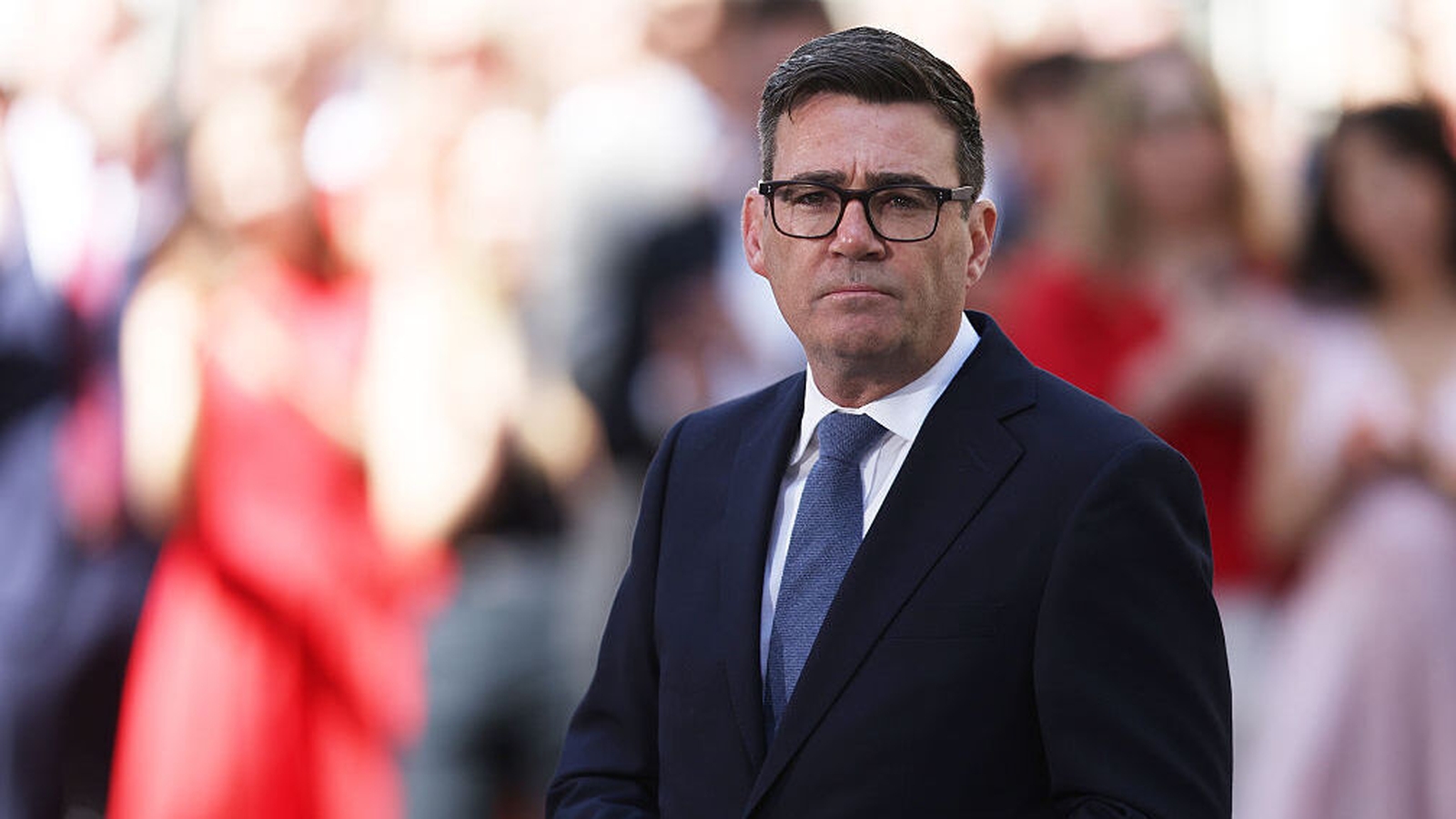
Stepping into Downing Street at a moment of deep public frustration, Prime Minister Andy Burnham vowed to win back voters “fed up with politics” and prove Britain can once again be a byword for stability.
In his first address outside Number 10, Mr Burnham promised to shift power away from Westminster and give the public greater say over “life’s essentials”, setting out an agenda he said would focus on the pressures squeezing household budgets.
Speaking without the lectern used by his predecessors, Mr Burnham said he would spell out measures to tackle the cost-of-living squeeze.
His first pledge as Prime Minister was unequivocal: he said he would “end rough sleeping in our country”.
Mr Burnham formally became British prime minister after meeting the UK’s King Charles III at Buckingham Palace.
The UK’s King Charles welcomed Andy Burnham at Buckingham Palace, London
Earlier, Keir Starmer left Downing Street this morning, using his farewell remarks to argue that his two years in office had improved the country.
King Charles met Mr Starmer to accept his resignation, after which Mr Burnham arrived for the traditional ceremony in which the monarch invited him to form the next government.
Greeted by cheers from supporters on Downing Street, Mr Burnham said: “I am acutely conscious that I am the sixth person in the last 10 years to walk up this street, the seventh prime minister since 2016, making this a moment for reflection and new resolution.
“It requires my generation of politicians to raise our game and rise to the new challenge.
“Britain needs to show the world that we can regain our stability once again.”
He ended his first speech as Prime Minister with an appeal for the country to “pull with me” to “build a new national sense of unity, of common purpose and positivity”.
He is the sixth prime minister to enter Downing Street in the last 10 years.
Mr Starmer, speaking earlier said: “I am confident that Britain is now stronger and fairer than it was two years ago,” Mr Starmer told reporters in his farewell speech outside his central London office.
“I go with good grace, I go with a smile, and I go proud of everything that we have achieved,” he added.
Keir Starmer made his final speech as PM in front of 10 Downing Street
Mr Burnham now takes over with an in-tray packed with pressing problems and little time to set the tone of his premiership.
In an interview with The Times published late yesterday, Mr Burnham said he wanted to draw a line under a decade of political turmoil.
“What we’ve been doing hasn’t been working. That’s the way I see it,” he said.
“I am going to try and do things in a different way.”
He is expected to move quickly on senior cabinet appointments, with particular attention on who will succeed Rachel Reeves as finance minister.
Mr Burnham, the former mayor of Greater Manchester known as the “King of the North”, was brought in by the Labour Party after Mr Starmer resigned last month, with MPs seeing him as their strongest option to rein in Nigel Farage’s anti-immigration Reform UK party.
Britain’s new Prime Minister will need to act fast
‘Bigger, bolder’
Among the most immediate tests are a sluggish economy, high government borrowing costs, a welfare bill that continues to swell, and irregular migrants crossing in small boats — an issue that has helped fuel support for Reform.
His room for manoeuvre could also be shaped by external shocks, including unpredictable energy prices linked to the US-Iran war and the impact of a volatile US president in Donald Trump.
Mr Burnham told The Times he would take a “different approach to public spending, and to running the economy – more focused on early investment, early intervention, setting people up for success, and much less paying for failure”.
He also promised “early moves to help” with the cost of living, saying that on the campaign trail he repeatedly heard about the “pressure people feel around their finances”.
Protesters outside Downing Street as Andy Burnham becomes the new UK Prime Minister
Mr Starmer led Labour into government in July 2024 with a landslide election victory, ending 14 years of Conservative rule.
He said in late June that he would step down as prime minister and Labour leader after his time in office was marred by scandals, missteps and a series of policy U-turns.
But Mr Burnham — back in Parliament only four weeks ago — inherits tight constraints, including sluggish growth, elevated public debt and strict financial rules that require government spending to be balanced against tax revenue.
‘Last chance’
Mr Burnham served as an MP from 2001 to 2017 and held ministerial posts under Tony Blair and Gordon Brown.
Since then he has reshaped his political persona as a man of the people, pairing an easy, folksy manner with polished social media videos.
Even so, he has a narrow window: just three years to deliver results, with Reform ahead in the polls before the next general election expected in 2029.
On Friday, Mr Burnham told supporters that Labour’s takeover was the party’s “last chance” to get things right.
Mr Starmer’s administration has faced criticism for being under-prepared for government after its July 2024 victory.
Mr Burnham has insisted he has a “plan”.
However, his rapid “coronation” as Labour leader has prompted questions about how he will turn his priorities into policy.
His first decision came on Saturday when he scrapped Mr Starmer’s flagship nationwide digital ID scheme, estimated to cost £1.8 billion (€2.1bn) over three years.
A spokesperson said the time and resources would be redirected “to where it’s most needed, such as helping with the cost of living”.