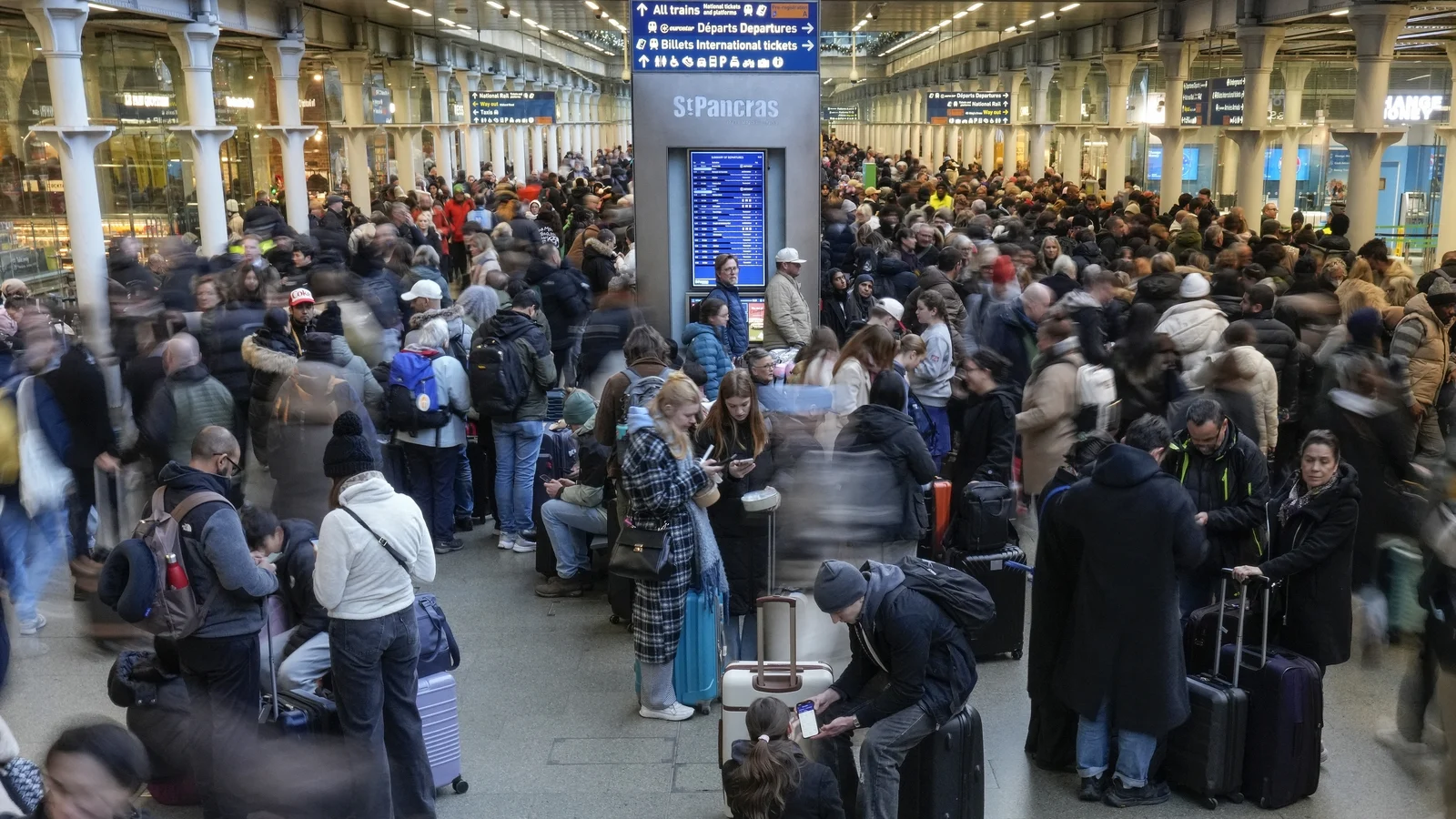
When the Tunnel Went Dark: New Year’s Travel Upended Under the Channel
There is a particular kind of hush that falls over a crowded station when the announcements stop making sense. At St Pancras on New Year’s Eve, that hush arrived as a string of cancellations and a single, weary sentence: “Today, nothing at all.” The words, delivered by a Eurostar staff member at the information desk, landed like winter rain—cold, sudden, unavoidable.
For thousands of people trying to cross between Britain and continental Europe, the Channel Tunnel—an artery of commerce and holiday plans for three decades—went inexplicably dark. An overhead power fault, compounded by a train that failed and blocked the line, forced operators to halt all traffic through the 50.45-kilometre tunnel. Eurostar services were suspended; LeShuttle vehicle-carrying trains ground to a halt. The immediate result was a scene of human impatience stitched with small kindnesses: a staff member handing out bottles of water, someone else helping a pair of anxious dogs off a packed car, a last minute exchange of disappointed smiles between would-be revelers.
Voices from the platforms and approaches
“We’d planned Paris as a surprise,” said John Paul, his voice tight with the frustration of a promise interrupted. He and his partner Lucy had been booked on a river cruise and a trip to the Eiffel Tower that night—romance and curtain calls postponed by a train that had returned slowly to London and then stopped for good. “You sit and you hope for an answer. The waiting is worse than the delay.”
In Folkestone, the approach road to the Eurotunnel terminal choked with cars. Drivers hunkered over steering wheels, windows fogged with impatience. Tim Brown, who’d been trying to get home from Germany with two spaniels, described being stuck on a LeShuttle vehicle for hours with little access to food or water. “My dogs are hating life,” he said, laughing ruefully. “And the strangest sting? Nobody really came round with water. For all the technology, the basics were missing.”
It is in those small, human details that the story landed hardest: the dog clutching a soggy toy, the child asking one question and getting no answer, the couple watching the city they’d hoped to kiss under remain forever across the tracks.
Technical failure, human fallout
Getlink—the operator of the Channel Tunnel—confirmed the incident stemmed from an issue with the overhead power supply. A subsequent technical problem involving a LeShuttle train compounded the situation and required an on-site intervention. “Our teams are working to restore the situation as quickly as possible,” a company spokesperson said, expressing apologies for the disruption and promising that LeShuttle traffic would begin to resume gradually from around 2pm, with waiting times continuously updated.
LeShuttle warned drivers to expect long delays at the Folkestone terminal—estimates of up to six hours were circulated by staff and posted on social media. Eurostar, too, advised travelers not to journey to stations while services were suspended, an instruction that left many stranded or rerouted at the last minute.
On the scale of the problem
The Channel Tunnel has been the backbone of UK–France rail links since it opened in 1994. It accommodates passenger trains, high-speed Eurostar services and LeShuttle vehicle trains moving freight and personal cars. Last year, Eurostar carried a record-high 19.5 million passengers—up nearly 5% on 2023—driven in part by surges of demand for Paris-bound travel during events like the Olympics. When the tunnel is taken offline, the ripple effects are immediate and broad.
Is it simply bad luck? Perhaps. But infrastructure experts point to the way modern transport systems concentrate risk. “When you’re carrying millions through a single piece of infrastructure, you’ve got to design for redundancy,” said Dr. Amina Patel, a transport resilience specialist. “Failures like an overhead line fault are relatively rare, but they show how vulnerable we remain when a single incident can grind travel—and livelihoods—to a halt.”
Small comforts, large frustrations
Staff tried to manage the crowd. At St Pancras, one member of staff handed out water bottles to people corralled behind a cordon. It was a small balm. “We’re doing everything we can,” said a station worker, who asked not to be named. “It’s not how you want to start the year—both for customers and for us.”
But small gestures only paper over systemic anxiety. Travelers spoke of lost bookings, missed celebrations and additional costs. “We lost a night in a Paris hotel and a dinner we’ve been dreaming about,” John Paul said. “It’s not just the money. It’s the moment.”
Broader lines of tension
The incident also raises questions about competition and resilience in cross-Channel rail. Eurostar has monopolized passenger services through the tunnel since the mid‑1990s, though rival plans are on the horizon. British entrepreneur Richard Branson has announced ambitions to enter the market with a competing service, and Italy’s state-owned Trenitalia has stated intentions to compete on the London–Paris route by 2029. Will increased competition drive investment and resilience? Or could it fragment an already delicate system?
“Competition can incentivize upgrades,” Dr. Patel said. “But we also need coordinated capital investment in maintenance and emergency response capabilities. Otherwise, we’re back to depending on luck.”
What travelers can do now
- Check official operator updates: Eurostar and Getlink social channels and websites tend to publish the latest information first.
- Confirm refunds and rebookings: If your trip is cancelled, secure your refund or alternative transport as soon as possible.
- Pack for contingencies: Snacks, water and essentials in your carry-on are worth their weight in calm.
Looking beyond the delay
A tunnel is more than steel and rock; it’s habit and expectation, a pact between nations that said travel should be swift, reliable, and unobtrusive. When that pact is tested, the human stories it carries come into focus: the dog panting in a car, the couple postponing a kiss under the Eiffel Tower, the commuter whose calendar now needs rewriting. It is tempting to reduce this to an engineering failure, but the truth is wider: it is about how we plan for failures in an increasingly interconnected world.
So what should we demand from the systems that stitch our lives together? More redundancy. Better on-the-ground support. Transparent communication when things go wrong. And, perhaps, a little more patience—though that, too, must be matched by visible competence from those who run the networks.
As services slowly began to resume and traffic management plans kicked in, there was relief in the air—tempered by the knowledge that, for some, the night was irretrievably altered. “Today was a reminder,” said one weary traveler. “We can survive a delay. But we shouldn’t have to accept it as normal.”