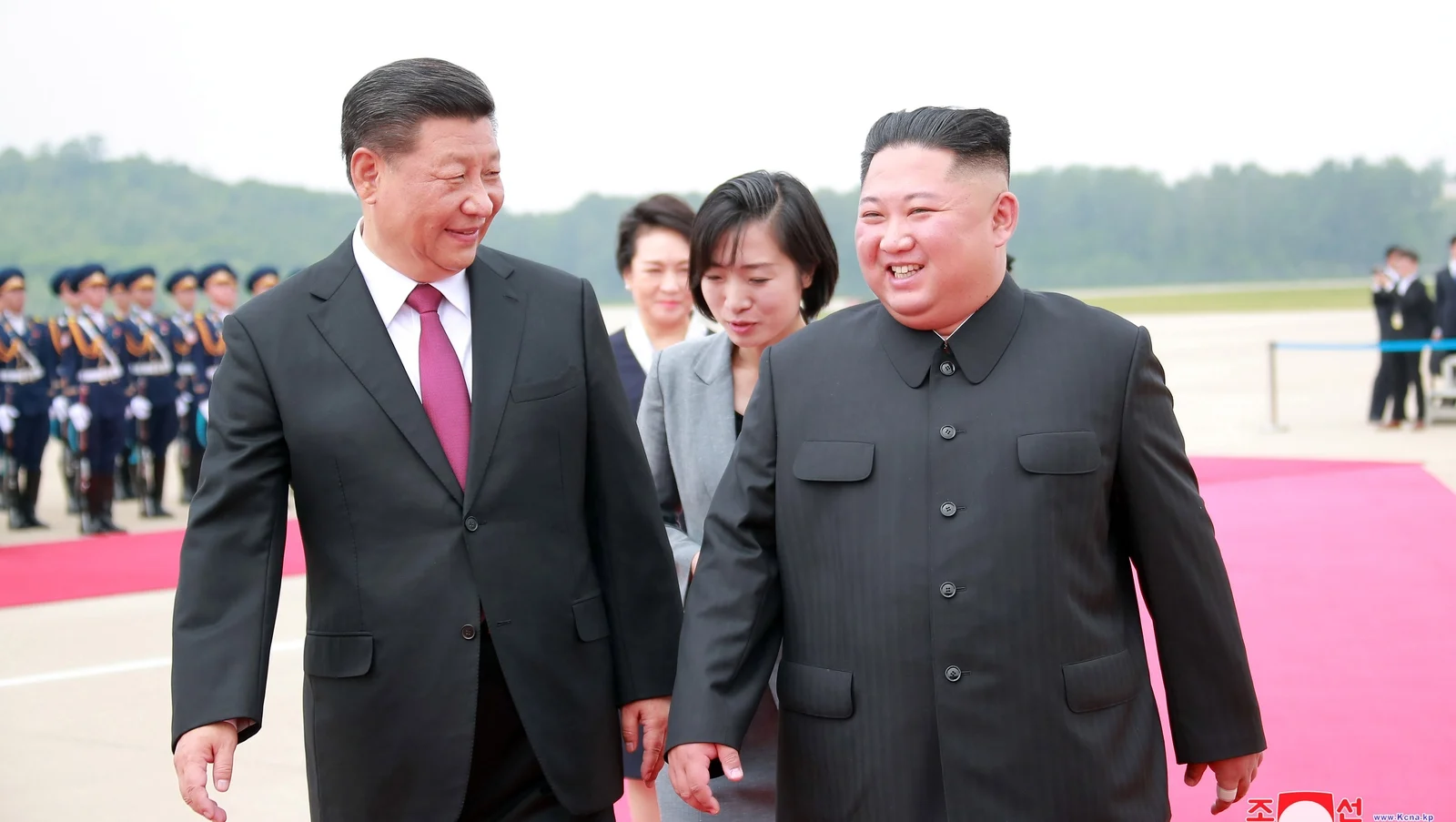
As he set off for North Korea on his first overseas trip of the year, China’s President Xi Jinping touted what he called an “invincible friendship” with Pyongyang — a message aimed at underscoring the durability of a partnership that has long shaped Northeast Asian geopolitics.
For decades, China has been North Korea’s dominant trading partner and a crucial diplomatic and economic backer, particularly as international sanctions have battered the country of around 26 million people. Beijing’s role has made it central to any discussion of Pyongyang’s future direction, from economic survival to security strategy.
The visit is Mr Xi’s first to North Korea since 2019 and follows a stretch of high-profile diplomacy in Beijing, where he held separate talks with US President Donald Trump and Russian President Vladimir Putin.
It also unfolds against the backdrop of stalled nuclear negotiations between North Korea and Washington, with no clear path back to talks.
The White House said last month that Mr Xi and Mr Trump “confirmed their shared goal to denuclearise North Korea” during their summit in Beijing.
Chinese foreign ministry spokeswoman Mao Ning said on Friday that the two leaders would “exchange views on bilateral relations and issues of common concern”, and would “make greater contributions to regional and even world peace”.
The White House said last month that Mr Xi and Mr Trump ‘confirmed their shared goal to denuclearise North Korea’
Yet just a day before Mr Xi’s arrival, leader Kim Jong Un’s powerful sister issued a stark reminder of Pyongyang’s position, calling North Korea’s nuclear weapons programme “the line of no retreat”.
China has “always prioritised stability and is currently having to manage its relations and differences with the US”, Minseon Ku, a diplomacy professor at DePaul University, told AFP.
“Beijing probably has accepted North Korea as a nuclear state,” she said, adding that Xi “will probably tell Kim that China wants stability more than anything”.
Elevated status
North Korea has repeatedly described itself as an “irreversible” nuclear state since the collapse of Mr Kim and Mr Trump’s 2019 summit, which fell apart over disagreements on the scope of denuclearisation and the lifting of sanctions.
Mr Trump met Mr Kim three times in his first term, but his remark in October that he was “100%” open to another meeting drew no response.
Mr Kim has also appeared bolstered by the war in Ukraine, winning critical backing from Moscow after dispatching thousands of troops to fight alongside Russian forces.
The leaders last met in September, when the North Korean leader and Vladimir Putin were guests of honour to a military parade in China
In an article carried on the front page of North Korea’s Rodong Sinmun, Mr Xi signalled deeper coordination between the neighbours.
“No matter how the times change or how the international situation evolves, the traditional friendship between China and North Korea is always invincible,” Mr Xi wrote.
Mr Xi last met Mr Kim in September, when he invited the North Korean leader and Mr Putin as guests of honour to a military parade in Beijing marking the 80th anniversary of the victory over imperial Japan in World War II.
Taiwan counterweight
Mr Xi’s North Korea trip comes as a stream of world leaders have sought time with him, reflecting efforts to reinforce ties with Beijing amid an increasingly unpredictable United States under Mr Trump.
At the same time, conflicts in the Middle East have absorbed more of Washington’s focus, while Mr Trump has made little headway on North Korea — particularly on the nuclear issue — despite the prominence of his earlier summits with Mr Kim.
North Korea also stands out as the only country with an official, binding military alliance with China.
Beijing claims self-ruled Taiwan as part of its territory, and analysts said North Korea could also function as a useful counterweight to US partners in the region, including South Korea and Japan.
Already strained China-Japan relations have worsened since Prime Minister Sanae Takaichi, a security hawk, suggested last year that Tokyo might intervene militarily in any Chinese attempt to take Taiwan.