When the Sky Turned to Garnet: A Red Day in Western Australia
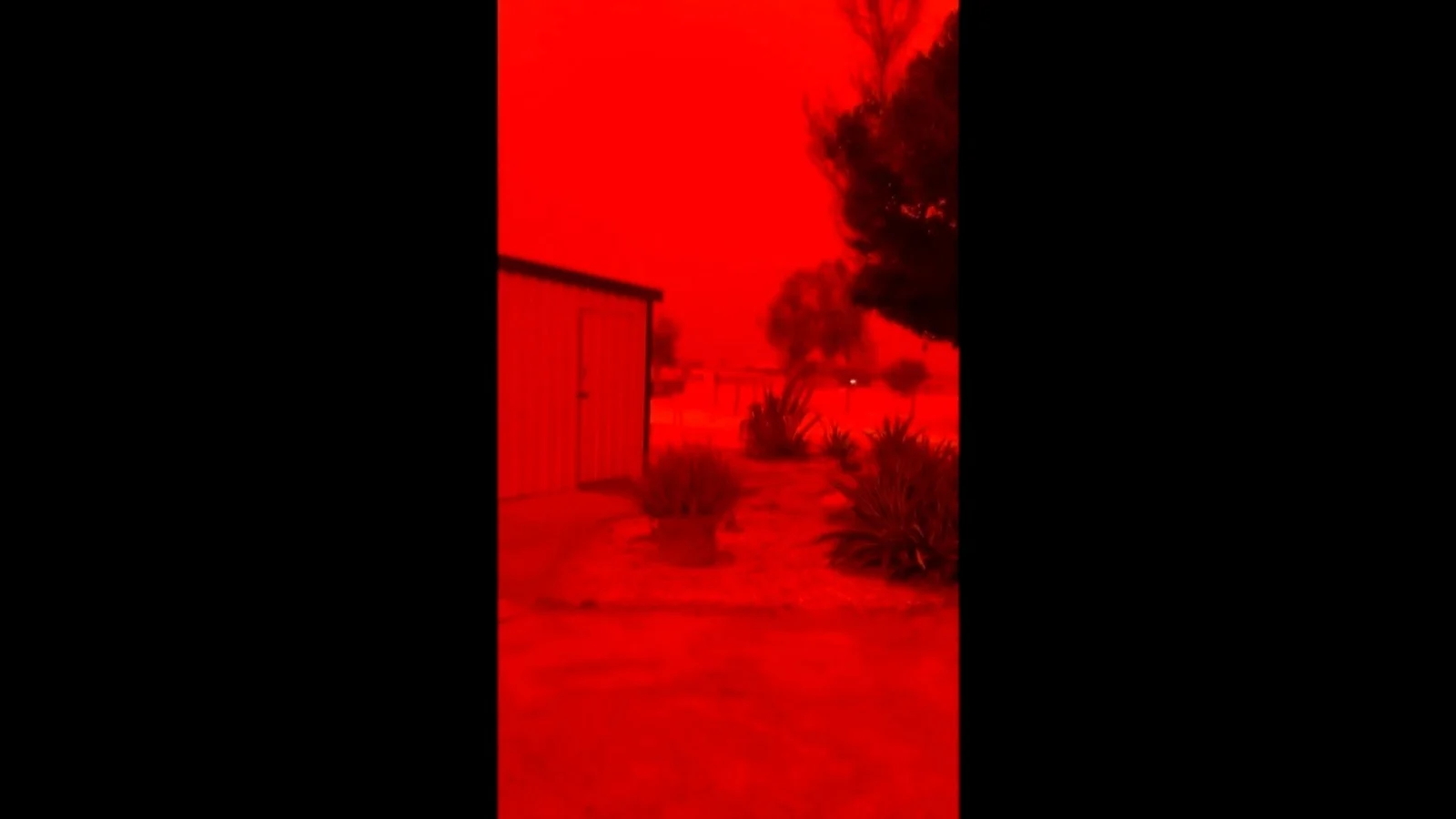
It arrived like a film reel hiccup—mid-afternoon light suddenly wrong, a low, bruised sun, and everything bathed in a color that belongs more to old photographs than to real life. In Denham, the tiny settlement that keeps watch over Shark Bay, tourists on the caravan park balconies whispered and pointed as a sinister rose spread across the horizon.
“It was incredibly eerie outside,” the owner of the Shark Bay Caravan Park said, standing in the doorway of her office as a fine, iron-rich dust sifted down like confetti in reverse. “Not a lot of wind yet. Everything was covered. We decided—inside day. Nobody’s driving anywhere until the sky clears.”
That “garnet” sky was not paint or prophecy. It was wind, geography, and a cyclone on the move, conspiring to paint a swath of Western Australia in a color most of us only see in sunsets. That same cyclone—named Narelle—had been traveling more than 5,700 km across Australia’s top end, reaching into places where the land is broad and mauve and the air is usually clean enough to taste the salt from the Indian Ocean.
What happened in Denham
By the time the red haze crept over Shark Bay, visibility had dropped to near zero in places. Locals described the air as thick, gritty, and damp—dust clinging to hair, settling on windshields, turning white countertops into a dusty pink by evening.
“My car looked like someone powdered it with rust,” said Michael, a local fisherman who has lived in Denham for twenty years. “You could taste the dust. The dogs didn’t even want to go out.”
Officials later explained it simply: fierce winds from Tropical Cyclone Narelle scooped up iron-rich soil—the iconic red dust of Australia’s interior—and lofted it high into the atmosphere. When sunlight filtered through that airborne soil, the scattering of light created the deep crimson glow people witnessed.
The cyclone’s improbable journey
Narelle is a travelogue of extremes. Born near the Solomon Islands—roughly 2,000 km northeast of the Australian mainland—it ramped up into a Category 4 system, making landfall in Queensland on 20 March before punching a path across the Northern Territory and finally brushing Western Australia. At its peak, damaging winds radiated 200–260 km from the cyclone’s center, a wind field broad enough to influence weather across states and ecosystems alike.
“It’s not common for a single cyclone to touch Queensland, the Northern Territory, and Western Australia in one go,” a forecaster with the Bureau of Meteorology told me. “But when systems find the right steering currents and energetic conditions, they can travel vast distances. Narelle was such a case.”
Imagine a storm that crossed the breadth of a continent—over deserts, outback cattle stations, coastal shallows—pushing an atmosphere filled with dust and moisture like an enormous hand through which everything passes, leaving traces.
Voices from the red curtain
In the caravan park, people swapped stories as day became dusk. Some joked about a film set, others snapped photos for proof. A mother described tucking her two children into bed early.
“My three-year-old kept asking if the sky was bleeding,” she said with a rueful laugh. “How do you explain a world turning red to a child? I told him the clouds borrowed the color of the earth for a while.”
Out on the salt flats, a tour guide who works with Shark Bay’s UNESCO-listed marine environments frowned at the images on his phone.
“You worry about the creatures,” he said. “Seagrass, dugongs, the small things that depend on clear water. When dust lands in the ocean it can change the chemistry for a while. We track these events because they ripple through the ecosystem.”
Numbers, trends, and the larger climate picture
What was dramatic in color is part of a pattern in physics. Globally, the last few decades have shown a rise in the intensity of tropical cyclones—storms that are fewer in number in some regions but more likely to deliver extreme winds and heavier bursts of rainfall. The Intergovernmental Panel on Climate Change (IPCC) has been clear: as the oceans warm, the proportion of high-intensity storms (Category 4 and 5) is expected to increase.
In the Australian region specifically, observations indicate a decline in overall cyclone frequency over several decades, yet the storms that do form tend to be stronger and wetter than in the past. That trend aligns with the way warmer air holds more moisture and how heat energy feeds storm systems.
“You can think of the atmosphere like an oven,” a climate scientist at a major Australian university said. “When the oven gets hotter, even if you turn the dial less often, the times you do bake often come out extra intense.”
These shifts matter. Stronger storms mean higher wind speeds, larger wind fields, and heavier short-term rainfall—factors that increase flooding risk, erode coasts, and strain evacuation and emergency systems. In places like Denham, where communities are small and supply lines stretched, even the dust from a passing cyclone can be disruptive—closing roads, coating water tanks, and halting tourism that local economies may depend upon.
What a red sky asks of us
When the air goes red, it’s a visceral reminder of connections most of us never see: the interior dust carried hundreds of kilometers; ocean temperatures nudging storm intensity; a storm’s path threading through human and natural landscapes. It also raises a question: how do we build resilience to events that are changing in character even if their frequency shifts?
People in regions prone to cyclones already have practical answers—boarding up windows, storing water, moving caravans to higher ground—but a broader, slower set of answers involves climate mitigation, coastal planning, and investment in early warning systems.
-
Emergency preparedness: local councils and residents updating plans and supplies.
-
Natural defenses: restoring mangroves and seagrass that reduce erosion and support biodiversity.
-
Global action: lowering emissions to reduce the long-term escalation of storm intensity.
Looking forward
After Narelle moved on and the dust settled, Denham’s residents stepped outside and began the clean-up—wiping countertops, shaking out doormats, starting generators for the caravans that lost power. Children returned to their games, offsetting the day’s strange awe with the ordinary rhythms of life.
“We live here because it’s beautiful and wild,” Michael the fisherman said, staring at the sea. “These things remind you of that wildness. They also remind you to listen—because the next storm might be different.”
When the sky turns red, it is spectacle and signal. It is an image that will end up trending on phones and newsfeeds. But if we look past the dramatic hue and into the science and the human stories beneath, we find threads that connect Denham with the Solomon Islands, with meteorologists in Hobart, with climate researchers and coastal communities around the world.
What will you do if your sky one day turns a color you have never seen before? How will your town, neighborhood, or country respond? The red sky over Western Australia was, briefly, a local wonder—and a global prompt to pay attention.