A New Constellation Rises Above Times Square
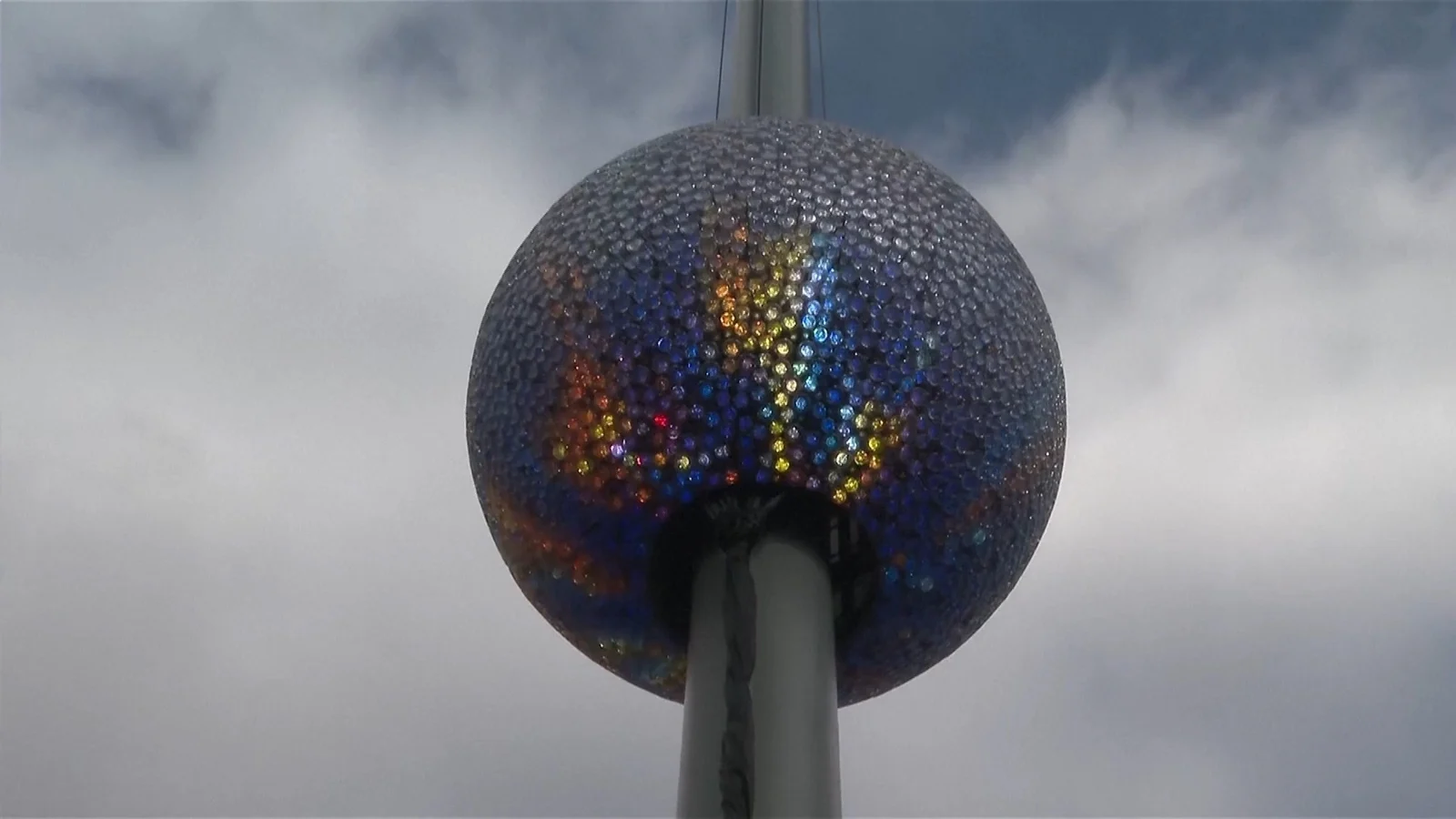
On a frosty December evening, when neon signs already fight to outshine the stars, the newest spectacle of New York City sat motionless above Broadway — a giant, glimmering sphere that promises to be the brightest star ushering in 2026.
They call it the Constellation Ball, and the city has been testing it all day: dimming its millions of pixels, checking cables, coaxing the old magic into a new form. It is, by every sensible measure, the largest New Year’s Eve ball the world has ever seen. Built to be seen from the sidewalks and the satellites, it carries 5,280 Waterford crystals interlaced with thousands of programmable LED light pucks, each one capable of painting the night with colors that move like liquid.
When Tradition Meets High Tech
For nearly 120 years, a ball in Times Square has been more than a drop; it is ritual and spectacle wrapped into a single breath before midnight. The first ball descended in 1907, replacing the raucous fireworks displays of a different age. Tonight, in a city that pivoted long ago from gas lamps to LED towers, the ball is a marriage of old-world handiwork and modern engineering.
“This is the biggest star of tonight’s show,” said Jeffrey Strauss, president of Countdown Entertainment, as technicians ran final diagnostics on the rigging. “We wanted something that honors the past but says something bold about now — about light and possibility.”
Inside the Sphere: Craft, Light, and Story
The Constellation Ball’s Waterford crystals are not mere decoration. Each one is hand-cut by artisans trained in the centuries-old traditions of Waterford, Ireland. Up close, they refract the city’s light into shards of color — warm ambers, icy blues, and a cascading pearl white that seems to slow time. Around them, the LED pucks are the modern chorus, capable of dynamic patterns and choreographies synchronized to the countdown music.
- 5,280 Waterford crystals, individually placed
- Thousands of LED pucks, programmable for infinite color blends
- Engineered for energy efficiency — LEDs use up to 90% less energy than older lighting technologies
- Designed to remain dark until the final seconds, amplifying the ceremonial reveal
Engineers note that the ball will remain intentionally dark until the final countdown — a pause so intentional it becomes a shared inhale among the crowd. When the first light blooms, it will be like someone has lit a lantern across the planet.
Voices from the Square
On the sidewalk, people wrestle with the cold and the thrill. A street vendor, who’s worked these blocks for more than two decades, wrapped his hands around a paper cup of coffee and smiled as he looked up.
“You get used to the ball,” he said. “But every year, when it comes down, the city holds its breath. Tonight feels different — more people are watching from screens, but those who squeeze into the square want to feel the drop in their bones.”
A tourist from Lagos, clutching a scarf knitted with tiny flags from different countries, said she’d saved up to be here. “It’s like the world condensed into a moment,” she said. “You turn to the person next to you and you’re strangers, but you are counting together. It’s beautiful.”
And downtown, a cultural historian who watches the New Year’s rituals explained why the ball keeps mattering. “These public rites give shape to time,” she said. “They convert an abstract edge of a calendar into a communal, sensory event. Whether in Dublin, Lagos, Tokyo, or New York, those fleeting seconds are where people practice hope together.”
Behind the Scenes: Logistics, Safety, and Sustainability
Pulling off the Times Square drop is less glitter than choreography. The ball is suspended from a mast constructed with redundant safety lines, monitored by engineers in control rooms bristling with screens. Police and first responders adopt a choreography of their own: street closures, medical tents, and crowd control measures aim to keep the nearly one million people who traditionally cram into the square safe. For those watching from home, global audiences are measured in the hundreds of millions; the event is one of the few internationally recognized rituals in which the world coordinates its attention for a single, communal countdown.
Environmental questions shadow every modern spectacle. The move to LEDs is not just about color; it is about conscious energy use. LEDs consume a fraction of the power older systems required, and the ball’s programmers have designed light sequences that recycle power-saving modes. It’s a small answer to a larger question: how does a city celebrate without devouring resources?
What the Numbers Tell Us
Consider the scale: nearly one million people on the ground, and viewers in the hundreds of millions worldwide. The ball is not merely a prop — it is a signal amplified to reach every time zone where humans are willing to say “here’s to something new.”
Counting Down, Thinking Forward
As midnight approaches, the ball will stay dark, a celestial secret held above the press of bodies and the electric hum. The pause — that pregnant silence — is the real technology. It demands attention. It forces the question we usually ignore when the calendar flips: what are we leaving, and what do we want to carry with us?
What do you want the light to mean to you? For some, it will be a promise to start anew: to call, to forgive, to change jobs, to act. For others, it will be a quiet moment of gratitude, a nod to survival and small victories. The ball, for all its engineering and crystal, is a mirror. It reflects back more than just city lights — it shows the shape of the crowd below, the good, the messy, the hopeful.
“We designed the ball to be a canvas,” Strauss said as technicians counted down the seconds on their own clocks. “It’s bright and ornate, but ultimately it’s yours. We only give you the stage.”
After the Drop: A City and a World Keep Turning
When the light floods the square and the chorus of 10, 9, 8 begins, the moment will be instantaneous and eternal at once: a contracted second that expands into a new year. Confetti will rain like slow, colorful hail. Smartphone flashlights will bloom. Lovers will hug, strangers will laugh, and for a sliver of time, disparate corners of the globe will share the same beat.
There’s a simple magic in that. No matter how grand the ball, the real spectacle is not the hardware but the humanity under it. The Constellation Ball may be the biggest yet, but its purpose is the same as the very first orb lowered in 1907: to mark the end of one chapter and the audacious beginning of another.
So as the ball remains dark until the final seconds, hold that pause with me. What are you counting into? What are you leaving behind? And when the light blooms, will you let it be permission to begin?