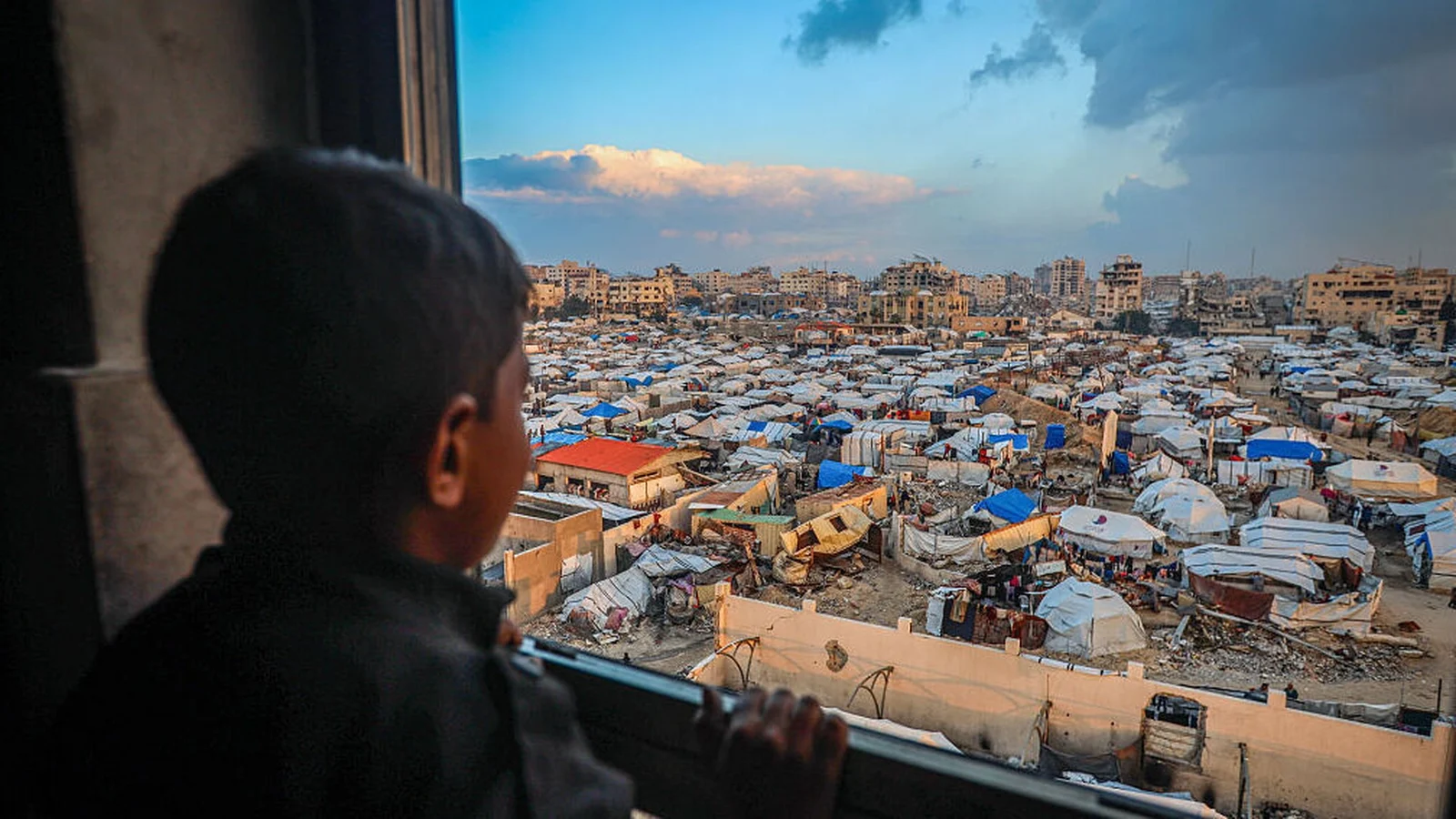
A Breath Between Bombs: One Gaza Hospital, One Small Delivery, Two Days of Life
Inside the low-slung compound of Al-Awda Hospital in Nuseirat, the air carries the taste of diesel and disinfectant, a metallic tang that has become part of daily life here. Corridors once bright with posters about vaccinations now double as sleeping spaces for relatives. A sputtering generator keeps the emergency lights alive; outside, the city’s broken skyline slices the horizon like an unsent letter.
“Most services have been temporarily stopped due to a shortage of the fuel needed for the generators,” Ahmed Mehanna, a senior manager involved with the hospital, told reporters earlier in the day. Those words landed like a verdict: what remains of organized healthcare is shrinking.
Al-Awda, which normally cares for about 60 in-patients and sees nearly 1,000 people seeking treatment each day, had been forced to pare back to essentials. The emergency unit, the maternity ward and paediatrics continued to function; everything else went quiet. Staff had rented a small generator to keep these lifelines open, but the hospital’s own supplies were failing.
In the late afternoon, the distant hope arrived — 2,500 litres of diesel dispatched by the World Health Organization. “This evening, 2,500 litres of fuel arrived from the World Health Organisation, and we immediately resumed operations,” Mehanna said. For a beat, the ICU monitors sounded in unison. For a longer beat, the fuel will last only about two and a half days. Under ordinary conditions, Al-Awda burns between 1,000 and 1,200 litres a day; stores on hand before the WHO delivery numbered just 800 litres.
Faces and Voices in a Clinic on the Edge
“We are knocking on every door to continue providing services,” Mohammed Salha, the hospital’s acting director, told me when I walked the wards. He paused at a small cot where a young mother cradled a newborn in a blanket patterned with tiny blue camels. “But while the occupation allows fuel for international institutions, it restricts it for local health facilities such as Al-Awda,” Salha said, his voice thin with exhaustion and frustration.
Nearby, a nurse named Laila smoothed down a child’s bandage with hands that seemed too tired to steady. “We’ve learned how to stretch everything — oxygen, antibiotics, even time,” she said. “We make shifts on 40 minutes of sleep. We talk quietly at night so the children can rest. But when the lights go, it is different. You cannot perform a cesarean with prayers alone.”
A WHO field coordinator, who asked not to be named, told me: “Fuel is as critical as medicine in these conditions. Without it you cannot run dialysis machines, ventilators, or sterilize equipment. Every minute of delay becomes a risk to life.”
The hospital’s predicament is a small, sharp lens into a broader humanitarian collapse. Despite a fragile truce observed since October 10, the strip remains in crisis — hospitals stretched thin, supply chains fractured, and civilians living in permanent emergency mode.
Ripples Across Borders: A Deadly Strike in Lebanon
While Al-Awda scrambled for diesel, another headline landed on the region’s fractured table: the Israeli military announced it had killed a member of Iran’s Quds Force in Lebanon. The operative was identified as Hussein Mahmoud Marshad al-Jawhari, said to be part of unit 840 and implicated, according to the Israeli statement, in planning attacks from Syria and Lebanon.
The military’s announcement was terse: al-Jawhari “operated under the Islamic Revolutionary Guard Corps (IRGC) and was involved in terrorist activities, directed by Iran, against the State of Israel and its security forces.” The strike reportedly occurred in the area of Ansariyeh. There has been no public response from Iran or Lebanese authorities at the time of reporting.
Security analysts cautioned that such killings are part of a long-running pattern of tit-for-tat operations that ripple beyond any single action. “This isn’t an isolated incident,” said Rana al-Khatib, a Lebanon-based analyst who studies cross-border militancy. “It’s part of a broader geography of conflict stretching from Tehran’s proxies to local militias, and every strike risks escalation.”
Back to the West Bank: Violence That Keeps Climbing
On the same day, northern Israel was rocked by what authorities described as a “rolling terror attack”: a combination of a car-ramming and stabbings that left two people dead — a 68-year-old man and a younger woman — and saw the attacker shot and apprehended. The incident began in Beit Shean, moved along Road 71, and ended near Maonot Junction in Afula.
Magen David Adom, Israel’s emergency service, said a 16-year-old was slightly injured after being hit by a vehicle. Police reported the attacker “infiltrated into Israeli territory several days ago.” The perpetrator was taken to hospital with gunshot wounds.
The attack followed another disturbing episode a day earlier in the West Bank: video emerged of an Israeli reservist, in civilian clothes, ramming his vehicle into a Palestinian man and firing shots in the area. Israeli military officials said the reservist had “severed violations of his authority” and that his service had been terminated.
These incidents are not statistically isolated blips. United Nations figures cited in recent reports show this year was among the bloodiest for Israeli civilian attacks against Palestinians in the West Bank, with more than 750 injuries. Between October 7, 2023, and October 17, 2025, more than a thousand Palestinians were killed in the West Bank — most during security operations and some in settler violence — while 57 Israelis were killed in Palestinian attacks during the same period.
The Human Cost Behind the Numbers
Numbers tell one kind of story. Walking the wards at Al-Awda, the human story is different in its texture. There’s a father who slept next to his son’s bed on a thin mattress and a grandmother who braided her granddaughter’s hair while she waited for a follow-up wound dressing. There’s the smell of strong tea, the hushed recitation of prayers between shifts, the small rivalries about who makes the best flatbread for the staff room.
“You begin to measure time in ‘how many nights can we last’ instead of clock hours,” a surgeon at Al-Awda told me, laughing weakly. “We are used to improvising. But improvisation with lives on the line is a heavy burden.”
Why Fuel Is More Than Fuel
It may seem bureaucratic to talk about litres and generators when human life is at stake, but the arithmetic is brutal: without consistent fuel supplies, vacuum cleaners used in surgeries fail, refrigerators that preserve blood supplies warm, and ventilators go silent. Humanitarian aid can sometimes flow in grand totals — “hundreds of tonnes,” “shipments” — but for a hospital, the crucial unit is the litre.
So what would change if pipelines and borders were kept open for hospitals? Apart from immediate survival, reliable fuel stabilizes staffing (no overnight evacuation), ensures continuity of surgical programs, and keeps vaccination and chronic-disease treatments from collapsing into disaster. That ripple effect means fewer long-term disabilities, fewer preventable deaths, and communities that can begin to plan for recovery.
Where Do We Go From Here?
Reading this, you might ask: what can a single reader do? Share these stories, support reputable humanitarian organizations, pressure policymakers to protect medical neutrality, and demand transparency around aid corridors. Ask your representatives how they are ensuring fuel and medical supplies reach hospitals — not just international agencies — and how they are supporting durable ceasefires and accountability.
This is not just a Gaza story, or a Lebanon story, or a West Bank story. It’s a human story about how conflict fractures essential systems, how a hospital’s heartbeat can be measured in litres, and how political decisions translate into the quiet agony of families waiting in dim wards. The people in those rooms — the newborn taking its first breath under the hum of a borrowed generator, the surgeon tucking a patient’s blanket — are not statistics. They are neighbors, and their survival asks us to imagine a different kind of politics: one where a hospital’s need for fuel is treated as a line that must never be crossed.