Robert Duvall: A Quiet Giant of the Screen, Gone at 95
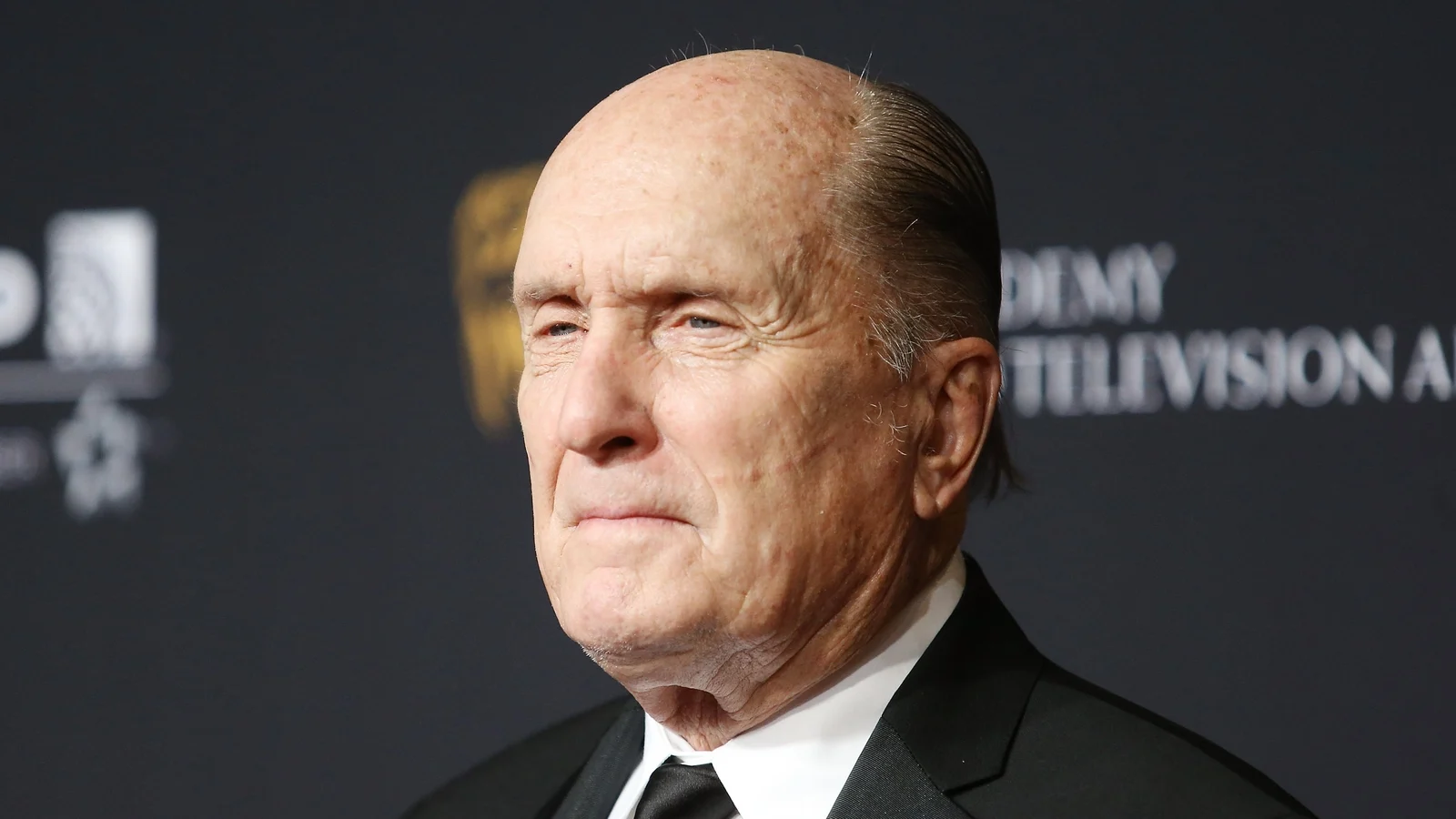
When Robert Duvall walked into a scene, he rarely announced himself. He arrived. A slouch, a half-smile, a voice that sounded like it had been sanded by a thousand weathered lines of dialogue—he had the uncanny ability to make the smallest gesture feel like revelation. On the morning the news broke that he had died at 95, tributes flowed like the slow, steady applause reserved for those whose work outlives them.
“He left the room exactly as he occupied life—calm, full of curiosity, and with a deep and abiding kindness,” his wife Luciana said in a statement shared with the world. “Bob passed away peacefully at home, surrounded by love.” It was an ending that felt true to the man many had come to know not only on screen but across farms, dance floors, and foreign stages.
From Annapolis to the World Stage
Born and raised amid the clipped flags and brass of Annapolis, Maryland, the son of a navy admiral and an amateur actress learned early how performance and discipline could coexist. After a stint in the Army and acting school in New York—where he roomed with a then-unknown Dustin Hoffman and struck up lifelong friendships with other struggling actors—Duvall moved from small television parts to a screen presence that critics and audiences could not ignore.
His first notable film appearance was an uncredited, haunting turn as Boo Radley in To Kill a Mockingbird, a small but memorable presence that hinted at a lifetime of complex, layered performances to come. Over the next six decades he would appear in nearly 100 films, amassing seven Academy Award nominations and winning the Oscar for Best Actor for his soul-baring portrayal of a washed-up country singer in Tender Mercies.
Roles That Carved an American Myth
If Hollywood loves archetypes, Duvall loved remolding them. He could be the smooth consigliere—Tom Hagen—who negotiates between gods and gangsters in The Godfather, and then, in the next breath, a surf-obsessed lieutenant who watches the sunrise after napalm and declares, “I love the smell of napalm in the morning.” That line, immortalized in Apocalypse Now, only scratches the surface. It’s the cadence, the way he holds a cigarette, a look at a subordinate or lover, that made his figures feel lived-in and dangerous or tender in equal measure.
“He didn’t act his roles so much as he inhabited them,” says Dr. Maria Alvarez, a film historian who has taught courses on American cinema for more than 20 years. “Duvall understood the American imagination—the soldier, the rodeo cowboy, the fallen preacher—and he refracted those myths back to us with a humane and often wry lens. He made men’s contradictions visible without sermonizing.”
From Lieutenant Colonel Bill Kilgore in Apocalypse Now to the domineering Bull Meechum in The Great Santini, from the ecstatic preacher in The Apostle (which he wrote and directed) to the stoic Gus McRae in Lonesome Dove, Duvall’s career mapped the breadth of American storytelling—heroic, small, cruel, tender, and always complicated.
A Career of Quiet Risks
He turned down the pay-off and the part of a lifetime at times, too—reportedly rejecting The Godfather Part III over a salary dispute—preferring instead creative control to comfort. That streak of independence carried him into filmmaking of his own: The Apostle and Assassination Tango are personal, idiosyncratic works that show an artist unafraid to steer his own course.
The Private Dancer: Tango, Farm Life and a Second Home
Off camera, Duvall cultivated a life that read like a parallel script. He split his time between Los Angeles, a sprawling 360-acre farm in Virginia, and Argentina, the country that would become central to his later life and marriage to Luciana Pedraza. There, he discovered the tango, a dance he embraced with seriousness and a boyish joy. He converted a barn into a dance hall where the music could chase off the dust and where, he liked to say, you learned more about a partner than any script could teach.
“He was a man of great appetites—food, music, conversation,” a longtime friend and neighbor on his Virginia farm recalled. “But he was also disciplined. If you were there to learn something, he’d listen and then teach, quietly.”
More Than Awards: A Legacy of Craft and Compassion
In an industry obsessed with flash, Duvall’s legacy is endurance. Seven Oscar nominations across a career that spanned more than sixty years and one Academy Award may quantify some measure of his success, but the truer measure lies in the anchors he provided to scenes, to films, and to younger actors who learned by watching him.
“You’d be surprised how many young actors would come by just to watch him breathe in a scene,” says Jasmine Carter, an actor who credits Duvall’s Lonesome Dove with shaping her early approach to performance. “He taught you that truth is not a big gesture. It’s the way you look when no one’s watching.”
He also showed a modern world that aging actors could still be central storytellers—directing, writing, and producing films well into their later years. In that sense, Duvall’s life offers a gentle rebuke to youth-obsessed cultures. In a moment when many industries reject older workers, his career suggests the opposite: experience, like vinyl that deepens with each spin, can yield new hues.
What Do We Lose When We Lose a Storyteller?
When an actor like Robert Duvall departs, what exactly vanishes? A face on celluloid, certainly. But also a particular way of looking at the human heart—its stubbornness, its generosity, its capacity for regret. In a global culture that often flattens characters into categories—the hero, the villain, the comic relief—Duvall relished the gray.
“He left us with a catalogue of performances that can be teachers for generations,” Dr. Alvarez reflects. “Not just in craft, but in empathy.”
Final Curtain
On last count, Robert Duvall’s filmography runs near a century of credits. His life was braided with music and mud, with Buenos Aires nights and Virginia mornings. He was a man who loved holding court at a dinner table, whose passions included a great meal and the slow intimacy of the tango. He was a husband, a friend, an artist who preferred to let work speak for him.
So ask yourself, when you sit down to a great film next week, to a scene that surprises you, to a line that lingers—who taught the actor on-screen how to be that honest? Chances are you’ll find a trace of Robert Duvall’s influence somewhere there, in the soft way a character exhales or the small, exact moments that turn performance into truth.
He leaves behind not only roles and awards, but a lesson: that acting can be a form of listening—and that a life lived with curiosity, craft, and tenderness becomes the richest kind of story.