Donald Trump has conditioned audiences to treat even his most consequential pronouncements with a raised eyebrow.
That reflex is now colliding with a proposal that, despite its theatrics, could reshape the aftermath of the Gaza war: his Board of Peace, billed as the vehicle for reconstruction and post-war governance.
Unveiled in January on Truth Social as “the Greatest and Most Prestigious Board ever assembled at any time, any place”, the body comes with an unusually steep price tag — $1 billion from states seeking permanent membership.
At a signing ceremony in Davos, the US President leaned hard into his familiar branding, displaying AI-generated images of a gleaming “New Gaza” featuring skyscrapers, luxury seafront apartments, data centres and tourism zones.
Mr Trump told those assembled that he’s “a real-estate person at heart,” calling Gaza “prime real estate”.
It sounded less like post-conflict statecraft and more like the language of a developer selling an ambitious waterfront project.
Yet behind the spectacle and self-praise, the 20-point blueprint attached to the Board of Peace has, improbably, emerged as the most credible bid in decades to tackle the broader Israeli-Palestinian conflict rather than merely freeze it.
That may say as much about the vacuum of alternatives as it does about the plan itself.
Still, as Hillary Clinton — hardly a natural ally of Mr Trump — put it last month, the proposal is flawed, but it is what exists, and paralysis is worse.
Sceptics have long questioned whether the Trump administration, or the board, would tolerate the slow, grinding diplomacy required to make any such framework stick.
But officials have reportedly spent months in painstaking, closed-door talks over the next stages. This is not a headline-grabbing launch followed by quiet abandonment once attention drifts.
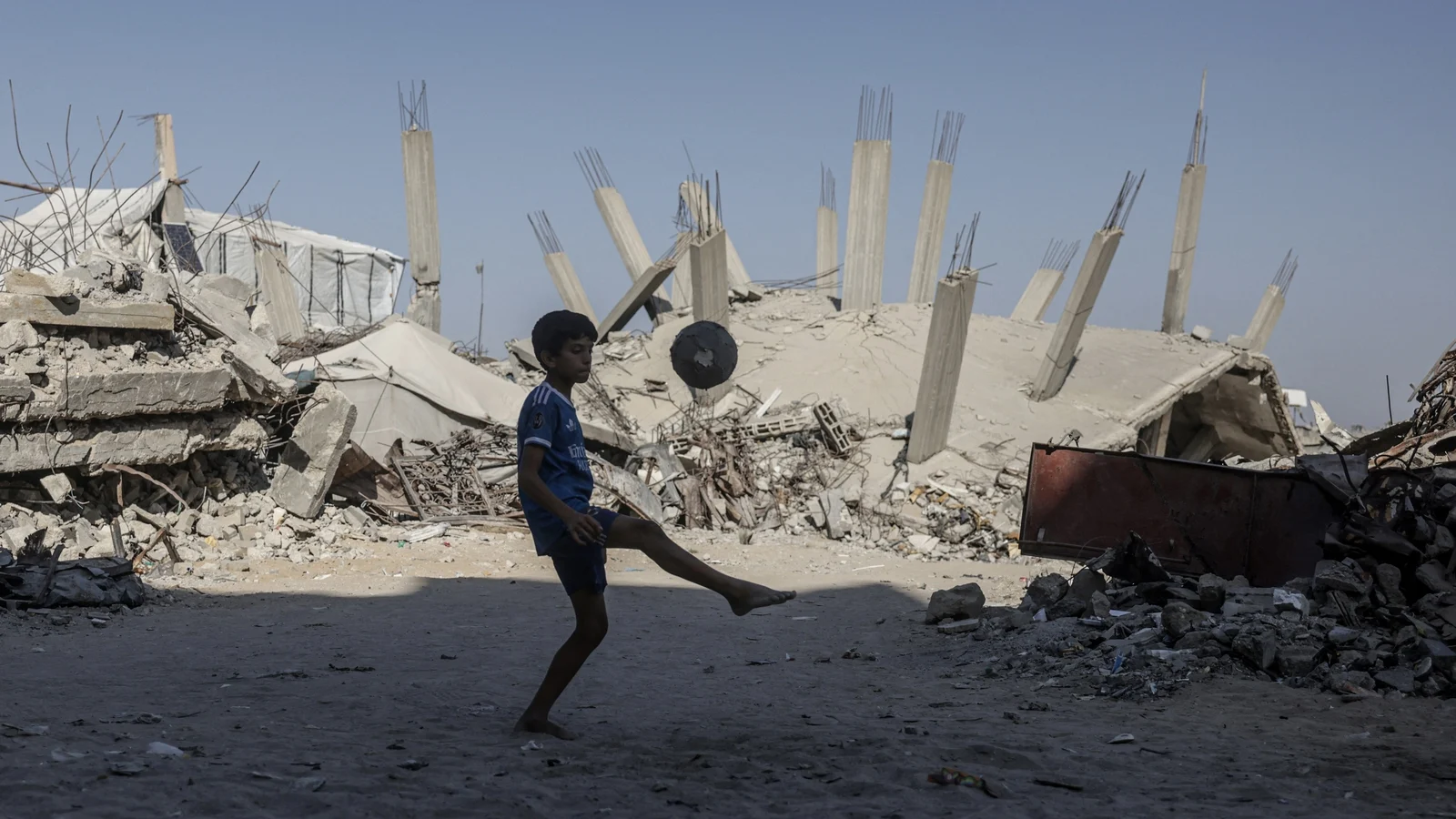
A child carries a cat among rubble Israeli strikes on Gaza City
The substance has been contested from the start. Critics have challenged the feasibility of nearly every step leading to its stated aim: creating “a credible pathway to Palestinian self-determination and statehood”.
One obvious sticking point has been demilitarisation. The plan says there would be a “process of demilitarisation of Gaza”, with weapons placed “permanently beyond use” — even as Hamas officials repeatedly insisted the group would not disarm.
So how should the world interpret Mr Trump’s latest claim that Hamas has agreed to “COMPLETE DISARMAMENT”?
“This is a monumental step toward lasting PEACE and SECURITY,” he wrote on Truth Social overnight.
It is the kind of declaration that invites an instinctive: here we go again.
Ghazi Hamad, a senior Hamas official involved in the talks, said the group was willing to accept the “difficult and painful” terms reached in Cairo.
But he did not use the word “disarmament”, instead describing a “comprehensive framework” that hinges on Israel first meeting its own obligations under the original ceasefire agreement.
Although multiple media outlets have quoted Hamas officials discussing the deal, Hamas has not officially confirmed it has agreed to the disarmament plan announced by the Board of Peace.
In a statement this afternoon, however, the group appeared to tacitly acknowledge an understanding had been reached, saying Israel’s commitment to ending its attacks was a “fundamental prerequisite for proceeding with implementing and establishing a timeline for what has been agreed upon”.
Under the first phase of the October ceasefire, Israeli troops were supposed to pull back to an initial demarcation point — the so-called “Yellow Line” as a first step.
US President Donald Trump announced that Hamas agreed to ‘complete disarmament’
Instead, satellite imagery and on-the-ground reporting indicate Israeli forces have spent months shifting that line deeper into Gaza. By late April, Israel effectively controlled an estimated 64% of the territory, and Mr Netanyahu has said it intends to expand that to 70%.
Since the ceasefire took effect in October, Israeli strikes have killed at least 1,190 Palestinians, according to Gaza’s Hamas-run health ministry — more than four deaths a day on average, in a conflict that was meant to have ended.
Against that backdrop, Hamas’s insistence that Israel fulfil its commitments before moving to a new phase is not hard to understand.
So while scepticism remains warranted about how any of this will unfold, the Board of Peace announcement is not empty on its face.
For years, Hamas treated disarmament as an untouchable red line. In October, it accepted a peace plan that made disarmament an explicit objective.
Now — however grudgingly and however conditionally — it is engaging with a framework that confronts the issue directly. That marks progress, even if it is precarious.
If any side merits deeper scepticism at this stage, it is Israel.
Even the Board of Peace appears to be signalling that concern.
In a post on X today, it reiterated that Israel “shall fully complete, without delay” all commitments it made in October, “particularly the cessation of military operations”.
But with an election three months away, there is little to suggest Benjamin Netanyahu’s government is preparing to deliver on its share of the bargain.
Today, Israel indicated it would not do so until Hamas fully disarms.
A senior Israeli official said: “There will be no IDF withdrawal from the current Yellow Line without the genuine disarmament of Hamas.”
That position reverses the sequence outlined in the deal. Hamas has hardly acted as a model actor — its growing armed presence in Gaza violates the spirit of the agreement — but it did satisfy the central requirement of phase one back in January by returning the last of the deceased hostages.
Israel’s obligations to end its offensive and withdraw were not conditional on disarmament. They are already due under phase one.
For all the doubts that Hamas would ever disarm and for all the scepticism Mr Trump’s Board of Peace has invited — it is Israel that now faces the test of whether it can meet its own commitments.