Gunfire at Dawn: Bamako Wakes to a City on Edge
At first light the capital smelled of dust and diesel, but the morning’s ordinary rhythms gave way to something sharper: the staccato rat-a-tat of automatic weapons, the distant thump of helicopters, and the unnerving silence where market noise should be. Streets that normally throb with taxis and vendors were empty. Phone videos—grainy, hurried—circulated with images of shattered walls and scorched earth in the suburbs of Kati. For many in Mali’s capital, the day began with a question that has haunted the country for more than a decade: will the violence sweep closer to home?
“We woke to the helicopters,” said Amina, a tea seller in Bamako’s Medina quarter, her voice low over a phone line. “People bolted their doors. Children cried. We are used to bad news, but not like this—guns and planes over the airport. It felt like the world had tilted.”
The Assault and the Response
According to a statement issued by the Malian army, unidentified armed groups launched coordinated strikes early in the morning, targeting military posts and strategic locations across the country. Reports of clashes came from the capital and from cities further afield: Gao and Kidal in the north, Sevare in the central region. In Kati, a military suburb where the junta’s leader maintains a residence, residents posted frantic videos of burning homes and shuddered walls.
“We are trapped in our houses,” a Kati resident wrote on social media. “The shooting is all around. There’s no safe route out.” Helicopters were reported circling near Bamako’s international airport, while sporadic gunfire echoed through normally bustling streets that had emptied into a wary hush.
Who Is Behind the Attacks?
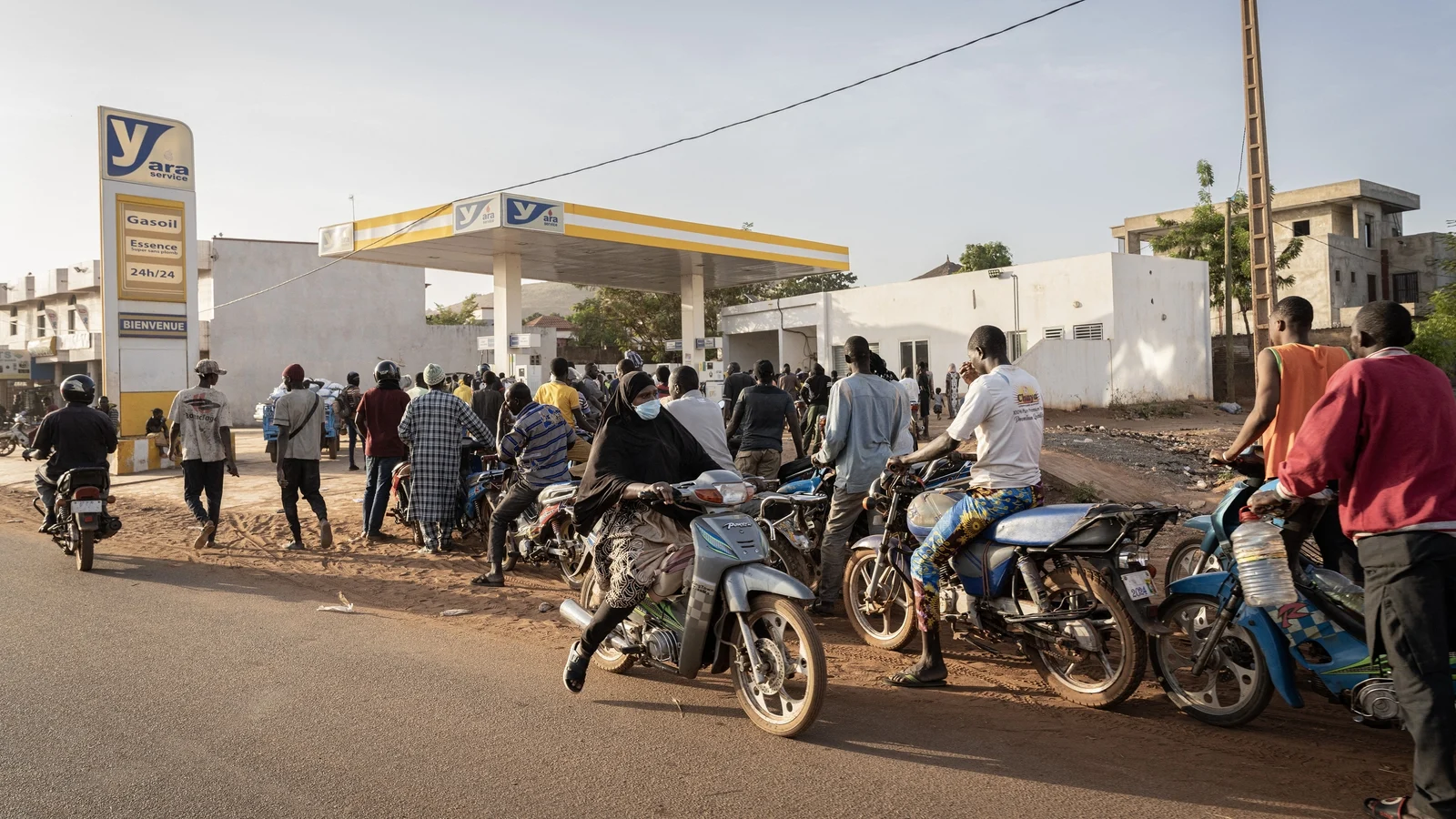
No organization immediately claimed responsibility. Mali has long been contested terrain for jihadist groups tied to both Al-Qaeda and the Islamic State, as well as for local militias and criminal networks that exploit the chaos. In recent months, fighters from JNIM—the Group for the Support of Islam and Muslims, an Al-Qaeda affiliate—have been striking fuel convoys and grinding the capital’s lifeblood to a halt. For many Malians, the pattern is familiar: hit the logistics, cripple the city.
“Attackers go after what keeps cities alive—the fuel, the roads, the supply lines,” said Seydou Diarra, a security analyst at a regional think tank. “When you cut a capital’s fuel, you don’t just stop cars. You stop hospitals, bakeries, water pumps. That’s warfare against the everyday.”
Familiar Fault Lines: Politics, Minerals, and Shifting Alliances
Mali is a country of sharp contrasts. It is rich in gold and other minerals, but the benefits of those resources have too often bypassed local communities and fed cycles of instability. Since 2012, the Sahel nation has been mired in a security crisis that has cost thousands of lives and forced tens of thousands to flee across borders into neighboring countries like Mauritania and Niger.
Politics have only deepened the peril. The military seized power twice—in 2020 and again in 2021—and since then the junta has tightened the screws on political life: restricting the press, banning political parties, and narrowing civic space. A transition to civilian rule was promised for March 2024; instead, in mid-2025 the junta extended the rule of General Assimi Goïta for a five-year term, renewable in perpetuity without an electoral process. Internationally, Bamako has shifted away from long-standing ties with France and Western partners and toward closer security cooperation with Russia.
“People here feel betrayed by the promises of both state and outside powers,” said Fatoumata Traoré, a human rights worker in Bamako. “They promised security and dignity. Instead, we have more repression and fewer answers.”
Wagner, Africa Corps, and a New Security Landscape
For several years, Russian mercenary forces—commonly known as Wagner—operated alongside Malian troops, a presence that heightened tensions with Western countries and drew international scrutiny. In June 2025, however, Wagner announced an end to its mission; the organization has since transformed into the so-called Africa Corps under the Russian defense ministry. Whether that restructuring signals more stability or a new phase of foreign influence remains unclear.
“Foreign actors bring capacity but also competing agendas,” said an independent analyst who studies foreign military intervention in Africa. “When external forces are entangled with local power brokers, civilians often pay the price without seeing promised gains in security.”
On the Ground: Human Stories Amid the Headlines
Behind the statistics are faces and names and ordinary routines interrupted. In Sevare, a town that has become a waypoint for displaced families, a baker explained how shortages of diesel have repeatedly forced him to close his oven. “Bread is life,” he said. “When the fuel runs out, people queue all night. Babies cry for milk that cannot be heated. You think of war as bombings, but often it’s hunger and cold that do the slow work of breaking a community.”
In the north, residents of Gao and Kidal describe an atmosphere of fear punctuated by resilience. “We plant, we trade, we pray,” said an elder in Kidal. “But we live with one foot on the road, ready to leave. You learn to carry your life in a small bag.”
Regional Ripples and Global Questions
Mali’s turmoil cannot be disentangled from wider Sahel dynamics. Neighboring Niger and Burkina Faso have also experienced coups and shifts toward military rule; the three countries have forged an Alliance of Sahel States. International actors are responding in varied ways—some countries seek dialogue, others tighten sanctions, and some, like Togo, attempt shuttle diplomacy to bridge gaps.
Meanwhile, the United States and other Western nations have been exploring new contacts and engagement strategies with the region’s juntas, balancing concerns about governance and human rights against the imperative of countering violent extremism. The broader question looms: can outside powers help stabilize the Sahel without enabling autocratic rule or becoming a vector for competing geostrategic interests?
What kind of partnership do citizens want? What kind of future do they deserve?
Looking Forward: Fragile Calm or a Deeper Descent?
The immediate priority is humanitarian. Months of unrest, fuel shortages, and constrained services have left hospitals, schools, and markets vulnerable. If supply lines are again compromised by attacks on convoys—tactics JNIM intensified from September, bringing the capital to a standstill last year—the city’s fragile lifelines risk snapping.
Longer-term, Mali stands at a crossroads between a return to civilian governance and an entrenched military order that relegates citizens to spectators. The sustainability of any security gains will depend on political inclusion, equitable management of natural resources, and the rebuilding of public trust—tasks that require more than military force.
“Security is not bullets and checkpoints,” Seydou Diarra reminded me. “It’s schools that stay open, courts that are fair, livelihoods that don’t depend on unsafe routes. Until people see that, the cycle will repeat.”
What Can Readers Take Away?
When the news cycles move on, the people of Bamako, Kati, Gao, Kidal, and Sevare will still be living with the consequences of today’s violence. They will count their losses, light fires for warmth, and tend to children who ask why their streets are empty. If you find yourself asking what you can do from far away, consider supporting reputable humanitarian organizations on the ground, amplifying local journalism, and staying curious about the complex forces shaping the Sahel.
And ask yourself: when a country rich in gold and culture is reduced to headlines about coups and convoys, who ultimately pays the price—and how might the international community act differently to prevent that slow unraveling?
The helicopters have moved on from today’s sky, perhaps for now. But the questions—about power, resource, and dignity—remain airborne, waiting for answers that must come from both inside Mali and beyond its borders.