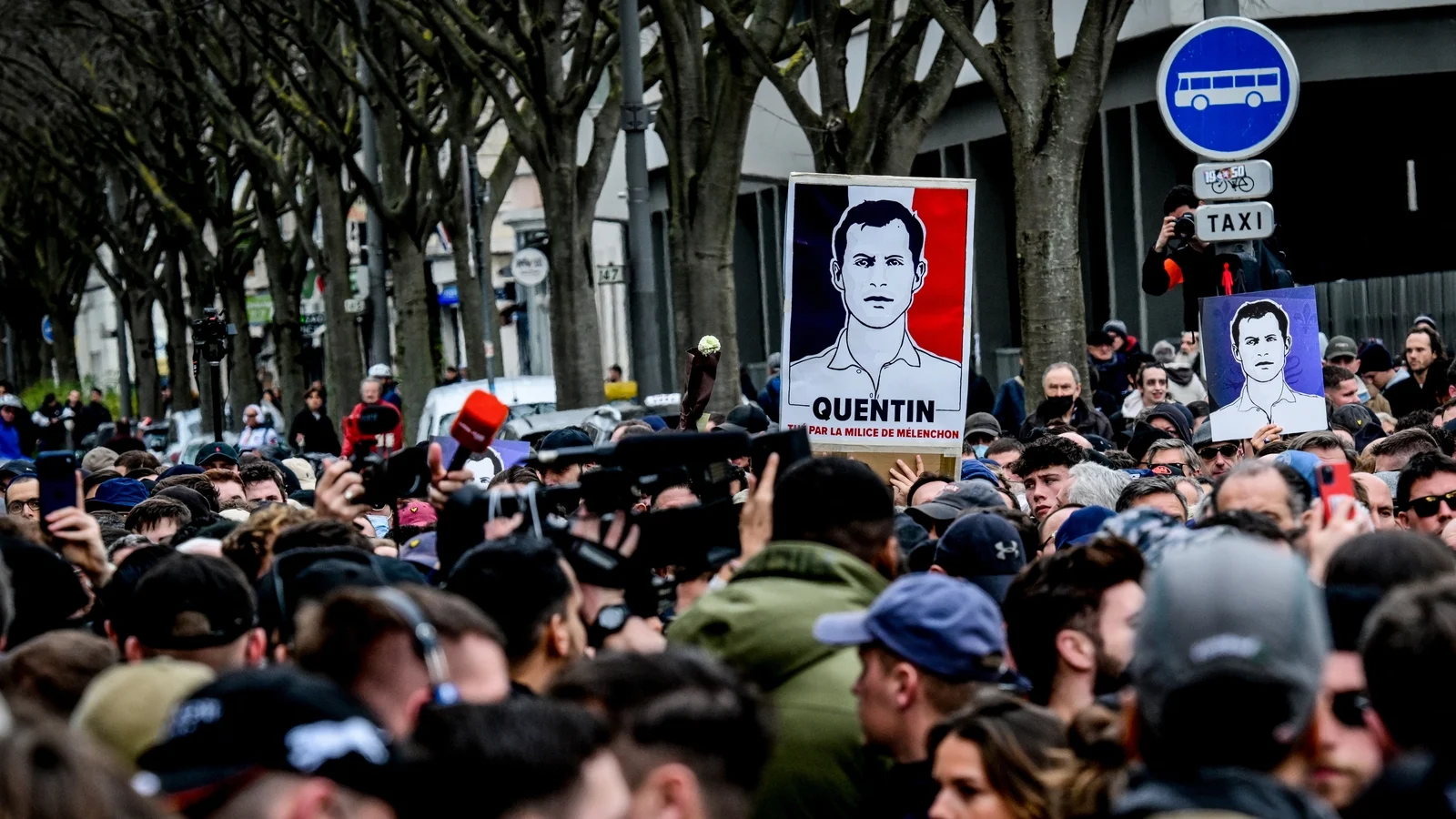
A City in Black and White: Lyon’s March That Felt Like a Pressure Test for France
The morning air in Lyon had a cool, metallic hush to it — the kind that makes every footstep sound louder than it should. Along the boulevard where the march began, people gathered in small knots: some clasping bouquets, others holding placards with grainy portraits taped to thick card. Many were dressed in black; a few pulled scarves up over their mouths against the chill and the glare of cameras. Above them, whirring discreetly, drones traced patient circles like surveillance birds.
What unfolded that day was part memorial, part demonstration, and part combustible public theatre. Thousands moved slowly through the city — not a festive parade but a procession heavy with grievance and warning. The faces in the crowd were varied: teenage boys with cropped hair, men and women in their fifties with church rosaries dangling from their fingers, a cluster of university students with austere, homemade banners. Their chants were measured and mournful rather than triumphant. “For Quentin,” someone cried. “Justice,” answered another voice, thinner and more desperate.
The Body Count of a Political Moment
The gathering was organized in the wake of the death of Quentin Deranque, a 23-year-old activist whose fatal injuries were sustained during violent clashes between radical left and far-right groups at a political rally. Authorities say six people have been charged in relation to the assault; a parliamentary aide to a far-left MP also faces charges of complicity. Those facts alone would make the case headline-grabbing. But the death has tapped a deeper nerve.
“This isn’t just about one person,” said Marianne Leclerc, a sociologist who studies political movements in France. “It is a symptom of how low the threshold has fallen for political violence. We’re seeing a normalization of confrontation that used to be confined to the margins.”
And with a presidential election on the horizon — France will head to the polls in 2027, with Emmanuel Macron unable to run again after two terms — the anger and the optics are being read as a harbinger: a test of how the state manages the collision of organized extremes and how public space can be kept safe for democratic expression.
Security, Drones and a State Trying to Walk a Tightrope
By most measures, the state prepared for the worst. Gendarmes and riot police ringed the route. Drones hovered above in a buzzing fog, streaming images back to command vans parked at the edges of the crowd. Street cameras were switched on. Government officials stressed that the priority was preventing further violence and preserving public order.
“We are here to safeguard peaceful mourning and to prevent any drift into vigilantism,” an interior ministry spokesperson told me, glancing at the line of officers like someone checking a fragile seam. “But we also have to respect the right of people to gather. That balance is not easy.”
President Macron urged calm in a televised message hours earlier, warning against vigilantism and pledging a government review of violent extremist groups. “In the Republic, violence must not be a way to resolve politics,” his office said, echoing a familiar refrain about the rule of law. Yet the words landed differently depending on where you stood in Lyon: reassuring to some; insufficient to others.
Religion, Ritual and Radical Memory
Before the march began, mourners moved through the old stone nave of the church Quentin was said to have frequented. Candles flickered on the windowsill. A portrait of him was draped from the façade of the regional administrative building — a small, defiant insistence that his life be seen.
“He found himself in that community,” said Laurent, a friend who stood near the altar and spoke quietly. “That’s where he felt most at peace — religion, tradition. We’re not here to inflame, we’re here to remember.”
Yet memory in public spaces is a fragile thing. A local organiser, a former campaigner known for her anti-abortion activism, implored the crowd to keep the tribute peaceful while also taking a swipe at political figures she felt had abdicated leadership by refusing to attend: “If you stand with us only in words, you stand with nothing,” she said.
Neighbors Board Up Windows and Whisper Warnings
On streets a few blocks from the route, the city’s quieter rhythms looked decidedly defensive. Apartment ground-floor windows were boarded. Cafés that usually spill tables onto the pavement had folded up and pulled in their chairs. An 82-year-old woman named Madame Moreau sat on the stoop of her building with a muffled expression and a thermos of coffee. She had lived through periods of unrest before, she said, but something about this felt different — more organized, and therefore more dangerous.
“I don’t want to be in the way of two sides who no longer speak to each other,” she said. “They shout and someone gets hurt.”
Voices from the Crowd: Angry, Sad, Resolute
Not everyone at the march shared the same political calculus. Some spoke of loss and the need for accountability. Others arrived with a broader agenda: a pushback against what they saw as left-wing violence, a rehearsal for a more muscular vision of politics.
“We aren’t here to start fights,” said Jérôme, a 30-year-old tradesman, gripping a bouquet of white lilies. “But we can’t pretend that there aren’t groups out there who think they can do as they please because they wear ideology like armor.”
Across the way, a university student named Léa — who had taped a printed quote about democracy to her sleeve — lamented the spectacle’s effect on public life. “When every disagreement turns into a battle, we lose spaces for conversation. Where do we learn to listen?” she asked.
Ripples Beyond Lyon
France is not alone in these struggles. Across Europe and beyond, democratic nations have grappled with the rise of hardline movements on both ends of the political spectrum, the amplification of grievance-by-viral-post, and the permeable boundary between protest and physical confrontation. Analysts point to social media’s role in quickly mobilizing groups and broadcasting spectacles that can radicalize audiences far from the original flashpoint.
“We are watching how online networks act as incubators,” Leclerc said. “They take local stories and turn them into transnational calls to action.”
What Comes Next?
For the Deranque family, the political grammar is secondary to personal grief. Their lawyer has asked mourners and media to respect their privacy; they declined to attend the march, seeking a quieter path through sorrow. For the state, the challenge is to investigate the killing, prosecute where appropriate, and — crucially — head off reprisals.
And for the rest of us, Lyon’s procession raises uncomfortable questions: How do democracies defend themselves against internal violence without curtailing civil liberties? How do communities rebuild trust when the air itself feels divided?
Next week, the government has promised a meeting to discuss “violent action groups.” It will be one technical response; but technical solutions alone rarely change the social weather that produces violence. That requires conversation, education, and spaces where disagreement can remain verbal and not physical.
As the sun slid behind Lyon’s rooftops and the crowds dispersed, a stray candle from the church guttered and went out, then was relit by someone passing by. It was a small gesture — private, stubborn — and perhaps the most apt image of a city trying to hold brightness in a hard, uncertain time.
What would you do if you lived here, in a city divided between mourners and militants, memory and mobilization? How should societies balance freedom and safety when both feel fragile? Think about it — and then, if you can, speak to someone whose view is not your own. It’s a start.