Beneath the Grey Sky of Brittany: When a Nation Decides to Stir the Atom
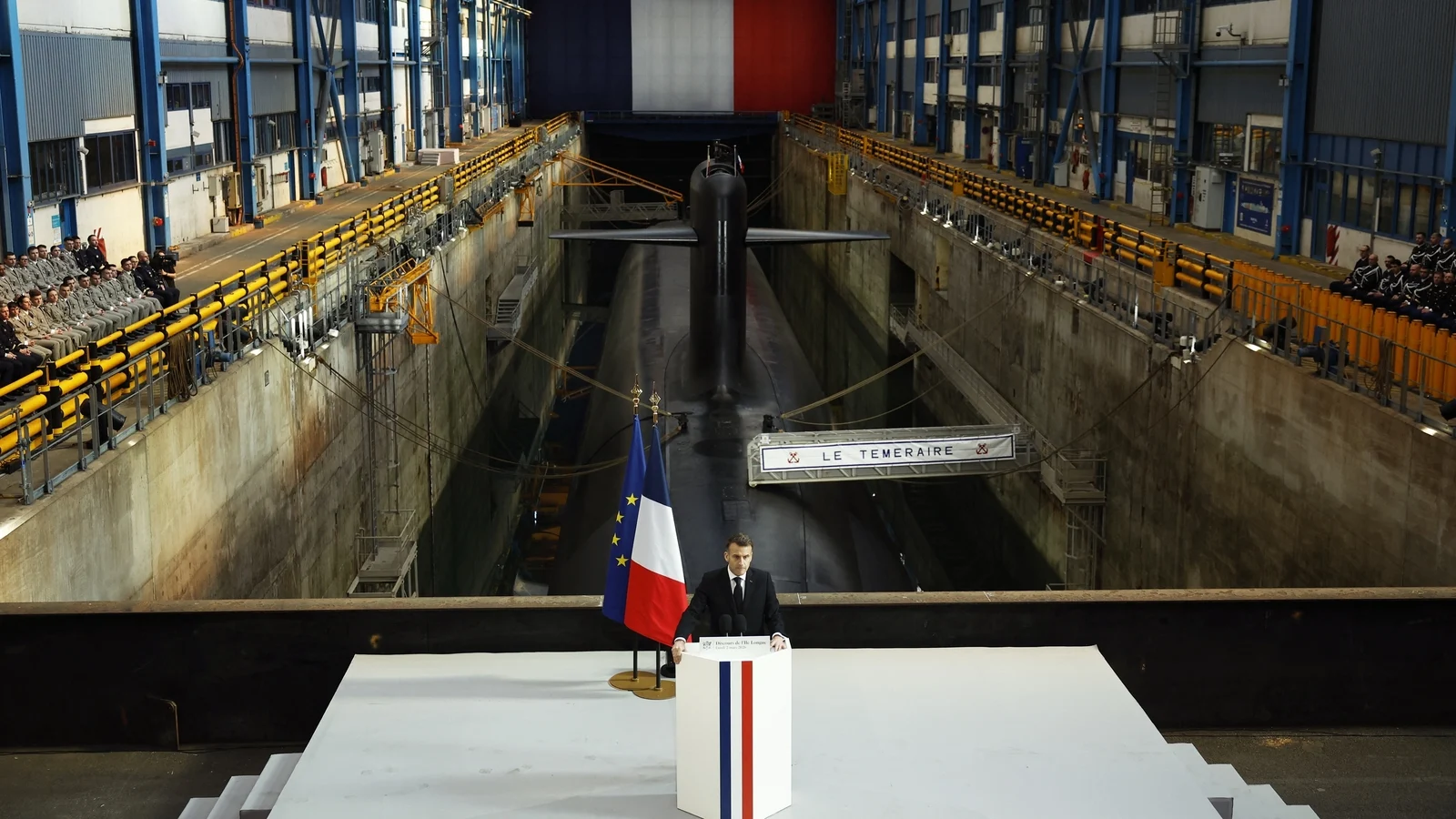
On a raw, windy morning at Île Longue—the granite-splashed naval sentinel of Brittany—a crowd of uniformed officers and a smattering of ministers gathered beneath the hulking silhouette of a nuclear submarine. Salty spray slapped the quay. A gull circled, unimpressed. And from a lectern that faced the Atlantic, President Emmanuel Macron delivered words designed to ripple far beyond the Breton coast: France would bolster its nuclear arsenal, conceal its true stockpile, and offer the shadow of its deterrent to other European countries.
It was the kind of scene that reads like a Cold War tableau, but the world in the background is not the one of 1960. It’s jagged: a full-scale war in Europe, deepening strategic rivalry with China, and a Middle East suddenly ablaze. Macron’s line—“To be free, one must be feared,” he said—cut straight through the salt air. “To be feared, one must be powerful,” he added. Those two sentences will travel; they will be replayed in parliaments and kitchen tables alike.
Why this matters now
For decades, Europe largely rested under a single, colossal guarantee: the American nuclear umbrella. That umbrella remains vast and heavy. But cracks and fissures have widened. The United States is pulling and pushing in ways some European capitals find harder to predict. Russia’s full-scale invasion of Ukraine and the recent US–Israel military actions around Iran have scrambled old certainties. In that turbulence, Paris has decided to make a more explicit and visible contribution to continental deterrence.
Macron’s announcement is not a wholesale handover of French warheads to other states. It is a promise of protection with strings attached—the arsenal stays under French command—but the reach of that protection will be broadened: fighter jets carrying nuclear ordnance could be deployed to other European theatres, and France stopped saying aloud how many warheads it keeps in its vaults.
Numbers and noise
Before the speech, France’s publicly acknowledged stockpile hovered around 290 warheads, making it the fourth-largest nuclear arsenal after Russia, the United States, and China. Yet Macron said the count would no longer be a matter of public record. In a world where the nine nuclear-armed states collectively own nearly 13,000 warheads, that decision is a seismic shift in transparency.
- Estimated warheads: Russia ~4,300; United States ~3,700; China ~600; France ~290 (public figure prior to the decision).
- Annual nuclear-related spending (estimates referenced in public debates): US ~$51 billion; China ~$11 billion; Russia ~$8 billion; France reportedly spent around $6 billion in 2024 on its nuclear forces.
Those figures are not abstract. Every billion euros committed to strategic weapons is a billion not spent on housing, hospitals, climate resilience, or schools. That is a political choice—and one that many European voters will feel in the ballots ahead.
The human texture: Breton fishermen, café talk, and a worried child
Down the lane from Île Longue, in a café that smelled of coffee and buttered buckwheat crêpes, local faces reflected a kind of cautious perplexity. “We have watched ships come and go my whole life,” said Yves Le Guen, a 62-year-old lobster fisherman, fingers stained with old rope. “But this talk of more bombs? It’s far from our nets. It makes me wonder what kind of Europe we’re building for my granddaughter.”
Marie Dupont, who runs the café, shrugged as she slid a plate across the counter. “People here worry about storms, about the salt on the windows. We’re used to living with the sea’s moods. But this—this feels like the weather inside politics. No one can predict the storms.”
Across Europe, the mood is varied. Berlin has been explicit: Germany, having loosened long-standing post-war spending limits, is pouring money into conventional forces. Chancellor Friedrich Merz has publicly aligned with Paris in creating a high-level nuclear steering group. Poland’s leader has confirmed exploratory talks with Paris about nuclear cooperation, and even hinted—delicately—that Warsaw may not rule out future self-reliance.
Voices at the margins and the center
Not everyone welcomed the move. “Every additional warhead raises the risk of use,” said a spokesperson for an anti-nuclear campaign, citing both moral and practical objections. “This is the brittle edge of a new arms race.”
Conversely, many defence officials and analysts argue this is sober realism. “Deterrence is not nostalgia,” said Dr. Anaïs Leroy, a defense analyst in Paris. “It’s a response to an environment where power projection is being recast. France is trying to ensure that, even if the world shifts beneath us, some lines will remain red.”
Questions that linger: control, calculation, and consequence
Several hard questions remain. Who gets consulted if a European air base hosts French nuclear-capable jets? How will neutral nations—places such as Ireland—protect their maritime zones while maintaining long-cherished non-alignment? Will domestic politics in Paris reverse the posture in the next election? And what happens if other countries follow suit—will the continent become more secure, or simply more febrile?
Edward Burke, a historian of post-1945 war, put it plainly: “There’s a thin line between deterrence and provocation. States must ask themselves whether they are buying safety or stoking an atmosphere that makes war thinkable again.”
Then there’s the international legal architecture. Treaties that once placed guardrails on nuclear competition are fraying. The landmark arms-control agreements that held the U.S. and Russia to limits have weakened. Diplomatic space is shrinking even as missile technology grows faster and cheaper.
Where do we go from here?
So here is the question I want to leave with you, reader: do you feel safer knowing that France will cast a wider, quieter nuclear shadow over Europe, or does the very idea of more concealed arsenals make the future feel darker and more precarious?
The answer will vary by capital, by kitchen table, by the child in Brest who learned about submarines in school and now sees them as symbols of national resolve or a cautionary tale. There are no easy answers. But there are costs—economic, moral, and human—and we must account for them.
In the weeks and months ahead, expect diplomatic conversations to multiply. Expect parliaments and pacifist groups to clash and coalitions to form. Expect the small Breton café to host heated debates as sailors pass through and fishermen repair nets. Nations will weigh autonomy against alliance, secrecy against trust, and the cold arithmetic of deterrence against the warm needs of societies that want schools, hospitals, and a livable climate.
History has taught us that when nations choose to invest in instruments of absolute force, the ripple effects are generational. The wave that began in Brittany may roll quietly across capitals—shaping budgets, alliances, and the story we’ll tell our children about what it means to be secure in the 21st century.