Hungary at the Ballot Box: A Country Teeters Between Two Futures
There are elections that feel like routine maintenance. And then there are votes that hum like a fault line beneath a city’s streets—ready to split everything open. Tomorrow’s parliamentary election in Hungary is the latter: a seismic moment that could, quite literally, reshape the country’s relationship with the European Union, its ties with Moscow, and the texture of everyday life for millions of Hungarians.
For more than a decade Viktor Orbán and his Fidesz party have ruled with a steady, muscular confidence. They won office in 2010 and, through four successive elections, carved out a super-majority that allowed them to rewrite the constitution, reengineer electoral maps, and consolidate control over public institutions and much of the private media landscape. Today, independent estimates suggest companies friendly to Fidesz have a dominant presence across Hungary’s media—some analysts place that share around 80% of private outlets.
Opposite them stands a challenger that until recently was barely visible. The Tisza party, led by 44-year-old Péter Magyar, who once moved in the same political orbits as Fidesz insiders, has remade itself into a plausible governing alternative in under two years. Polling aggregates have put Tisza comfortably ahead in national support, with some surveys suggesting they could win a super-majority of parliamentary seats—if the arithmetic of Hungary’s reworked voting maps works in their favor.
On the Ground in Aszód: Flags, Folk Songs, Hope
Drive an hour east from Budapest and you reach Aszód, a commuter town where the election has shed its abstraction and landed on the pavement. At a recent Tisza rally, about forty volunteers in branded jackets fussed over sound equipment, handed out flyers, and steadied nervous candidates as they rode a wave of genuine optimism.
When Péter Magyar appeared, the crowd’s reaction was part rock-concert roar, part Sunday church—hands outstretched, phones raised for selfies, the national flag fluttering like a heartbeat. The smell of chimney smoke and the faint note of a folk clarinet threaded through the gathering. A group of retirees hummed along to an old revolutionary song; somewhere a child tugged a parent’s sleeve and asked, “Will things be better?”
“This isn’t just about a government change,” a young woman who’d come home from Amsterdam to vote told me. “It’s about whether I can see my future here.” She asked that I call her Anna. At 24, she sounded both fierce and exhausted; she said she wanted Hungary to be anchored in Europe, not adrift in geopolitics.
Elsewhere, an older man named János—retired, with callused hands and a quiet, blunt manner—was frank. “We’ve been told stories for years,” he said. “It’s time to stop paying for them with our children’s opportunities.” He waved a flyer promising pension protections and housing support, skeptical but hopeful that change might be tangible.
Promises on a Handout
Tisza’s platform reads like a cross between center-right pragmatism and social conservatism: tax reforms targeting the ultra-wealthy, subsidy programs for insulating homes, and expanded family support. It’s a set of promises designed to touch both the wallets and the pride of Hungarians—appealing to older voters’ sense of national sovereignty and younger voters’ desire for opportunity.
- €18bn in EU cohesion and recovery funds remain stalled pending rule-of-law concerns—one of Tisza’s central selling points is restoring those ties.
- Polls show a potential Tisza lead of roughly ten percentage points in national vote intention aggregates.
- Some poll models suggest Tisza could win as many as 138 of 199 seats—though electoral boundary changes made in 2011 complicate seat-to-vote translation.
Two Competing Narratives: Europe or an “Illiberal” Periphery?
At its core, this election is a battle over identity. Orbán’s “illiberal democracy” pitch has been about strong borders, cultural conservatism, and skepticism of supranational constraints. It’s a message that has won him fierce loyalty in rural districts and among voters who prize stability and national pride.
But critics argue that the price of that stability has been the hollowing out of democratic checks and balances. Since 2011, Hungary’s constitutional changes have reduced judicial independence, reconfigured administrative bodies, and muted critical media. That has strained relations with Brussels and led to conditionality over billions in EU funds.
“This is not simply a domestic quarrel. It’s about whether Hungary remains fully part of the European project,” said Dr. Gábor Tóth, a political scientist at Eötvös Loránd University. “The question for voters is whether they trust a reset after years of erosion—or whether they favor continuity that keeps a particular order in place.”
The Russia Question
Internationally, Hungary has been a pivot of controversy. While most EU members have moved to support Ukraine after Russia’s 2022 full invasion, the Orbán government has maintained unusually warm ties with Moscow—fuel deals have been a public centerpiece, and Hungary’s foreign minister has made repeated trips to Russia since the war escalated.
A leaked recording of a call between Hungary’s foreign minister and Moscow officials intensified scrutiny, portraying a relationship that European diplomats say looks transactional and unusually close. To many Hungarians, this raises a simple, sharp question: Whose interests is my government putting first?
“We remember 1956,” Péter Magyar reminded the Aszód crowd, invoking the uprising against Soviet forces to draw a historical line between Hungary and foreign domination. His refrain—Hungary belongs in Europe—struck a chord that felt as much moral as strategic.
The Narrow Paths of Democracy
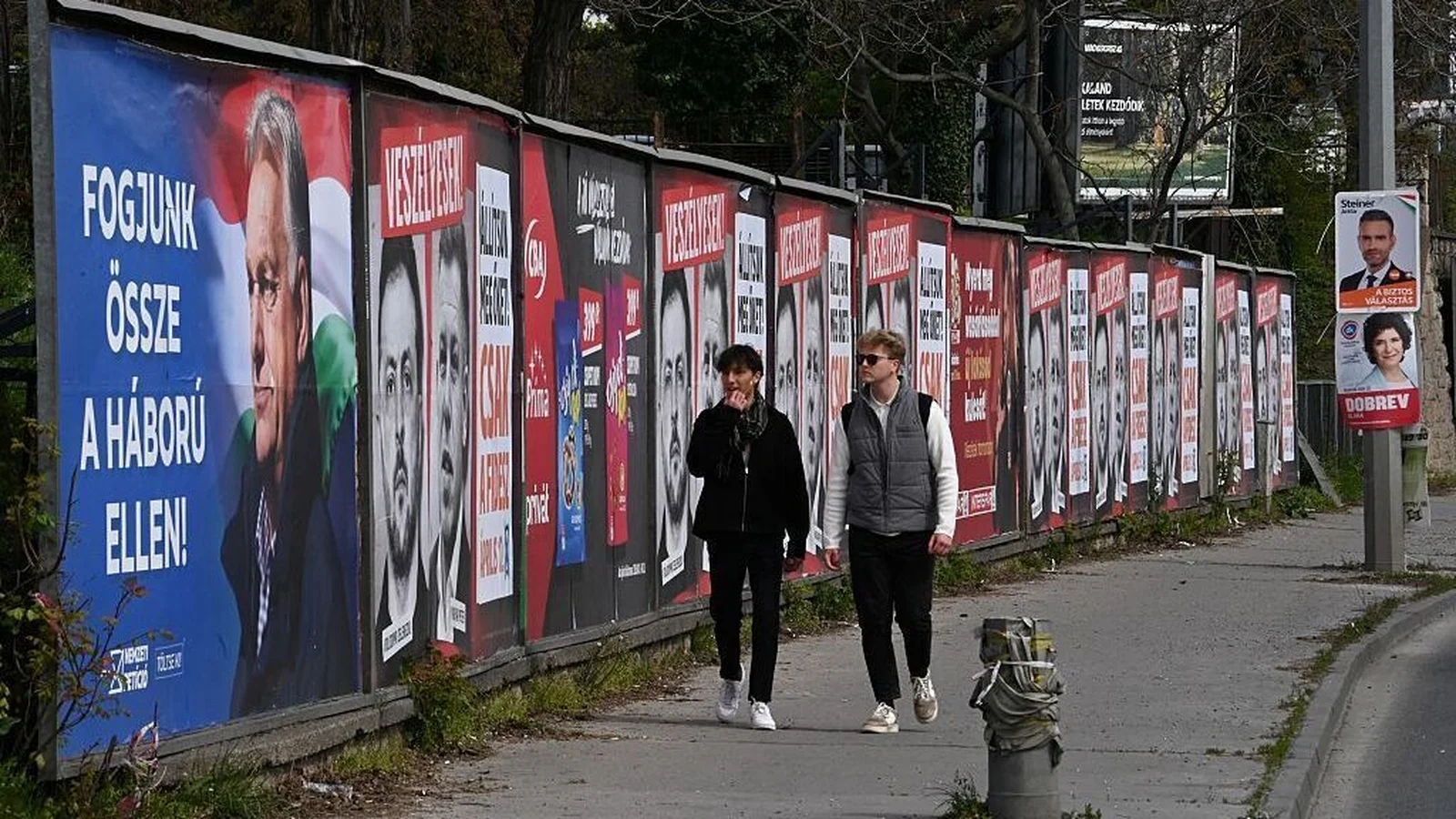
There are practicalities that may determine the result in the end: turnout, the redrawn district maps from a decade ago, and whether rural Fidesz strongholds mobilize their base. And there is always the wild card of disinformation and fear-based campaigning. Fidesz has leaned hard into portraying its opponent as reckless on foreign affairs, plastering campaign posters that conflate Tisza with risky international entanglements—an effort to make voters fear being dragged into war.
“Polarization is their tool,” a Fidesz campaign volunteer told me on condition of anonymity. “If people are scared, they vote for security—even if it’s the kind of security that limits them.”
So what happens if neither side lands a clear blow? If Tisza cannot convert votes to a parliamentary majority because of district engineering, a hung outcome could leave the country in prolonged political limbo—raising the specter of coalitions, compromises, and possibly, the rise of smaller, more radical parties that now hover around thresholds in national polls.
Looking Beyond Hungary
This election is not just Hungary’s reckoning. It is a test case for Europe and for democracies everywhere. Can institutions built after World War II withstand populist strains? Can a country balance national pride with the obligations of multilateral partnerships? And can voters, weary from inflation, energy worries, and global anxiety, make decisions that prioritize long-term civic health over short-term comfort?
Tomorrow, Hungarians will answer those questions at the ballot box. And the world will be watching—not merely for the name of the victor, but for the direction a European democracy chooses under pressure.
How do you think democracies should navigate trade-offs between sovereignty and partnership, security and openness? If you were standing in Aszód tonight, which story would you believe—that of continuity, or of change?