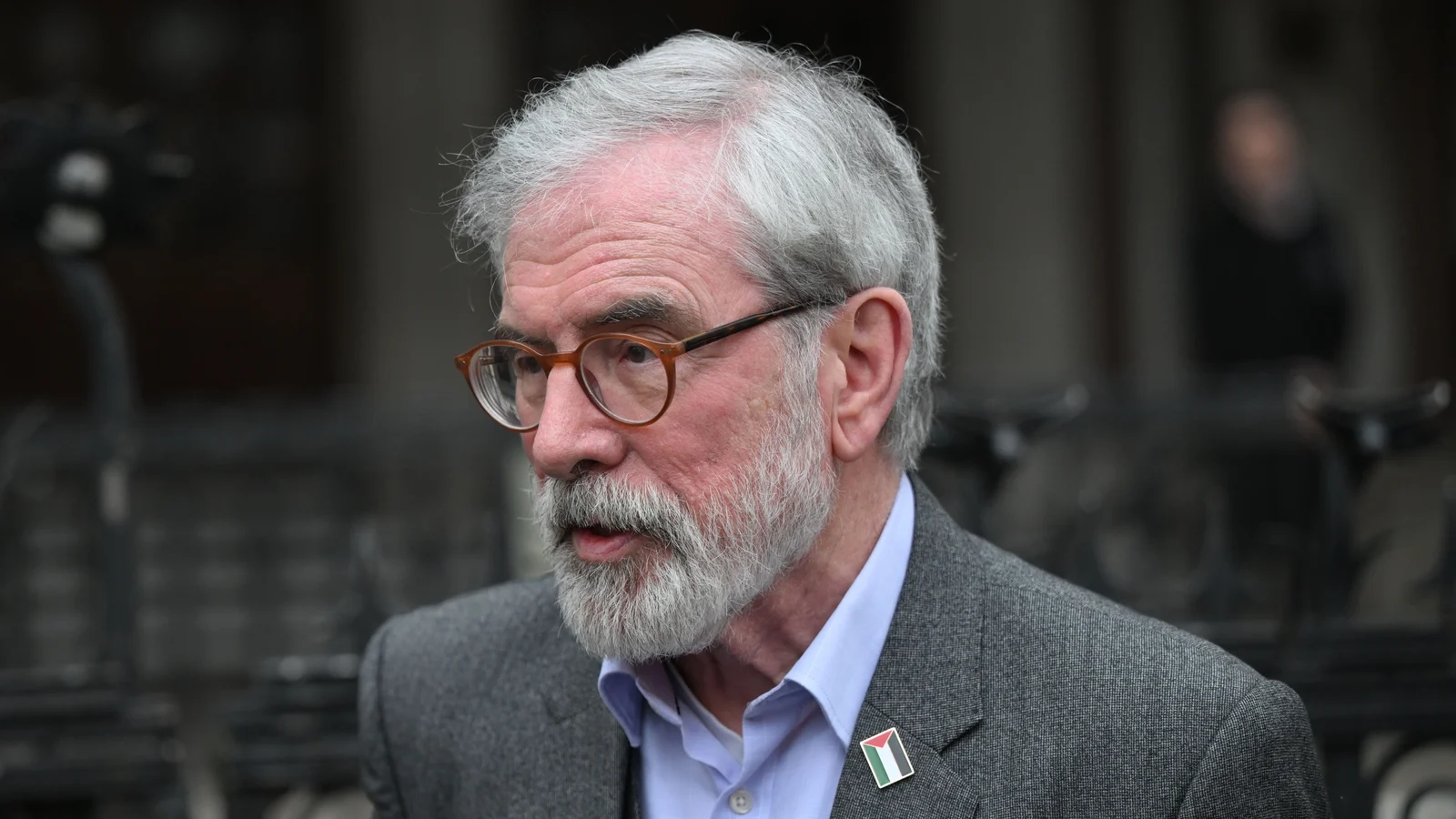
Inside a London courtroom: history, memory, and the long shadow of the Troubles
The High Court in London hummed with a particular kind of silence the day I arrived — the hush that comes when history is being re-sifted under fluorescent lights. Men and women shuffled in with the careful, deliberate step of people who know something heavy is about to be named. Television crews loitered politely at the edges. Lawyers moved with the cool choreography of ritual. And at the center of it all was a civil claim that pulls at the frayed threads of Northern Ireland’s past: three victims of separate IRA bombings are suing Gerry Adams, alleging his direct responsibility for attacks in 1973 and 1996.
It is not just a courtroom drama. It is a story about how we assign guilt and responsibility when conflict blurs the boundaries between political struggle and criminal violence. And it is a story that asks a simple, terrible question: when decades have passed, who owns the truth?
John Ware: the journalist who followed the seams
John Ware, a veteran reporter who spent decades covering security and paramilitary activity for outlets including The Sun, ITV and the BBC, took the stand. His testimony read like the accumulation of a career spent listening to people who do not often speak in public.
Ware told the court that former IRA members he had interviewed were struck — and angered — by Gerry Adams’s persistent denials that he was ever a member of the Provisional IRA. It was not merely skepticism; it was a moral hurt. As Ware recounted, many of those he spoke with felt that Adams’s public embrace of the armed struggle while denying membership allowed him to avoid personal responsibility for killings and bombings.
“It clearly grated with many of them,” Ware wrote in a witness statement heard in court. “When Adams said that he strongly supported the armed struggle, his denial of actual PIRA membership allowed him to avoid taking personal responsibility for their actions.”
Later, Ware put the view more bluntly: it would be wrong, he said, for history to record that Adams was never a member when “it is perfectly clear to me, my colleagues and scores and scores of people” that he was. Those are fierce words from a man whose work has been to pry loose facts from secrets.
What the witnesses said — and what they did not
It’s important to underline what this civil case can and cannot do. Ware himself agreed under cross-examination that he had no first-hand knowledge tying Adams to the three specific bombings cited in the suit. The difference is between direct operational responsibility for a particular device on a particular day and a broader question of influence, leadership, and strategy within a violent campaign.
That ambiguity fuels both the litigation and the passions it sparks outside the courtroom. For victims and their families, the legal filaments of civil law can be the only route to some form of accountability. For former combatants and politicians, such proceedings reopen wounds that the Good Friday Agreement and subsequent political developments aimed to seal.
Outside the court: voices of memory and anger
Standing on the steps of the court, you could feel the geography of grief. A woman in her seventies, who introduced herself as the sister of a man killed in the 1970s, wiped her eyes and said, “We just want someone to be honest. Not apologies framed for TV. Honest answers.”
A former security analyst who has followed Northern Irish affairs for decades told me: “This is as much about how we remember as it is about who did what. There are entire communities that define themselves by narratives of victimhood and heroism. Courts cut through that in blunt ways.”
And a younger person, born long after the ceasefires and the political settlements, shrugged and asked: “Why do we keep digging up this past? Can’t we move on?” It’s a question that lands differently depending on where you sit. For many survivors, moving on has always required knowing what happened; for some younger citizens, moving on means building institutions that make past violence impossible to repeat.
Facts and figures to frame the debate
To understand the scale of the Troubles, numbers can be sobering. Between the late 1960s and the Good Friday Agreement, about 3,500 people were killed and tens of thousands injured across Northern Ireland, the Republic, and Britain. The violence involved an array of paramilitary groups, state security forces, and shadowy networks. Allegations of collusion between security services and loyalist paramilitaries have been investigated for years, and reporting — including work Ware has done — has at times exposed misleading statements by the military, the police, and MI5.
Those revelations matter in a civil case. Edward Craven KC, representing the claimants, told the court there had been a “pattern of dissemination of false information” by the British Army, the RUC and MI5. If state narratives were at times unreliable, that fact complicates the archive upon which historians and litigants alike must rely.
Why a civil court, and why now?
Civil courts operate on a balance of probabilities, not the criminal standard of beyond reasonable doubt. That lower threshold is why victims often file civil suits when criminal cases cannot proceed: the passage of time, lost evidence, faded memories and political compromises all make criminal prosecutions difficult. Civil litigation becomes a tool, imperfect but sometimes the only available one, for families seeking a public finding of responsibility.
For Adams — a long-standing figure in Irish politics who led Sinn Féin for decades and served as an elected representative both at Westminster (though abstentionist) and in the Dáil — the case presents both reputational and personal challenges. He has consistently and strenuously denied being a member of the IRA.
Beyond personalities: truth, reconciliation, and the global lesson
This trial is not just about Gerry Adams. It is a microcosm of how societies try to reckon with past political violence: the tension between peace and justice, memory and reconciliation. Around the world, truth commissions, courts and community processes struggle with the same questions. How do you hold powerful figures to account without destabilizing a fragile peace? How do you balance the right to know with the possibility that revelations could re-ignite old conflicts?
There are no easy answers. But the court will hear more evidence: today, a former senior military intelligence officer who was based at British Army headquarters in Lisburn during the Troubles is due to give evidence. Each witness adds another tile to a mosaic that will never be perfectly whole.
So I ask you, the reader: when history is contested and pain lingers, what does justice look like? Is a legal finding enough to satisfy a family who lost a child? Is a political confession enough to make a community safe for the next generation? And if truth is messy and partial — what then?
Walking away from the court that afternoon, I passed a mural in West Belfast — a painted history, vibrant and unrepentant — and watched a group of teenagers laugh, their phones held high to capture the moment. The past is there, painted on brick and memory. The future is making itself, bit by uneven bit. Courts, journalists, politicians and communities will pass judgment in different fora. But perhaps the real work — the kind that changes daily life — happens when people who have been at odds begin to share the same pavement again.