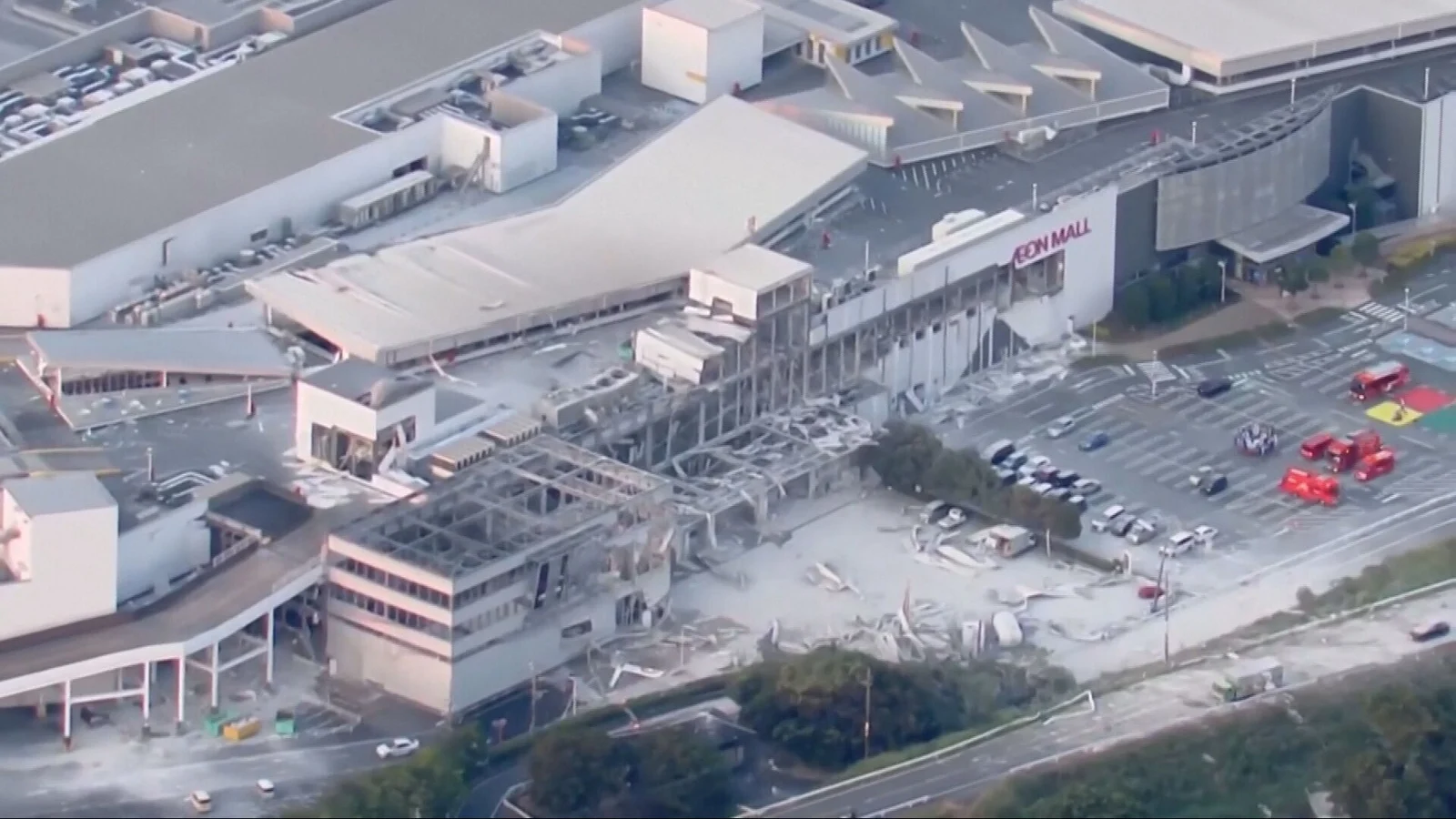
Rescuers raced to a damaged shopping centre in southwestern Japan after a powerful earthquake left “many people” trapped, according to emergency services, as officials worked through reports of injuries, fires and widespread disruption across Kyushu.
In “Kashima town, a shopping complex’s second floor collapsed, leaving many people trapped inside,” the fire department said in a statement.
Broadcaster TBS said that a “considerable” number of people in the shopping centre had died following the earthquake.
Police told AFP that they could not confirm whether there were any fatalities at the shopping centre in the town of Kashima.
Earlier, police said they had received reports of what sounded like an explosion at the Aeon shopping outlet in the Kumamoto region, with no information on damage or any casualties.
An Aeon spokesperson said customers and employees were evacuated right after the initial quake and that the exact cause of the ensuing explosion was unclear.
Kazuya Tsurunaga told TBS he heard the explosion while cleaning up dishes broken by the earthquake inside a pub about 300 metres from the Aeon shopping centre.
“It was a huge impact,” he said.
“A large cloud of smoke billowed up, and because the wind happened to be blowing and the wind direction was towards the shop, the area around us was in a state like volcanic ash was falling.”
Around 300,000 people have been instructed to go to evacuation centres, the disaster management agency said
Prime Minister Sanae Takaichi said the earthquake brought down buildings and ignited fires across Japan’s southwest, while broadcaster NHK reported that at least 50 people were taken to hospital.
NHK footage showed the scale of the aftermath on Kyushu island: multiple blazes, damaged bridges, a derailed cargo train and roads split by cracks after the tremor.
The broadcaster reported at least 12 collapsed houses.
TSMC, the world’s largest contract chipmaker, evacuated workers from its plant in the area as a precaution, a spokesperson for the firm said.
Sony and Fujifilm also evacuated staff from their plants in the area, Nikkei newspaper reported.
A Sony spokesperson earlier said it was checking the situation.
The earthquake collapsed buildings and sparked fires in Japan’s southwest
The quake struck at 4.27pm (08.27 Irish time) and measured 7.1, the Japan Meteorological Agency said, reaching the top level of seven on Japan’s Shindo intensity scale.
The US Geological Survey (USGS) recorded the quake—one of hundreds that hit Japan each year—at 6.8. Most cause little damage.
“We are still assessing the extent of injuries and property damage, but I have been informed that there have already been several injuries,” Ms Takaichi said.
“Power outages and fires are happening in some areas, and roads and bridges have been damaged and buildings collapsed,” she said.
The disaster management agency said around 300,000 people were instructed to go to evacuation centres. Ms Takaichi said 3,600 soldiers would be deployed to support recovery efforts as aftershocks continued to rumble.
Watch: Cameras capture violent shaking as 7.1 magnitude tremor hits Japan’s Kyushu island
The JMA initially issued an alert for a possible tsunami of up to one metre, but withdrew the warning at around 6.10pm.
“This earthquake occurred inland, and no tsunami activity has been observed so far. For this reason, we hope to lift the tsunami advisory at a relatively early stage, depending on future sea level conditions,” a Japan Meteorological Agency spokesperson said.
No immediate abnormalities were recorded at nuclear power plants, the Nuclear Regulation Authority said.
The UN nuclear watchdog said that Japan’s nuclear regulation authority has informed it that there is no damage or safety issues at the Sendai nuclear power plant after the 7.1-magnitude earthquake hit Japan’s southern Kumamoto prefecture.
“The IAEA will continue to monitor the situation,” said the watchdog in a post on X.
About 45,000 households and facilities have no power in the Kumamoto region, according to local utility Kyushu Electric Power.
The firm added that three nuclear reactors operating in the region at the time were functioning normally.
‘Shaking is continuing’
On NHK, a local staff member wearing a helmet delivered a live report describing how the tremors persisted about half an hour after the quake, with the newsroom swaying so hard it was difficult to stay upright.
“Shaking is continuing as I speak. Including myself, there may be some people who feel their hearts racing,” the staffer said.
“When the quake struck, the shaking was so big that I could not stand up. Please be aware of possibility that shaking might continue after this.”
The latest quake revived memories in Kumamoto, which was struck by two major earthquakes in 2016—one of magnitude 6.5, followed two days later by a magnitude 7.3—killing 273 people and injuring more than 2,800.
A magnitude-7.2 quake hit northern Japan on 25 June but caused no deaths or major damage.
Japan is among the world’s most seismically active nations, sitting atop four major tectonic plates along the western edge of the Pacific “Ring of Fire”.
People wait in a park after evacuating buildings following a strong earthquake in Kumamoto City
The country of roughly 125 million people typically endures hundreds of quakes each year, accounting for about 18% of the world’s earthquakes.
Most are minor, though the impact can vary sharply depending on where they strike and how deep they are beneath the surface.
Japan remains marked by the 2011 disaster, when a massive 9.0-magnitude undersea quake triggered a tsunami that killed or left missing around 18,500 people and devastated the Fukushima nuclear plant.
On 20 April this year, a 7.7-magnitude tremor struck the country’s north, injuring at least 10 people and shaking large buildings in Tokyo.
That prompted authorities to issue a special advisory warning of an increased risk of earthquakes of magnitude 8.0 or stronger.
The advisory was lifted after a week.