Morning in a Frontline City: Kharkiv’s Ordinary Acts of Defiance
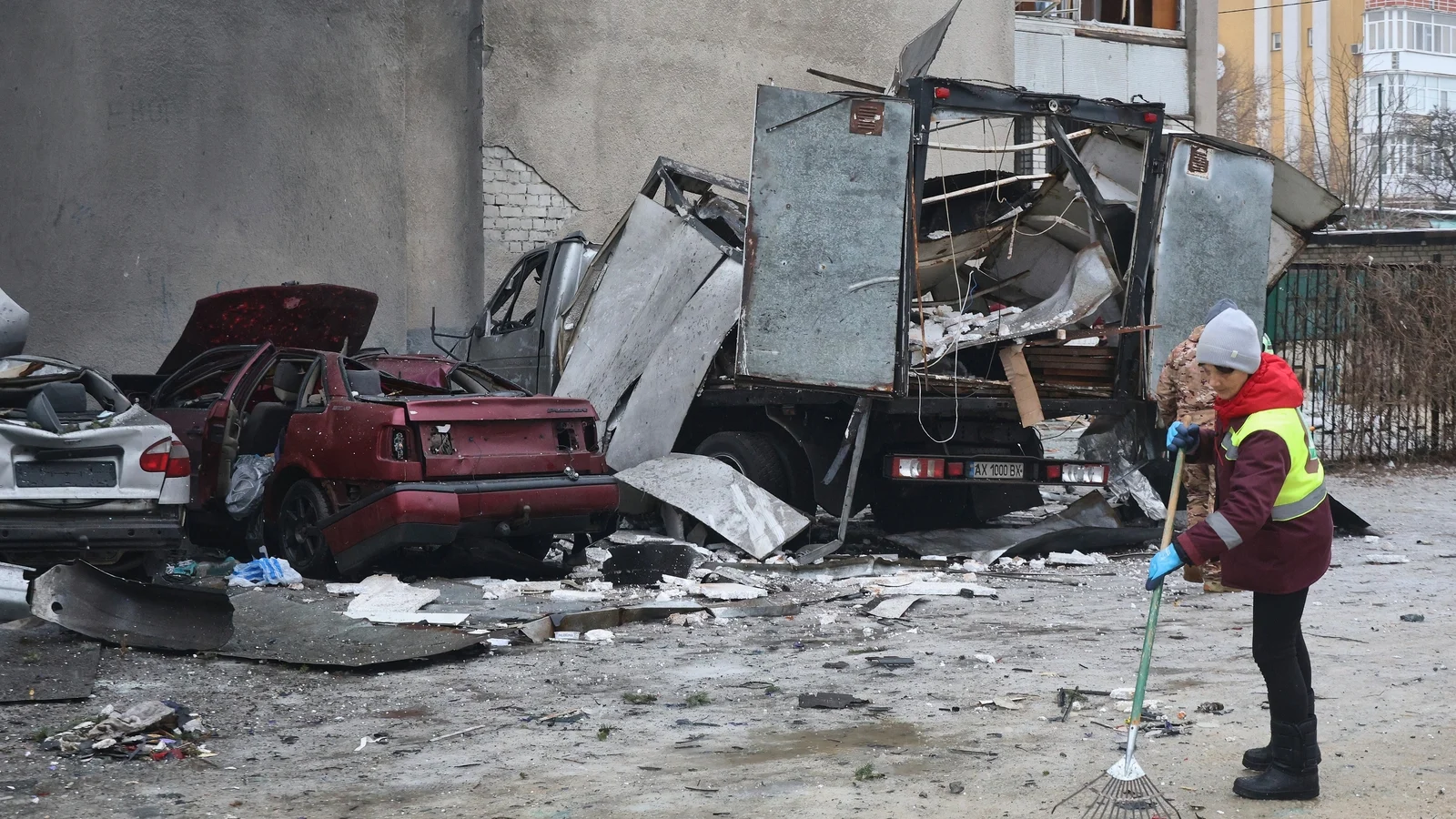
There is a small ritual to life in Kharkiv that feels almost defiant: municipal workers, bundled against the wind, hunched over scrapers and brooms as if performing a gentle, daily exorcism of war.
On a cold Friday, coming up from an underground classroom that doubles as a sanctuary for children during air raids, I watched them chip ice from pavements and hose slush from the curb. Above us, the city’s wide, old boulevards still remember the gilded, European Kharkiv of another century—streetlamps, elm trees, the echo of tram bells. Below, an entire network of human routines has been re-engineered around the possibility that a missile could arrive at any moment.
Between Two Frontiers: A City Shaped by History and Proximity
Kharkiv sits on an uneasy seam. From the city centre it is only about twenty kilometres as the drone flies to the Russian border. That geography has always threaded through daily life here—families who once worked on both sides of the frontier, markets that sold goods from across borders, a language and culture that did not fit neatly into a single national box.
Centuries ago Kharkiv was founded as a Cossack outpost against raids, and by the 19th century had become a multicultural, industrial city with universities, investors from Britain and Belgium, and a cosmopolitan energy that drew students and poets. Before Russia’s full-scale invasion, the city hosted roughly 230,000 university students, including tens of thousands from abroad.
But history also holds darker chapters: the Soviet era’s campaigns that hollowed out the intelligentsia, the forced demographic shifts of collectivisation, and the memory of intellectuals who once populated the city’s artistic life and were later silenced.
When Borders Turn Violent
There is a linear cruelty to the story that began on 24 February 2022. In the early hours, barrages struck military targets and columns of troops from across the border pushed toward Kharkiv’s ring road. Hopes that the city’s Russian-speaking majority would greet invaders with open arms proved tragically misplaced.
The Battle of Kharkiv unfolded as a brutal, three-month fusillade with airstrikes and street fighting that ripped into residential districts, killed hundreds of civilians and changed the city’s psychology. Today, municipal tallies and local officials describe damage on an almost industrial scale: thousands of structures damaged or destroyed, and essential services—schools, hospitals, kindergartens—among the hardest hit.
Numbers that Shape a City’s Memory
- Kharkiv population (pre-war): roughly 1.4 million
- Students before invasion: ~230,000 (including ~27,000 from abroad)
- Buildings damaged or destroyed: reported in the low thousands; municipal estimates vary
- Izium exhumations: hundreds of bodies documented in mass graves following Russian withdrawal
- Documented alleged war crimes across Ukraine: reported in the hundreds of thousands; dozens of indictments and in absentia sentences recorded
Those numbers sit like hot coals under the city’s skin. They are the facts that shape conversations at cafe tables and the priorities set in basements where investigators and volunteers still sort through the remnants of occupied towns.
Life Underground: Schools, Ballets and Basements
If Kharkiv has learned anything, it is how to move beauty into survival spaces. The National Academic Opera and Ballet Theatre—an enormous post-Soviet edifice nicknamed by locals as “the aircraft carrier”—lost much of its glass and half its staff to war and displacement. Yet the company refused to vanish.
They built a micro-stage in a basement, a space eight times smaller than the grand auditorium upstairs, and they started again. Dancers rehearse under exposed pipes and concrete beams, their tutus a stubborn flash of white against industrial grey. When the orchestra begins, the pipes rumble a little less like plumbing and more like the heartbeat of a city that refuses to stop.
“We are not simply performing to forget,” a principal ballerina told me, tying a ribbon with fingers still inked from a ticket sales ledger. “We perform because art keeps us human. That matters when everything else feels designed to take that away.”
Scrap Metal as Evidence: The Drone Cemetery
Outside the city, in a snow-chilled field, lie the bent ribs and scorched hulls of tactical drones and missiles captured or shot down during the fighting. Locals call it the “drone cemetery.” It reads like a modern archive: circuit boards, frayed wiring, fragments of serial numbers that investigators can stitch into legal narratives.
A regional investigator, elbows dusted with grime, guided me through the rows. “This is not scrap,” he said. “This is testimony.” His office—sheltered in an unmarked basement—holds stacks of case files. The team has logged tens of thousands of alleged war crimes cases, cataloguing everything from looted apartments to mass graves.
“We document, we interview, we try to tie weapons to units, to names,” he added. “Justice is not just a courtroom thing for us. It is how we rebuild trust.”
Neighbors, Identity, and a Hardening Resolve
Kharkiv’s identity—Russian-speaking but civic and Ukrainian in its orientation—has been tested and transformed. “Before, we treated our Russian neighbours like relatives,” a former schoolteacher told me. “Now the relationship is raw. But what has changed is not language alone; it’s a political and moral reorientation.”
That seismic shift in civic identity has not stripped the city of its warmth. There are still bakeries where the air smells of fresh rye, and small shops where the vendor remembers your name and your family’s wartime stories. There are also new rituals: anti-drone nets strung along roads to protect supply lines, underground classes for children, and volunteer brigades that patch windows at dusk.
What Justice Looks Like—And Why It Matters
Across the region and the country, prosecutors have collated mountains of evidence. International mechanisms are tentative and imperfect, but the point on the ground is clear for many: accountability must be more than a slogan if society is to stitch itself back together.
“If there is no justice, there is no stable peace,” said a local historian whose family archives survived in a cellar. “People need to know that crimes against civilians are not a cost of geopolitics but discrete acts that can be traced, named and punished.”
Why Kharkiv Matters to the World
What happens here is both intensely local and unmistakably global. Kharkiv is a laboratory for understanding how modern urban communities withstand the pressures of long-range bombardment, asymmetric drone warfare, and the slow violence of attrition. The city’s experiments in underground schooling, in cultural persistence, in meticulous evidence gathering—these are templates that other cities in conflict zones will watch closely.
And for ordinary people everywhere, Kharkiv asks hard questions: what do we do when the places that taught us how to be human are threatened? How do communities preserve art, memory, and dignity while the world debates geopolitics?
Walking back through the city at dusk, past patched windows and battery-powered shop signs, I passed a woman on a bench feeding breadcrumbs to a stray dog. She looked up and said, simply: “We will bake bread again in the big oven, we will dance in the big hall. But we will also make sure what happened here is not forgotten.”
In that sentence you can hear the shape of Kharkiv today—a place that insists, not just on surviving, but on being remembered for what it loved before the war and what it refuses to lose now.