Ink on Fingers, Silence in the Streets: Myanmar’s Election That Felt Like a Postcard From a Country at War
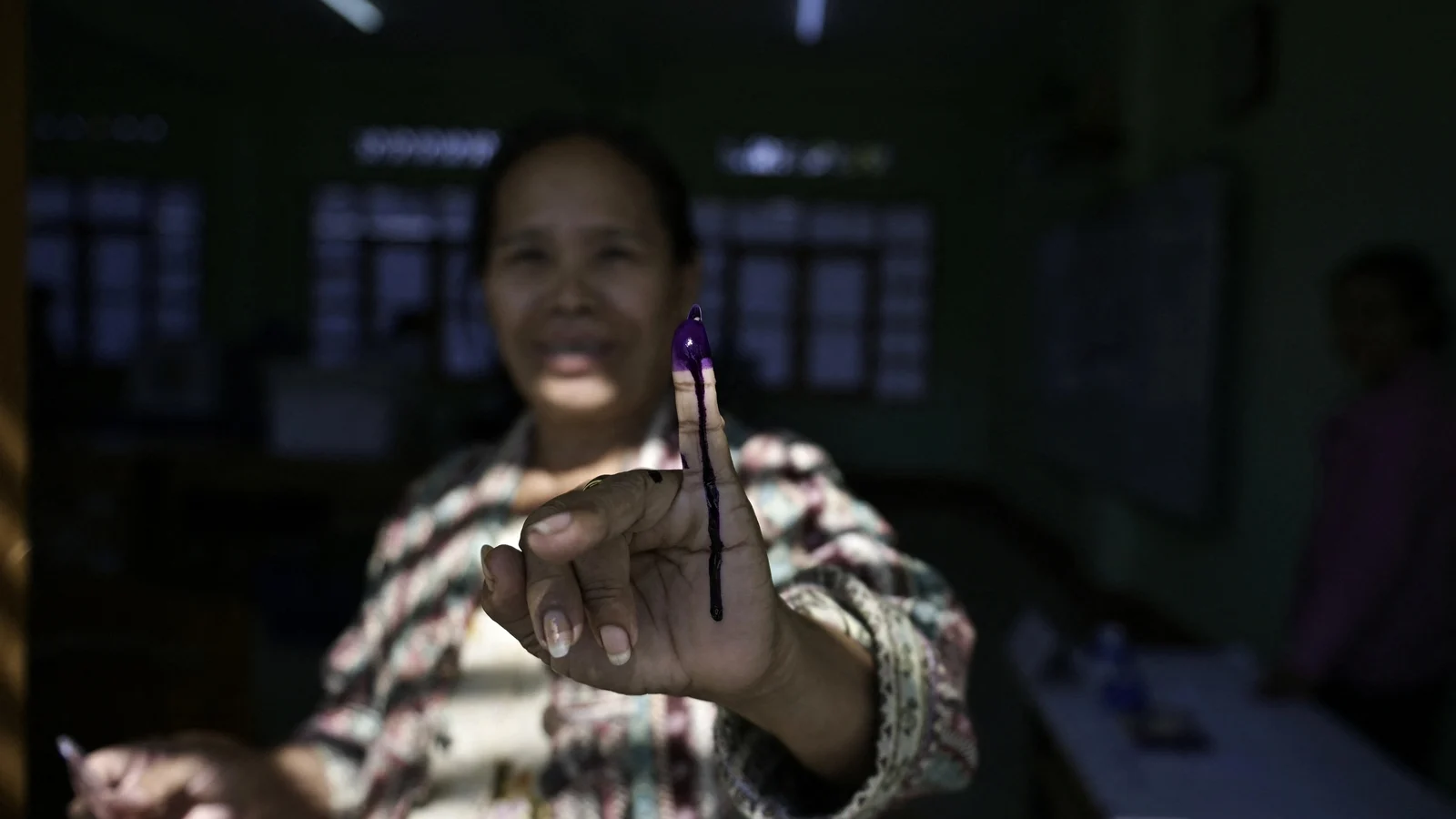
When the polling stations opened, the ritual was familiar: the dip of an index finger into indelible ink, the soft shuffle toward a cardboard booth, the hushed murmur of names crossing the ballot. But the scene felt hollow in places that once overflowed. In Yangon’s quieter neighborhoods, in Mandalay’s wide avenues, and in the government-built capital of Naypyitaw, people moved past polling booths as if skimming the surface of a story they no longer trusted.
For many, this was the first national vote since a military seizure of power in early 2021, and it arrived in three slow beats — a first phase followed by voting scheduled for 11 and 25 January in a process the junta framed as the return to normalcy. Yet normality is a word that sits uncomfortably beside checkpoints, regular clashes in the hills, and a dissolved opposition—not to mention a Nobel laureate who remains behind bars.
Under the Guarded Lamps: How Voting Looked on the Ground
Security was everywhere. Armored vehicles idled on side streets; platoons walked past temples where monks once canvassed in quiet. In Naypyitaw a man in plain clothes—junta chief Min Aung Hlaing—appeared on state television beaming as he showed off his inked finger, a small, defiant signal of civic participation. Reporters pressed him about presidential ambitions; he smiled and deflected, saying only that the parliament will decide the next head of state.
But across the country, voters simply stayed home. Ten residents Reuters spoke to reported turnout that was markedly lower than the 70% participation seen in both the 2015 and 2020 general elections, figures remembered almost reverentially by those who had campaigned door-to-door for years. In many townships the queues were thin. In others—particularly those affected by active resistance—the streets remained entirely empty after calls from armed groups to boycott the polls.
What the Numbers Hide
The junta has not set a legal minimum turnout for the vote, a quirk that allows it to claim legitimacy regardless of how thin crowds may be. Meanwhile, the landscape of candidates has shifted dramatically. Parties linked to the military, most prominently the Union Solidarity and Development Party (USDP), were the loudest voices on the campaign trail—old machinery dusted off for a new march. Observers counted the USDP among the most visible, noting it had placed a significant share of candidates on ballots where opposition parties are absent or disbanded. Local analysts estimate the USDP accounted for roughly one-fifth of candidates in this cycle, though seats still extend across complex and often contested terrain.
Voices From the Lines: Citizens, Analysts and the Unheard
“I came to see what the fuss was about,” said Thiri, a tea-shop owner near Yangon’s western district, her hands wrapped around a steaming cup. “But I don’t believe this is for us. It feels like a show.” Her words echoed those of a college student in Mandalay who told me, “We have elections, yes. But does anyone outside these walls believe in them?”
Others spoke through resignation rather than outrage. “I voted because my mother asked me to,” said an elderly man in Mawlamyine, his voice small amid the muffled thud of military vehicles. “She remembers better days.” In Hakha, capital of Chin State, the story was different: residents described deserted streets after local resistance groups urged families to stay indoors, saying the choice to abstain was also a form of protest.
Experts were blunt. “This election is engineered to entrench military power under a civilian veneer,” said Lalita Hanwong, a lecturer and Myanmar specialist at Kasetsart University in Thailand. “Institutions that once allowed political competition have been hollowed out.” Tom Andrews, the UN’s special rapporteur on human rights in Myanmar, called the vote “not a pathway out of the country’s crisis” and urged the international community to reject the exercise.
The Political Terrain: A Dissolved Opposition and a House of Mirrors
Since the 2020 landslide victory for Aung San Suu Kyi’s National League for Democracy (NLD), Myanmar’s political terrain has shifted violently. The NLD was dismantled by the junta; its leader remains detained and charged with multiple offenses. In the absence of a major pro-democracy contender allowed to campaign freely, parties with military ties have reasserted themselves, drawing lines between past rule and the current architecture of power.
“They want the trappings of democracy without the messy business of dissent,” said a Yangon-based civil society activist, who requested anonymity for fear of reprisal. “You get ballots and booths, but not competition.” This set-up raises an uncomfortable question for any external observer: when electoral form exists without genuine choice, can we call it a democracy at all?
Local Colors and Quiet Rebellions
Myanmar’s streets tell the truth in small details. Around many polling stations, vendors still sold laphet—fermented tea leaves—wrapped in banana leaves, and schoolchildren in crisp uniforms glanced at soldiers with curiosity rather than fear. In rural markets, the familiar rhythm of bargaining persisted even as the country’s political heartbeat faltered.
But other places suggested deeper ruptures. Refugee buses lined up near border towns; families whispered about relatives who had fled. In towns where the junta never fully asserts control, networks of resistance continue to operate, offering basic services and local governance in the vacuum created by the coup.
What This Means Beyond Myanmar
Myanmar’s election is more than a national event. It is a case study in how modern authoritarians co-opt democratic forms to gain a semblance of legitimacy. It is a warning for a world where constitutional processes can be hollowed and repurposed. And it is a test of international resolve: whether foreign governments and institutions will recognize governments that emerge through constrained, coerced, or staged contests.
As you read this, consider the choices nations make in the face of repression. When the ink on a finger becomes the symbol of civic life, what does it mean when so many hands remain unstained?
Looking Ahead
The junta has promised to announce preliminary results after the first phase and to continue with subsequent rounds covering 265 of 330 townships—some of which it does not fully control. For many inside Myanmar and for observers abroad, that is not the end of a story but another chapter in a struggle that has already cost lives, livelihoods, and trust in institutions.
Will the world engage with the government that emerges? Will locals find ways to rebuild democratic life amid conflict? Those answers are not in the ink on a finger but in the choices people—inside Myanmar and outside—make in response. For now, the polling booths stand like empty sets at the end of a play, lights still on while the audience files out, uncertain if the show can or should go on.