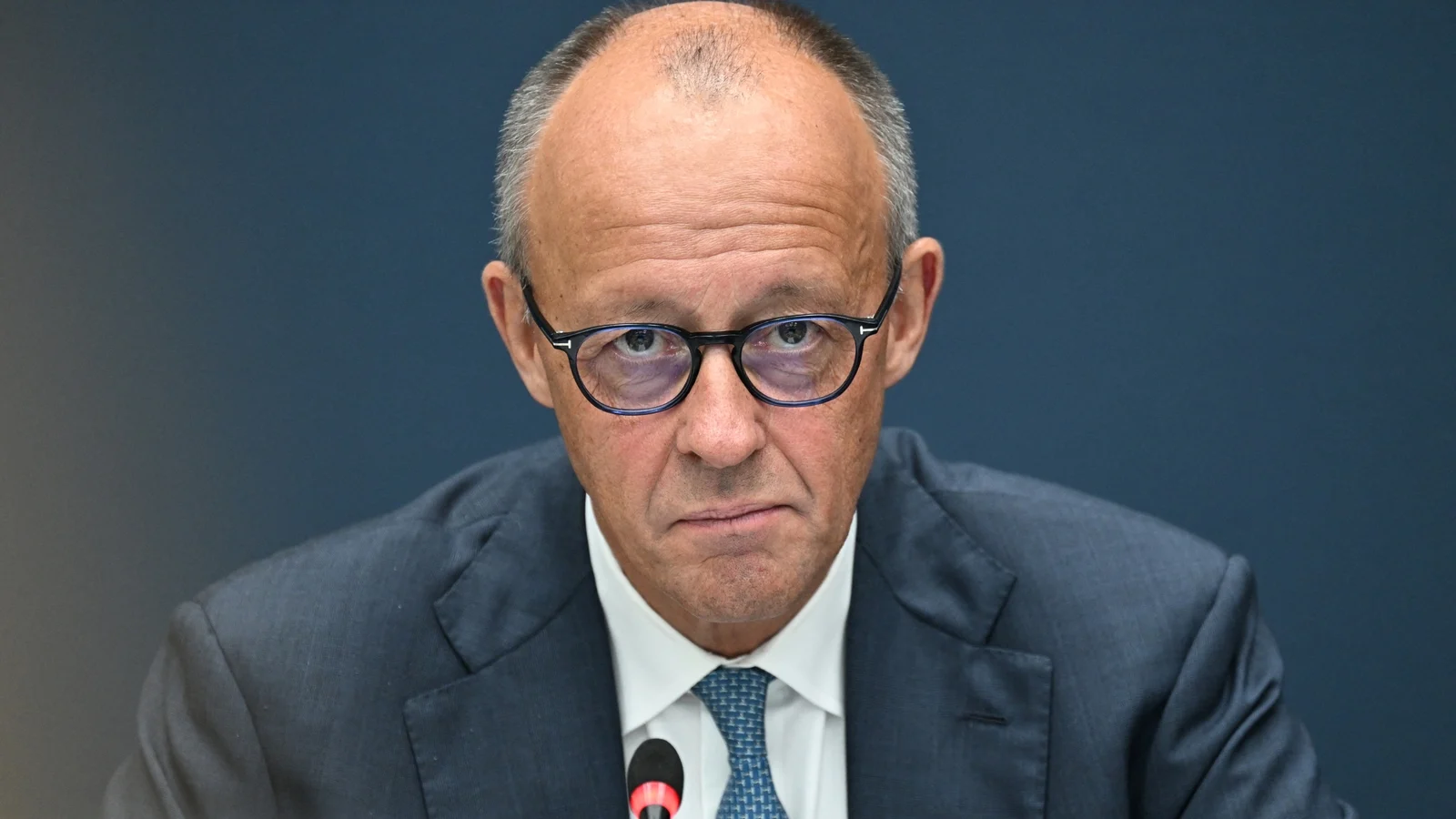
Germany’s political centre has been jolted in Saxony-Anhalt, where the far-right Alternative for Germany (AfD) vaulted into first place in state elections — a result Chancellor Friedrich Merz said had rattled his Christian Democrats “to its very foundations,” even as he flatly rejected any cooperation with the party.
The AfD is now urging politicians from Mr Merz’s conservative camp to back its push to govern the eastern state, a scenario that would mark the first time a far-right party has taken power at state level in post-war Germany.
With nearly 44% of the vote, the anti-immigrant, pro-Russia AfD delivered a striking verdict on Mr Merz’s ruling coalition, exposing its deep unpopularity and sparking concern among Germany’s neighbours, including France and Poland, and beyond.
Yet the party — which has pledged to deport immigrants, end support for Ukraine and re-establish ties with Moscow — did not secure an outright majority in the state legislature. It won 39 of the 83 seats, leaving it short of control and looking to entice individual conservative lawmakers.
The outcome threatens to put renewed strain on the longstanding “firewall,” the pledge by Germany’s mainstream parties — including Mr Merz’s Christian Democrats (CDU) — to refuse collaboration with the AfD.
The AfD argues the approach is undemocratic.
“This shakes our party to its very foundations,” Mr Merz said, according to the Bild newspaper. “We are all deeply shocked,” he added later at a press conference, calling it his party’s worst result in decades.
Mr Merz struck a chastened tone and promised a stronger connection with voters, but he brushed aside suggestions he might step down, saying he would broadly continue with his government’s reform programme.
With his own approval ratings at record lows, Mr Merz faces further state elections in the coming weeks and into next year. He is banking on a mix of reforms and higher spending in selected areas to help revive growth in Europe’s largest economy.
Alice Weidel, Ulrich Siegmund and Tino Chrupalla celebrate a first exit poll win to AfD
In remarks that hinted the AfD’s advance would be welcomed in Moscow, Mr Merz cast the moment as a struggle for the survival of Western values.
He also stood by a decision taken last year to borrow hundreds of billions of euros for defence, arguing the cohesion of the NATO alliance was on the line.
“Giving up is not an option for me,” he said.
AfD national co-leader Tino Chrupalla, meanwhile, called on CDU lawmakers to help deliver what he described as a “centre-right conservative majority” in Saxony-Anhalt.
“Partisan games really ought to be a thing of the past,” he told German radio, pointing to the firewall policy.
BSW party a potential partner
The only German party to signal a willingness to cooperate with the AfD is the populist left-wing BSW.
BSW shares the AfD’s hostility to mass immigration — which it says erodes local workers’ rights — and likewise supports ending Germany’s backing for Ukraine and renewing ties with Moscow.
Both parties describe sanctions on Russia as needless self-harm, arguing they cut German companies off from Russia’s vast, cheap energy resources that helped Germany’s export-driven economy prosper for decades.
“Peace in Europe” ranked as the second biggest factor shaping voting choices in Saxony-Anhalt, according to figures from the ARD broadcaster.
We need your consent to load this rte-player contentWe use rte-player to manage extra content that can set cookies on your device and collect data about your activity. Please review their details and accept them to load the content.Manage Preferences
Even so, Mr Merz insisted the election was not a reason to reverse course.
“I will not deviate by even a millimetre from my fundamental conviction that we must defend our freedom, especially now, against Russia,” he said.
“If we stop supporting Ukraine, the situation will not improve by tomorrow; it will only get worse. The Russian leadership aims to destabilize the system of values underpinning what we once called ‘the West’, a system of values that is non-negotiable.”
Throughout the campaign, the AfD channelled growing frustration with established parties, portraying them as weary and detached. In their place, it pitched hardline policies, promises of cleaner and safer streets, and a revival of national pride.
For some voters, the party’s message also intersected with nostalgia for aspects of life in the former communist-run East Germany.
‘Very, very worrying signal’
Voter breakdowns showed the AfD drew especially strong backing from men: 50% voted for the party, compared with 39% of women. Its supporters also tended to be less economically secure and less educated.
Saxony-Anhalt is a relatively small state and among the poorest in Germany’s former communist east. Still, Alice Weidel, the AfD’s other national co-leader, described Sunday’s result as a milestone and said the party was targeting at least 40% in the next national election, scheduled for 2029.
The AfD has been designated right-wing extremist by the local office of Germany’s domestic intelligence service. The party rejects claims of extremism, calling them scaremongering and an affront to its millions of supporters.
As far-right figures across Europe celebrated the outcome as a mandate for change — and US billionaire Elon Musk voiced support for the AfD from the sidelines — French Finance Minister Roland Lescure warned on RTL radio that it “sends out a very, very worrying signal”.
“This shows that we face a major challenge in the face of a populist wave which is spreading around the world today and which we must resist,” said Mr Lescure, noting that his own country faces national elections next year that could see far-right veteran Marine Le Pen become president of France.