When Flame Meets Steel: Inside North Korea’s Push for Faster, Deadlier Missiles
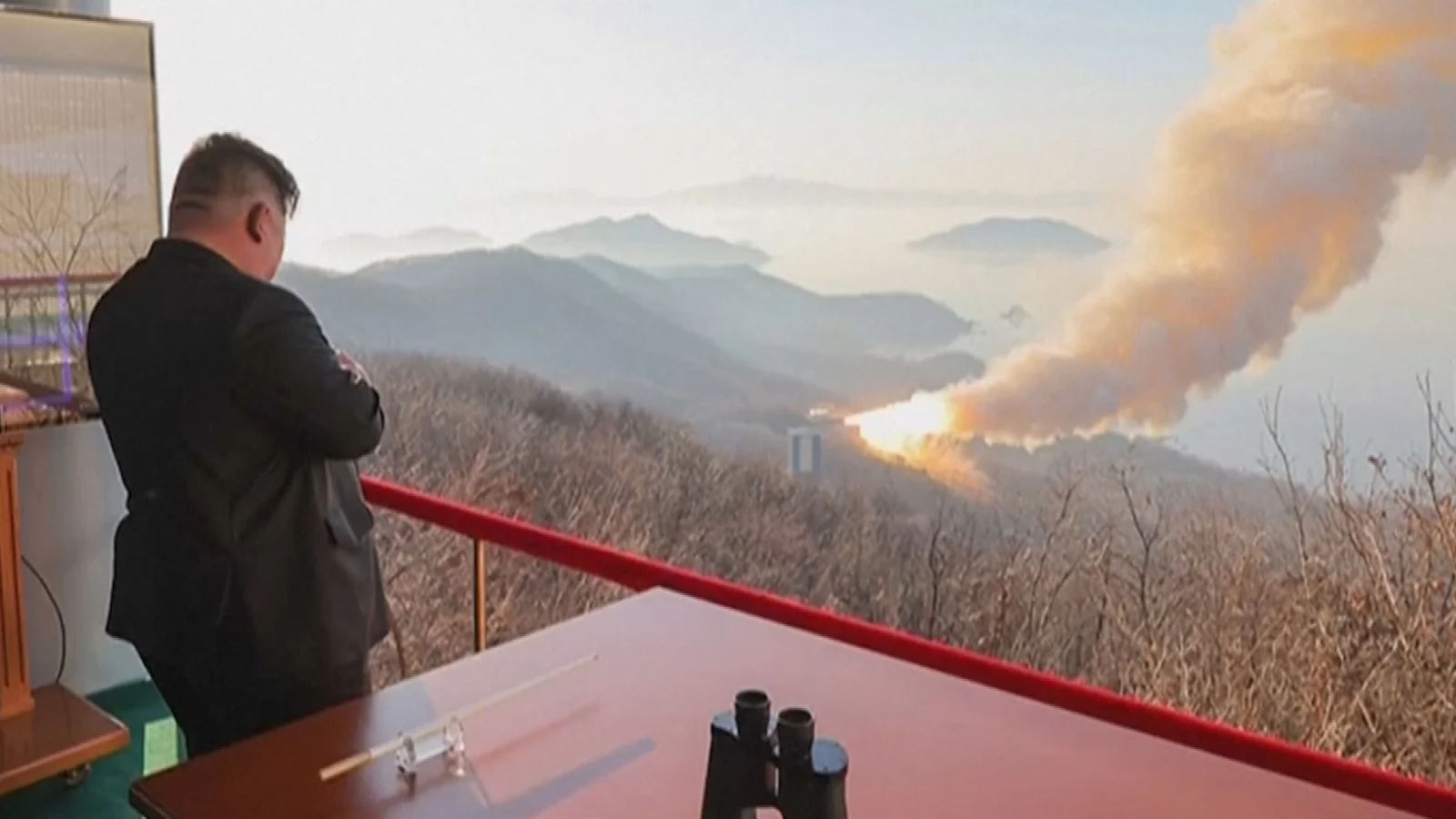
There is that strange, cinematic photograph: orange fire licking the night, a silhouette of men in dark coats crowded around an enormous cylinder of metal, and at the center, a single figure — Kim Jong-un — peering closely as if inspecting not just steel, but the promise of power itself.
State media released those images this week after North Korea announced the ground test of a high-thrust solid-fuel rocket engine. The technical detail — 2,500 kilonewtons of thrust, KCNA reported — is cold science on the page, but the implications ripple across capitals and markets and through the minds of people from Seoul to San Francisco. This was not merely a technological exercise. It was theater, deterrence, and a message rolled into one.
Why solid fuel matters
To put it plainly: solid-fuel rockets let you launch fast. Whereas liquid-fuel missiles require hours or days of fueling and are vulnerable during that window, solid motors sit ready like a coiled spring. For any state looking to increase the survivability and responsiveness of its strategic forces, the technology is a siren call.
- Speed: Solid-fuel missiles can be readied and launched in minutes rather than hours.
- Mobility: Their simpler fueling needs allow deployment from mobile launchers and submarines more easily.
- Payload: Higher thrust can carry heavier or multiple warheads, complicating missile-defence calculations.
“If you want to be able to threaten a target around the globe without a long window of vulnerability, you go solid,” says Hong Min, a missile analyst at the Korea Institute for National Unification. “The jump from about 2,000 kilonewtons to 2,500 is meaningful — it points to a strategy of range and overwhelm.”
Not an isolated act
This test comes on the heels of a speech Mr. Kim gave at the Supreme People’s Assembly, where he vowed to “irreversibly cement” his country’s status as a nuclear power and blamed the United States for “state terrorism and aggression” — a not-so-subtle reference to conflicts elsewhere in the world. The dictator’s rhetoric and the engine’s roar are two halves of the same coin: a narrative of survival, prestige, and leverage.
It’s also consistent with a longer march of technological ambition. North Korean media framed the test as part of a new five-year plan to modernize strategic forces, and state photographs showed Mr. Kim inspecting components made of composite carbon-fibre — a material that signals a move away from clunkier, heavier designs toward lighter, more efficient engineering.
“This isn’t a cosmetic upgrade,” says Dr. Meredith Lane, an arms-control specialist at a Washington think tank. “Composite materials, higher specific impulse, mobile launch capability — put together, these increase both the strategic and tactical utility of an arsenal.”
Images, performance and political theatre
KCNA released a pair of images that felt staged for maximum effect: the engine’s guts under inspection, and a night shot of flames erupting from a ground-mounted test stand. The agency did not say when or where the test took place. That cloak-and-dagger element is part of the calculus; ambiguity can be leverage.
For analysts, the numbers matter as much as the optics. The regime’s own report compared the engine favorably to one tested in September, when state media claimed a maximum thrust of 1,971 kilonewtons. To go from roughly 2,000 to 2,500 kilonewtons is to increase lift capability substantially, potentially enabling missiles with intercontinental reach to carry heavier or multiple warheads.
“This development underscores Pyongyang’s resolve to possess missiles capable of hitting targets around the globe,” Hong Min told AFP. “It also suggests an intention to overwhelm missile-defense systems rather than simply evade them.”
Voices from the region
In Seoul, the mood is a blend of frustration and grim calculation. Park Ji-won, a retired South Korean naval officer, tracks North Korean launches and missile parades the way meteorologists track storms. “These tests are a reminder that the balance on the peninsula is always shifting,” she said. “We have to prepare for new vectors of threat — from ranges to missile types to the very speed of launch.”
Across the border and beyond, diplomats and strategists are watching for answers to two questions: Can North Korea operationalize these solid-fuel engines on mobile or submarine platforms? And will they pair them with multiple warheads or decoys to defeat missile defenses?
“Even if the technology is imperfect, the strategic calculus is changed when a nation is faster to launch and more difficult to preempt,” said David Morales, a former U.S. State Department official who worked on Northeast Asian arms control. “For the United States and its allies, it forces a reassessment of deterrence, missile defense, and diplomatic options.”
Local color: a country of spectacle and scarcity
It’s important to humanize what often reads only as geopolitics. In Pyongyang, rocket tests are both technical milestones and public theater. Parade practice, carefully curated photos, and the ritual of official inspection are part of a domestic narrative that frames such advances as the fruits of sacrifice and self-reliance.
At the same time, the rest of North Korea lives under chronic shortages: the same regime that invests resources into strategic programs presides over periodic food scarcities and limited trade. “People here are used to hierarchies of priority,” explains Ji Hyeon, a scholar of North Korean society. “Military prestige and technological milestones are amplified in state media because they serve the domestic need for legitimacy.”
When a test is presented as the country entering “a significant phase of change” — as KCNA put it — that change is as much about internal narratives as it is about external reach.
Questions for the reader
What does the world owe to citizens living under regimes that prioritize strategic might over basic welfare? How should democracies balance deterrence with diplomacy when faced with a state that sees nuclearization as its insurance policy?
These are not abstract queries. They lie at the heart of policy debates in Washington, Seoul, Tokyo, and Beijing — and they shape how families in the region plan for worst-case scenarios.
Broader currents: proliferation, deterrence, and the new age of missiles
The test is a microcosm of larger global trends. Technologies that reduce launch times and increase payload flexibility are becoming more accessible. This makes missile defense tougher and calculus more precarious. The past decade has seen North Korea iterate rapidly on its missile designs, and while public data on reliability and accuracy is often scarce, the trajectory is worrying to many analysts.
Consider a few hard points:
- ICBM ranges: Intercontinental ballistic missiles typically have ranges exceeding 5,500 kilometers; true global reach requires 10,000+ kilometers depending on the flight profile.
- Solid vs. liquid: Solid fuels shorten launch times dramatically, enabling surprise or responsive launches.
- MIRV potential: Multiple independently targetable reentry vehicles can overwhelm missile defenses, though fitting MIRVs reliably is an advanced engineering challenge.
Each technological leap nudges the international system toward either tighter controls — arms agreements, inspections, sanctions — or toward an arms spiral in which neighbours acquire countermeasures and offensive capabilities in response.
Final frame: a world watching, waiting
The photograph of Mr. Kim at the engine test is, in one frame, power condensed: the leader, the machine, the fire. Around it circles a global conversation about risk, arms control, and survival in an age of fast rockets and fraught diplomacy.
For citizens in the region and policymakers around the world, the imperative is clear: understand the technical details, anticipate strategic responses, and keep diplomatic avenues open. If lessons from history teach us anything, it’s that technical brilliance without political imagination can be a dangerous cocktail.
So I return the question to you, the reader: how do we live sensibly in a world where the next test could change the balance of fear and safety? The answer is difficult, urgent, and collective — and it will require more than engines and spectacle to resolve.