Chicago’s Gospel and a Gathering Storm: Remembering Jesse Jackson
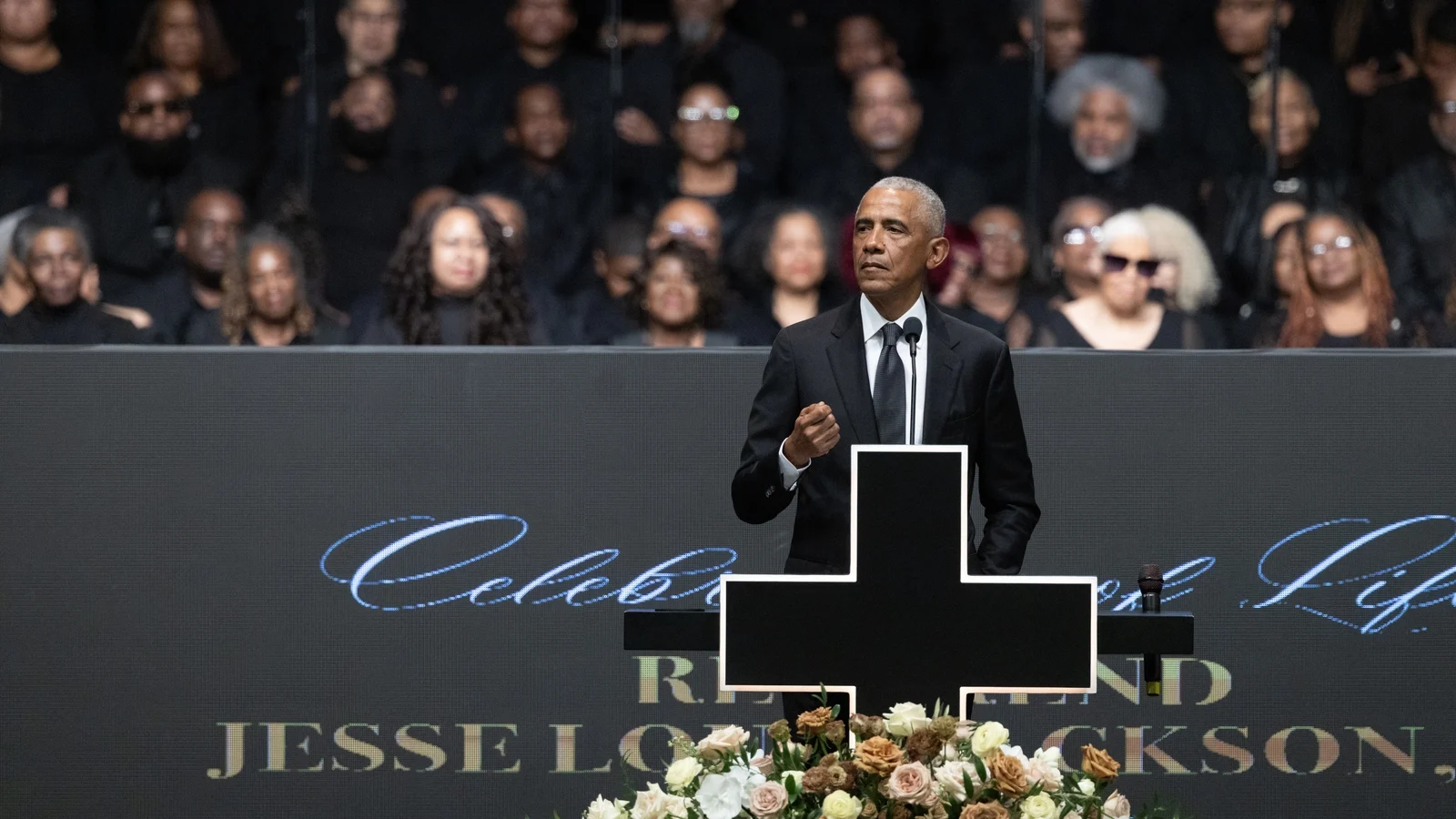
The air outside the House of Hope felt like a church revival and a town hall rolled into one. People wrapped in winter coats clutched programs, children swung between parents’ legs, and a line of mourners looped around the 10,000-seat arena on Chicago’s South Side. Inside, a choir’s voice rose and fell like the tide—low, aching hymns that made the rafters hum. It was a memorial, but it was also a summons.
Jesse Jackson’s passing last month brought together a cross-section of America at once intimate and impossible: former presidents, civil rights veterans, neighborhood activists, and strangers who’d been shaped by a life spent fighting to widen the circle of belonging. Barack Obama, Joe Biden, Bill Clinton and Kamala Harris sat in a row up front. Their faces, familiar from countless campaign ads and late-night shows, looked smaller in the cavern of grief and song. Not all invited were present—President Donald Trump was absent, his office later explaining scheduling conflicts—but the political contrast was as clear as the choir’s cadence.
A pulsing tribute, with a pulse-point on democracy
Speakers at the service did not simply eulogise. They issued a call. They held up Jackson’s life as a mirror and asked the crowd to look, and then to act. For decades, Jackson had hammered at barriers—segregation, voter suppression, economic exclusion—refusing to let promises of American equality remain rhetorical. The memorial became a ledger of unfinished business: voting rights under pressure, civic institutions strained, the nation’s moral vocabulary tested.
An elderly woman who traveled from a nearby neighborhood said to me, “He taught me that hope is not a feeling; it’s a responsibility.” Behind her, a group of young organizers passed out leaflets about community voter registration drives. “We’re not here for nostalgia,” one of them said. “We’re here to make sure his work isn’t a eulogy.”
Voices and visions: what the speakers told the crowd
Former presidents and civil rights leaders took turns sketching Jackson’s long arc—from preacher and agitator to political candidate and coalition builder. They framed his campaigns in the 1980s not as quixotic bids for power but as clarion calls: to expand the Democratic tent, to name those who had long been ignored, and to mobilise communities often treated as afterthoughts.
“He demanded we live up to our promises,” said one speaker. “Not just the lines in our founding documents but the daily, difficult work of making them real.”
There were also sharper, contemporary notes. Speakers warned that democracy is not a static inheritance but an ongoing project, vulnerable to erosion. The language they used—loss of faith in institutions, attacks on science, erosion of norms—felt less like partisan rhetoric and more like the diagnosis of citizens watching the scaffolding of trust creak under stress.
A policy scholar I spoke to outside the venue tied the moment to a broader pattern: “Across democracies in the last decade we’ve seen backsliding—weakening institutions, limits on free press, and laws that make it harder for people to participate in elections. What Jackson fought against was precisely this atomisation: policies that told some people they didn’t count.”
Local color, national echoes
The House of Hope itself offered its own litany of details. The smell of coffee and fried dough in the lobby. Choir robes like stained-glass windows. Men in suits shaking hands with pastors wearing clerical collars and activists in hoodies. A line of veterans from grassroots organisations exchanged stories of canvassing in neighborhoods Jackson had long championed.
“This man helped me register my first voters,” said Marcus, a 45-year-old community organizer whose family has lived on the South Side for three generations. “He told people they had a right to be heard. That’s why we keep showing up.”
It was not merely a Black church ritual. The audience was mixed—White, Latino, Asian—and you could feel the work that Jackson had done to stitch together disparate constituencies into a shared political force. His Rainbow Coalition, a concept and a living practice, sought to stitch together farm workers, urban laborers, Black and Brown communities, and progressive whites into a single rising tide.
Lines of contest: policy, memory, monuments
Outside the reverent hush, politics kept moving. Recent years have seen heated debates over how history is taught, what monuments remain in public spaces, and how diversity initiatives are framed. Some speakers at the memorial took those controversies head-on, warning that rolling back diversification programs, sanitising curricula about slavery, or restoring symbols of the Confederacy were not harmless acts of nostalgia but active steps that narrow public memory and civic inclusion.
Others pointed to an everyday reality: when people feel excluded by state policy—when registration barriers rise or educational materials are censored—participation falters. That decline is not abstract; it shows up in who votes, which voices are heard, and which communities receive resources.
A local teacher who had brought a dozen students said, “If you take away stories, you take away possibility. Kids need to see themselves in history, otherwise they can’t imagine changing it.”
Moving forward: what would Jesse Jackson want?
The memorial was full of challenges. Not only to honor Jackson’s memory but to match it with action. Bill Clinton, stepping to the podium, invited the crowd to ask themselves what work could match the scale of Jackson’s achievements. The Rev. Al Sharpton urged attendees to take Jackson’s “fire” out into the streets, the courts, and classrooms—not to fossilize him into a shrine but to animate his ethos.
“We can’t leave here only feeling inspired,” said a young lawyer helping to set up post-service community workshops. “We need to map the steps—register here, volunteer there, call legislators, build local power. Jackson’s strategy was always practical: get people into the room and then into the ballot box.”
Questions for the reader
What does it mean to preserve a legacy in politics? Is remembrance enough, or does memory demand action? When institutions wobble, who steadies them—and how?
As you read this from wherever you are in the world, consider how communities maintain the practice of democracy. Are you part of a civic circle? A neighbourhood association? A classroom? A phone tree? Jesse Jackson believed politics could be a moral act—a way to widen the circle so more lives counted. Today, that belief is both a comfort and a task.
In Chicago, the choir finished and the lights came up, but the conversation carried on in the lobbies, on stoops, and in living rooms. People left with pamphlets, with plans, with a lingering chord of gospel in their chests. A woman folding her program into a pocket said simply, “He gave us a map. Now we have to walk it.” Who will walk with you?