The Moment a Political Joke Became a Mirror: What a Viral Clip Told Us About American Discourse
It was over in a blink: a single second slipped into a minute-long video, but that second did a great deal of heavy-lifting. The faces of Barack and Michelle Obama, two of the most internationally recognized figures of our era — the first Black president and first lady in American history — were briefly pasted onto the bodies of apes in a clip shared on former president Donald Trump’s social platform in early February.
The image lasted a heartbeat, but the conversation it forced was long. Across living rooms and newsrooms, on cable and in grocery-store lines, Americans circled the incident like people peering at the aftermath of a small but revealing storm. What felt new was not just the ugliness of the caricature; it was the casualness with which it was deployed, and the speed at which an entire political ecosystem shrugged, explained, or excused it.
How it unfolded
The clip appeared on Truth Social — a platform Mr. Trump launched after leaving the White House — and promoted a familiar and now-debunked chorus of claims about the 2020 election. Near the end of the minute-long montage, for roughly one second, the Obamas’ faces were superimposed on primate bodies. The post drew immediate condemnation from many quarters. But the White House response was a short, confused choreography: initial dismissal as “fake outrage,” then an acknowledgement that a staffer had posted the image in error, followed by removal of the clip.
For his part, Mr. Trump told reporters he “stood by the thrust” of the claims in the video but insisted he had not seen the offensive clip at the end. The distinction — “I support the message, but not the one-second image” — felt to many like an evaporating responsibility, a shrug from someone with the microphone.
An elder statesman’s rebuke
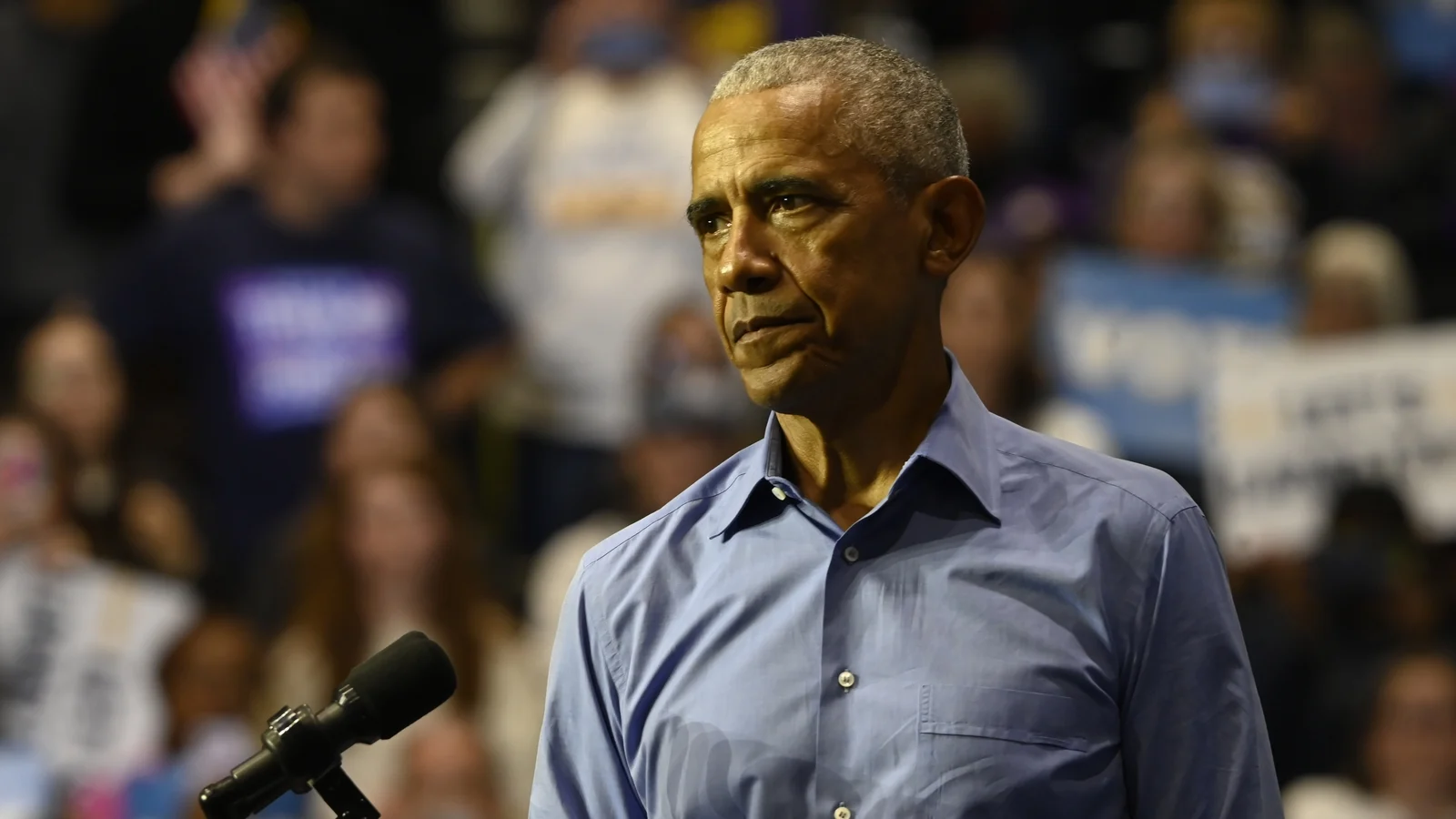
Barack Obama — who has largely remained above the fray since leaving the presidency — finally spoke about the episode in a conversation with podcaster Brian Tyler Cohen. He did not mince the emotional content. “The discourse has devolved into a level of cruelty that we haven’t seen before,” he said, a line that landed with the gravity of someone who watched his country and its institutions from inside the room.
He warned that the spectacle — the “clown show,” as he called on-air theatrics and social-media baiting — corrodes norms that once kept public debate tethered to a baseline of dignity and respect for office. “There doesn’t seem to be any shame,” he added, “among people who used to feel like you had to have some sense of propriety.”
Why this image mattered
This was not just politics; it tapped into a long, ugly seam of American history. Imagery that equates Black people with animals has been used for centuries to justify exclusion, ridicule, and violence. It’s a form of dehumanization whose echoes are still felt in schools and communities and in the criminal-justice statistics that shape daily life.
“When public figures deploy that kind of language or images, the effect ripples,” said Dr. Asha Patel, a scholar of race and media. “It doesn’t simply insult individuals — it normalizes contempt and makes it easier for discriminatory actions to be excused.”
On the street in Chicago, where Mr. Obama’s first political reawakening took root, a barista named Marcus shrugged and said, “I get politics gets dirty. But this? It’s lazy and mean. It’s trying to make people laugh at the expense of something that’s still hurting.” In small-town Davenport, Iowa, a retired teacher named Liza Hernandez told me she felt embarrassed for the nation. “We used to talk about restoring civility,” she said. “This feels like we’re practicing to be mean.”
Politics, optics, and the midterm question
Beyond the moral argument lies the practical one. Obama signaled the potential political fallout: behavior like this could boomerang on the party associated with it. “Ultimately, the answer is going to come from the American people,” he said, suggesting that voters will weigh not just policy but tone.
Political analysts agree that tone can shift turnout and persuasion. “We’re not talking about a minor gaffe,” said Jonah Weiss, a veteran pollster. “For swing voters and independents who already find today’s politics exhausting, repeated spectacles of disrespect may be enough to motivate them in one direction or another.”
And the marketplace of media attention is unforgiving. Images that are intentionally provocative are precisely the content that travels fastest online — whether through shares, outraged headlines, or late-night monologues. Platforms earn engagement when they allow incendiary content to persist. The question for regulators and the public becomes: where do we draw the line between free expression and a media ecosystem optimized for outrage?
Voices from the heartland and the coasts
It’s illuminating to listen to the variety of everyday reactions. A pastor in Atlanta, Rev. Joyce Carter, said the image “resonates with the memory of our grandparents who were ridiculed in ways that weren’t just online.”
By contrast, a small-business owner in Florida, Tom Alvarez, told me he found the media’s interest overblown. “Politicians have always mocked each other,” he said. “But what I want is someone who will run the town, not someone who can’t take the heat.”
Both voices speak to the larger divide: some see a moral line crossed, others a theater of politics in which anything goes. The tension is the country’s current weather.
What this moment tells us about our social media era
There are practical takeaways. Social platforms that propel political leaders’ messages unfiltered become a kind of public square — messy, immediate, and often cruel. Moderation policies are inconsistent. Users weaponize outrage. And powerful voices sometimes dodge accountability by blaming “staff errors” or claiming ignorance.
Experts say that rebuilding norms will require more than pleas from former presidents. It will require a mixture of platform responsibility, clearer political standards, and citizen scrutiny. “We need institutions that aren’t just reactive,” Dr. Patel said. “We need proactive systems that can keep discourse from funding contempt.”
Actionable steps readers can consider
- Call out dehumanizing language when you see it, and explain why it’s harmful.
- Support media literacy programs that help people spot manipulative imagery and false narratives.
- Demand clearer enforcement from platforms that host inflammatory political content.
Closing thoughts: What kind of nation do we want to be?
This episode was small and large at once — a fleeting clip that shone a spotlight on a deeper erosion. It asked an old question with new urgency: how do democracies survive when public life is increasingly theatrical and unmoored from shared norms?
“I don’t know that we’re doomed,” Barack Obama said in a separate moment of reflection, returning to a more hopeful register. “What I do know is that if we’re going to repair this stuff, it’s going to take people willing to stand up for decency.”
So I ask you, reader: when the next one-second image flashes across your feed, will you scroll, retweet, or resist? What responsibility do we each bear for the atmosphere we share — online, in town halls, and at kitchen tables? The choices are daily, and the stakes, as that tiny clip reminded us, are very real.