Inside a Night of Stagecraft, History and Politics: My Take on the State of the Union
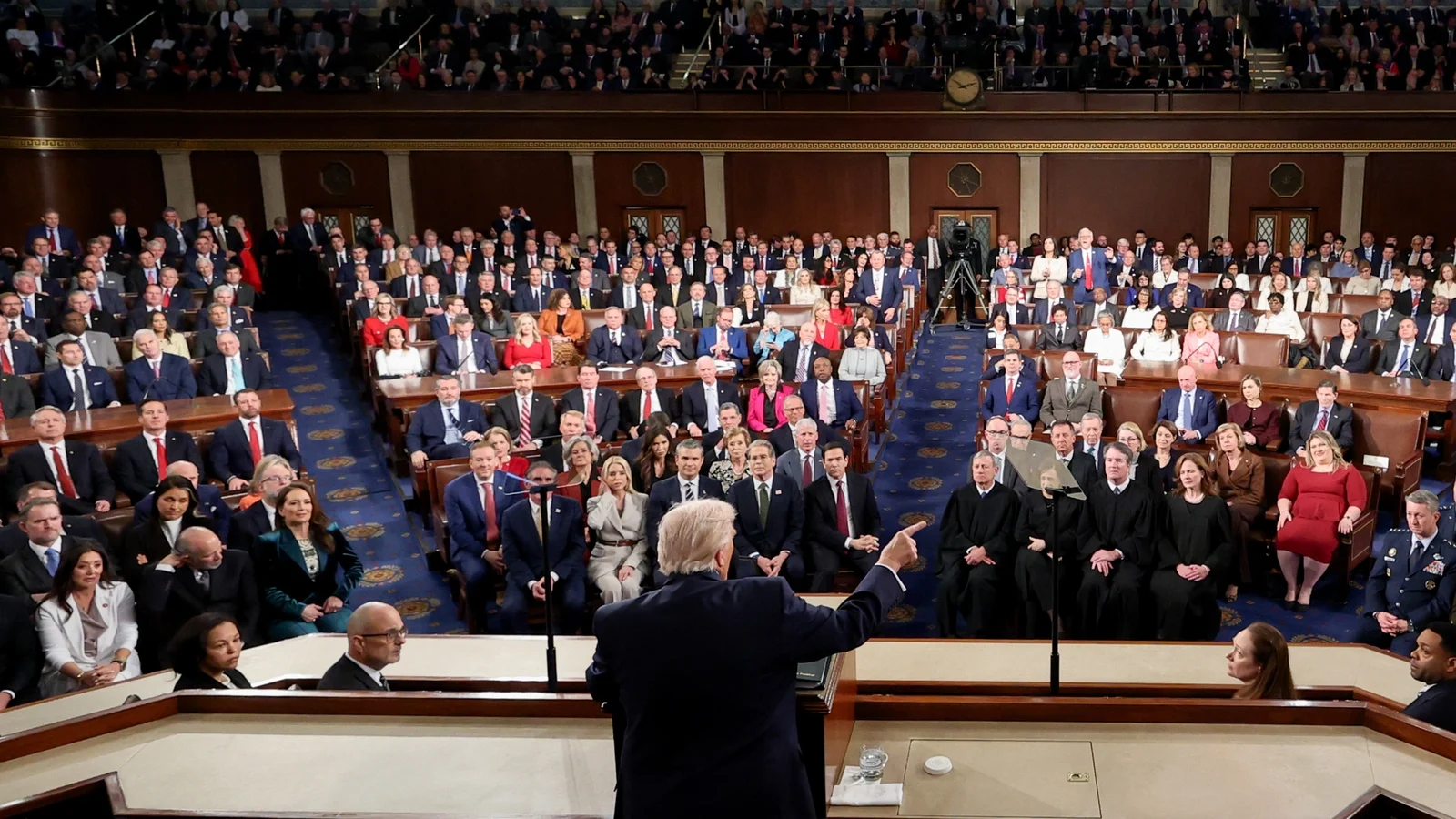
Wednesday night in Washington felt less like a constitutional ritual and more like an expertly produced television special — bright lights, orchestrated applause, and punctuated moments designed to land on camera. The Capitol chamber, packed with lawmakers, family members and a clutch of invited guests, became a theater where policy, patriotism and politics traded places for nearly two hours.
As a reporter who has seen many State of the Union addresses, I was struck by the clarity of its choreography. This was not a meandering manifesto. It was a tight, meticulously timed show that leaned on human stories to soften and sharpen the message. When the president spoke of factories and stock markets, he would immediately cut to a veteran or a grieving mother seated in the gallery. When he wanted a unifying cheer, he invited Olympic gold medalists to stand. Television producers call that “staging”; politicians call it connection. The line between the two is thinner than ever.
Staging the Narrative: Guests, Heroes and Tears
There were deliberate peaks: moments engineered to deliver emotional payoff. The freshly crowned men’s Olympic hockey team rose to a roar — a unifying moment that produced chants of “USA!” and thawed some of the frost between both parties. A 100-year-old Navy veteran received the Congressional Medal of Honor, and a young National Guard sergeant wounded in a Washington attack accepted a Purple Heart with his mother at his side. Cameras lingered on tears, on hands clasped on knees.
“It felt like watching history and theater at once,” said Ana Rodriguez, who runs a small café two blocks from the Capitol. “When the athlete stood, everyone forgot the politics for a second. That’s powerful.”
Tariffs Under the Justices’ Gaze
Midway through the address, the president pivoted to trade — and to the justices seated directly behind him. The Supreme Court’s recent decision to rule several of his “reciprocal” tariffs unlawful was not merely a legal footnote; it became a political prop. He called the ruling “unfortunate” and signaled he would pursue new pathways to reimpose fees on foreign goods, implying executive authorities could be stretched in different directions.
Here’s the arithmetic he used: he reminded listeners that, in 2024, individual income taxes totaled roughly $2.8 trillion — about half of the federal government’s revenue — and suggested tariffs could supplement tax revenue. He also invoked estimates that the tariffs, during the months they were in force, generated somewhere between $150 billion and $170 billion for federal coffers.
Trade analyst Maya Chen, who studies tariff policy at a Washington think tank, offered a caution: “Tariffs are blunt instruments. They can shift supply chains and prices, but the incidence — who really pays — is complex. Consumers and import-reliant businesses often feel the sting.”
Economy, Praise and a Political Lens
For much of the speech, the economic pitch was relentlessly upbeat: 53 record highs for stock indexes in the last year, new laws to protect tips and overtime pay, and promises that factories and foreign investment are rushing back. “Trillions” of promised investment became a rhetorical beat repeated to underscore the administration’s “America first” branding.
Across the city, reactions were split. “My registers are fuller than last year,” said Thomas Nguyen, who owns a mid-sized manufacturing shop in Ohio. “But when my suppliers raise prices, my margins shrink. A lot of people are still feeling squeezed.”
Ordinary measures of fiscal health were also invoked. The national budget deficit — roughly 6.5% of GDP — popped up as a challenge the president said he could solve by rooting out fraud and waste. Whether broad claims of future fiscal balance can be reconciled with projected spending and aging entitlements remains an open question for economists who study long-term budgets.
Immigration, Minnesota and a Contentious Moment
Perhaps the most combustible section came when the president shifted to immigration and fraud. He named Minnesota — and specifically members of its Somali community — as sites of alleged mass welfare fraud, citing figures that were, in the words of several watchdog groups and local leaders, unsubstantiated or exaggerated.
The remarks sparked immediate, audible pushback from the Democratic delegation. Representative Ilhan Omar, who was born in Somalia, led a chorus of heckling that highlighted the deep racial and cultural undercurrents of the moment. “You should be ashamed,” Democrats chanted at the podium’s assertions, while Republican members of Congress rose in unified applause when invited to stand in support of border enforcement.
“These are families, students, neighbors,” said Fatima Abdi, a Somali community organizer in Minneapolis. “When you put our stories into sound bites about crime and theft, it hurts people who are working hard and following the rules.”
Health, Housing and Crime: Practical Promises
Between the rhetoric on national pride and security, the president offered policy carrots: negotiated prescription prices through a program he branded “Trump Rx,” and an executive order aimed at stopping large investment firms from buying up single-family homes — a move he asked Congress to make permanent. The intent was to wrap populist rescue narratives around everyday struggles: rising rents, shrinking housing supply, and sticker shock at the pharmacy counter.
“Homes should be for families, not institutional portfolios,” he said, and the line drew applause from members whose constituents complain about absentee corporate landlords gobbling up neighborhoods.
Short on New Foreign Policy, Long on Resolve
Foreign policy, by contrast, was compact. He claimed diplomatic progress in returning hostages and reiterated an uncompromising stance on Iran’s nuclear ambitions: diplomacy preferred, but the threat of force left unbowed. “No nation should ever doubt America’s resolve,” he said, an intentional echo of 20th-century rhetorical staples.
For analysts watching from abroad, the speech emphasized continuity: peace where possible, pressure where deemed necessary.
Did the Speech Land?
Rhetorically, it was a success — for the production team. The address was tightly crafted and delivered with confident cadence. Politically, its impact will be parsed in neighborhoods, diners and polling booths in the coming days. Partisans on either side rushed to the microphones: Republicans called it a soaring performance; Democrats labeled it a distraction from data-driven solutions.
“It’s theater with policy painted on top,” another Capitol Hill veteran told me. “That doesn’t mean it won’t move votes. It means we have to be ready to separate spectacle from substance.”
Questions to Carry Home
As you close this piece on your screen, consider the trade-offs implicit in a spectacle-driven politics. Are we better served when leaders perform for the camera — or when they engage in the slow, granular work of policy that doesn’t fit into a sound bite?
How do communities targeted in political rhetoric heal in the wake of nationalized scrutiny? And finally: in a country marking 250 years since its founding, are we more interested in ceremonies that celebrate identity, or policies that tangibly improve everyday life for the majority?
For many in Washington, Wednesday was both a show and a referendum: an evening that stitched together bravery, grievance, hope and anger into a single broadcast. Whether it changes hearts, minds or ballots will be revealed not by cameras, but by the slow, stubborn arithmetic of daily life.