Home Blog Page 79

Irish national detained in Spain to challenge extradition proceedings

Irish man arrested in Spain to contest extradition

On a sunny Canary morning, an arrest that ripples from Lanzarote to Dublin

On an island where volcanic stone and turquoise ocean usually draw sunseekers and surfers, the routine was broken by sirens and a filmed arrest that has already threaded its way into two countries’ headlines. Spanish police, working hand-in-hand with Irish investigators, detained a 37-year-old Irish national in the town of Tías on the island of Lanzarote. Authorities in Madrid have since described him as a senior figure within a notorious Irish criminal network; Irish investigators have signalled they want him returned to face charges at home.

The arrest was neither low-key nor private. Surveillance teams, plainclothes officers and members of the Garda National Bureau of Criminal Investigation converged in the early hours, and a short video of the arrest—now circulating online—shows officers moving with swift, practiced coordination. The man later appeared by videolink before a Spanish judge and made clear he will contest being sent back to Ireland.

Who are the players? A long, bitter feud

The detention touches a bitter chapter in Ireland’s recent criminal history: the violent feud between two organised crime groups whose names are now synonymous with bloodshed, Dublin turf wars and hard-to-trace cash flows. That feud has claimed at least 18 lives, shattered families and pushed Irish authorities to expand cross-border policing and money-laundering investigations across Europe.

“These are not the sort of figures you would expect to find in a resort town,” said one local hotel owner, Maria López, watching the commotion from her lunchroom window. “But if someone thinks a holiday island is safe from the reach of organised crime, they’re mistaken.”

The operation: coordination across borders

Spanish police described the detained man as central to the organisation’s finances and intelligence activities—roles that, in the modern criminal world, are often as crucial as street-level violence. Officers say he directed money movements, supervised laundering schemes and helped steer the group’s intelligence-gathering efforts.

“We worked together on this one,” a Spanish National Police spokesperson told reporters. “This was an operation born of cooperation: our officers on the ground in Lanzarote supported by Irish detectives, sharing information, resources and legal instruments.”

Members of Ireland’s Garda were indeed present for the arrest. The presence of an international team reflects a broader trend: criminals increasingly move across borders, and law enforcement agencies are responding with transnational task forces and shared warrants.

Why Lanzarote?

The Canary Islands, with their mixture of sun, relative anonymity and a thriving service economy, have been an attractive crossroads for travellers—and, occasionally, for those hoping to avoid scrutiny. Narrow lanes in towns like Tías, evening markets spilling with the scent of mojo and grilled fish, and a fast-moving local ferry network can all make it easier for a determined fugitive to blend in. Yet the islands’ small communities also mean an outsider’s presence can stand out.

“We see people from everywhere,” said Carlos Hernández, who runs a fish stall by the market. “You get the British, the Germans, families from the mainland. But when the police arrive like this, nerves go up. People say, ‘That’s not our island life.’”

Legal tug-of-war: extradition and the European mechanism

Following the arrest on a European arrest warrant issued by Dublin, the detained man has informed the Spanish courts he will not consent to a voluntary surrender to Irish authorities. Under the European Arrest Warrant framework, such cases are normally handled relatively quickly—weeks rather than years—though legal challenges and appeals can extend the timetable.

“Contesting an extradition is a right anyone has,” explained an Irish legal analyst familiar with transnational cases. “It doesn’t mean the process will fail; it simply means defence counsel will exhaust the possible defences—jurisdictional issues, human rights claims, procedural matters. In recent years these cases have become more technical and robustly argued.”

As the paperwork moves between Madrid and Dublin, the defendant remains in custody in Lanzarote, the Spanish judge having ordered his detention while the warrant is processed.

The human toll behind headlines

Numbers tell part of the story. Eighteen people dead in a feud that started as rivalries over drugs and territory. Scores more have been arrested, properties searched and bank accounts frozen. But behind that arithmetic lie families who have lost sons, neighbors who live in fear, and towns where the ordinary rhythm of life feels interrupted by court dates, police checkpoints and televised trials.

“This has been draining,” said Aoife Murphy, whose brother was killed several years ago in the feud. “You grow up thinking the worst things happen somewhere else. Then suddenly you’re learning case numbers, reading court transcripts. It’s surreal.”

Money, networks and modern organised crime

Experts say the case highlights how organised crime today is less about the pistol and more about movement—of people, of cash, of data. Money laundering can involve real estate, hospitality businesses, cryptocurrencies and cross-border shell companies. Investigators increasingly rely on financial forensics and international cooperation to untangle the threads.

“The operational centre of these organisations can be anywhere their money can be hidden,” said Professor Aisling Murphy, a specialist in transnational crime. “A seaside apartment in Lanzarote, a bank account in a different jurisdiction, a cryptocurrency exchange—these are the infrastructures of modern organised crime. Arresting someone involved in the financial cells is often more important to disrupting the group than catching a foot soldier.”

What happens next?

The legal process will now play out: the Spanish courts will consider the warrant and any legal objections. If surrender is ordered, the Irish authorities will take custody for prosecution or charging in Dublin. If the extradition fails, the suspect could face charges in Spain—if any are applicable—though authorities have signalled their intention to have him face Irish justice.

Beyond this arrest: broader questions for societies and policymakers

As you read this, think about the juxtaposition: tourists sipping cold wine on a volcanic beach, local fishermen hauling nets at dawn, and law enforcement officials tracing complex financial trails across continents. What does it say about the globalised world that crime networks can operate smoothly across borders—and that islands famed for their beauty might also offer cover?

And what should communities demand of their institutions? More international cooperation? Stricter checks on luxury property purchases? Better protections for witnesses and victims? These are not just legal questions but moral ones, forcing societies to balance civil liberties, due process and the imperative to protect citizens.

Final note: an island under a magnifying glass

For now, Lanzarote returns to its daily rhythms—toddlers learning to surf, chefs preparing papas arrugadas with mojo, tourists chasing golden light across a landscape shaped by fire—but the arrest remains a story that bridges oceans. It’s a reminder that in a connected world, no place is entirely insulated from the long reach of organised crime, and that justice increasingly requires cooperation across languages, legal systems and cultures.

“We want to be known for our beaches and our food, not because of a single case,” said María, the hotel owner, pulling a coffee pot from the stove. “But if the police catch the people who bring violence here, everyone—locals and visitors—will breathe easier.”

Would you feel safer visiting a place after hearing that its police and foreign partners are actively hunting organised crime—or would it make you wary? The answer may depend on how much faith you place in international law enforcement—and on whether you believe the global community can stitch together a patchwork of cooperation strong enough to hold.
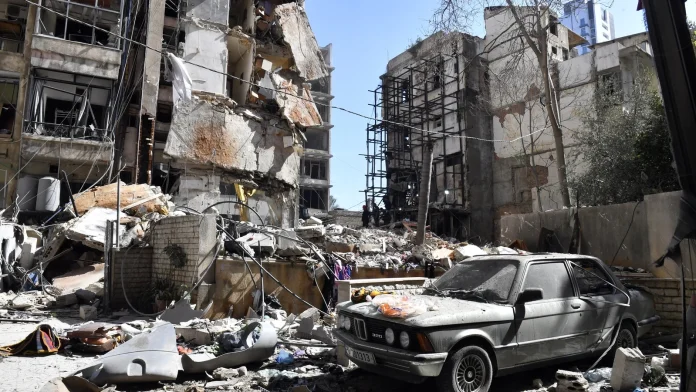
Israel Launches New Airstrikes on Lebanon Despite Ceasefire

Israel launches fresh strikes on Lebanon despite truce
Israel's attacks on Beirut continued as a dispute arose over whether Lebanon was included in the ceasefire

Nightfall Over Lebanon: A Ceasefire Fraying at the Edges

Bombs fell again last night and dawn broke over neighborhoods that should have been quiet—streets littered with glass, a bakery still smelling faintly of yesterday’s bread, and people whose lives were cleaved into before and after. More than 250 people were reported killed in the heaviest Israeli strikes on Lebanon in recent days, and with every blast the fragile architecture of a regional ceasefire creaked toward collapse.

“You cannot sleep when your city is a target,” said Hana Khalil, a seamstress in Beirut who sheltered with her two children in the stairwell of an apartment block whose windows were gone. “We put rugs on the floor so they don’t feel the cold. Every time an explosion comes, my youngest grabs my hand like it can stop the noise.”

The diplomatic choreography meant to keep this war contained is unraveling. Brussels’ foreign policy chief, Kaja Kallas, urged that any truce must explicitly cover Lebanon—stating in sharp terms that Israel’s latest actions did not fit the narrow legal language of self-defence. Across Europe, leaders echoed the same concern: the ceasefire’s boundaries are no longer theoretical lines on a map but battlegrounds where millions of civilians are paying the price.

Rescue, Ruin, and the Human Landscape

Rescue teams worked through the night, digging through concrete and dust for neighbors, cousins, the occasional pet. “The worst part is the silence,” said an emergency responder who asked to be named only as Karim. “After you pull someone alive out, you hear how the whole block exhales. But then there are more calls.”

The strikes hit densely populated neighborhoods without the customary warnings designed, at least in theory, to give civilians time to evacuate. Buildings crumpled the way old bread crumbles in a palm: quickly, without dignity. Streets that yesterday hosted cafés and fruit stalls now served as triage zones. The human picture is painfully simple: homes destroyed, livelihoods dismembered, futures suddenly uncertain.

Hezbollah, Israel, and the Elastic Line of the Truce

Lebanon was drawn into the wider conflict when Hezbollah began firing rockets into Israeli territory earlier this month. The group says it is retaliating for attacks it attributes to Israel and its allies. Israeli forces, for their part, said they struck high-value targets overnight—including, the military stated, a relative of Hezbollah’s deputy leader and river crossings used by fighters—moves that prompted the militia to resume cross-border fire.

“This is not a contained skirmish anymore,” commented Dr. Miriam Al-Khatib, a regional security analyst. “When precision strikes occur in residential zones and when non-state actors cross the threshold of a truce, escalation becomes hard to rein in.”

Voices of Authority and the Local Reality

Global leaders have taken awkwardly different positions. Washington has signalled that Lebanon is not covered by the current truce, while mediators—most prominently delegations from Iran and Pakistan—insist the opposite. Britain and France, for their part, have publicly called for Lebanon’s inclusion. “Lebanon must be fully covered,” said France’s president in a recent statement. The fragmentation of international messages only amplifies uncertainty on the ground.

Back in Beirut, ordinary people parse these grand statements into everyday questions: Will the water come back? Can I get medicine for my father? Will my child be safe going to school? These are the questions that do not make headlines but shape life for millions.

Strait of Hormuz: A Chokehold on Global Energy

Beyond Lebanon, the conflict has tightened its grip on a different front: the sea lanes. Iran’s moves to control the Strait of Hormuz—the narrow funnel through which roughly one-fifth of the world’s seaborne oil and liquefied natural gas flow—have had immediate global effects. Supply disruptions and the spectre of mined waters pushed physical oil prices toward record highs, with some spot cargoes reportedly fetching near $150 a barrel and refined products like jet fuel trading at still higher premiums as refineries scramble for scarce supply.

“For months, markets priced in disruption as a tail risk,” explained Sofia Mendes, an energy economist. “Now we’re seeing the risk materialize. Insurance costs, shipping delays, and uncertainty about alternative routes all inflate the bill for consumers and businesses worldwide.”

Iran’s Revolutionary Guards published a map suggesting alternative routes around mined areas, a practical step if the strait is to be partially reopened. Yet even such maps are double-edged: a sign of readiness to re-open, but also proof that reopening will be slow, hazardous, and expensive.

Diplomacy on a Tightrope

Negotiators from Iran were due to meet a U.S.-led delegation in Pakistan—a rare forum since the war began—for what diplomats described as urgent talks. The goal: to convert fragile understandings into durable mechanisms that protect civilians and keep global commerce flowing. But Tehran was clear, according to sources close to the talks, that any relief would depend on an end to strikes on Lebanese territory.

“You can’t stitch peace with one hand tied behind your back,” an unnamed Pakistani mediator told me. “If one side feels it’s being squeezed while the other is allowed to strike, there is no mutual confidence to build.”

Freedom of the Seas—A Moral and Practical Argument

British Foreign Secretary Yvette Cooper is among those pressing a simple, almost old-fashioned demand: freedom of navigation must be preserved. “An international waterway cannot be monetised or militarised by one actor,” she argued in a speech, invoking centuries of maritime law. The sentiment resonates far beyond London: shipping companies, airlines, and manufacturers all feel the consequences of chokepoints when energy prices surge.

Where We Go From Here

Look closely and you can see the strands that might lead to containment: shared economic pain, third-party mediators with room to manoeuvre, domestic political constraints on leaders keen to avoid open-ended wars. Look closer still and you see the strands that could snap them: miscalculation, local reprisals, and the human impulse for revenge after personal loss.

What happens if the strait remains contested? How long before higher fuel costs ripple into food prices and broader inflation? And at the most intimate level—how do families rebuild when the skyline of their city has been refashioned into rubble?

“I don’t want to be a symbol,” Hana Khalil told me, voice steady despite everything. “I want to sew a dress and go to the market. I want my children to learn math without hearing sirens. Is that too much to ask?”

That question is both specific and universal. It lands in capitals and kitchens alike: how do we protect ordinary life when geopolitics reshapes maps overnight? If the ceasefire is to be more than a pause between bombs, it must be stitched together with credibility, guarantees—legal and practical—and a recognition that the war’s frontlines are not only defined by tanks and missiles but by supermarket queues and schoolrooms.

There are no easy answers. But the choices made in the coming days—by negotiators in Islamabad, commanders on the battlefield, and leaders in global capitals—will decide whether a weary region can begin to breathe again, or whether the air will remain heavy with the smoke of an intensifying conflict. What would you do if your city became the center of a dispute between giants? How would you choose between justice, safety, and survival?

Trump criticizes NATO’s Iran approach during meeting with Dutch PM Rutte

Trump criticises NATO over Iran in meeting with Rutte
Donald Trump said NATO 'wasn't there when we needed them, and they won't be there if we need them again'

At the White House Door: A Rift in the Transatlantic Bond

Late on a humid Washington afternoon, Mark Rutte — the Dutch prime minister turned NATO secretary-general for this awkward, critical moment — walked out of the White House with a face that carried the weight of more than a two-hour conversation.

Inside, the exchange had been blunt. Outside, reporters waited like vultures. Between the two, an alliance that has for 75 years promised mutual defense and steady reassurance found itself looking uncertain in the mirror.

“He is clearly disappointed with many NATO allies, and I can see his point,” Mr Rutte told CNN after the meeting. “This was a very frank, very open discussion, but also a discussion between two good friends.”

The frankness is the point. For decades, NATO has been the architectural spine of Euro‑Atlantic security: 32 nations with a collective promise that an attack on one is an attack on all. Yet within that structure, recent events have cracked open old tensions and revealed new ones — not least over what role, if any, the alliance should play far from its traditional theater.

When the Strait of Hormuz Became NATO’s Rubicon

The immediate trigger was a military standoff in the Middle East. Following a dramatic round of strikes between the United States and Iran, Washington asked allies for logistical and naval support — requests that many European capitals met with hesitation, some with outright refusal.

Planes were grounded; airspace was denied. Navies that have long sailed under the NATO flag stayed away from a contested waterway that carries a fifth of the world’s seaborne oil. “They were tested, and they failed,” White House spokeswoman Karoline Leavitt quoted President Trump as saying — a line that landed like a gavel in a court already half in session.

President Trump took to Truth Social after the meeting: “NATO wasn’t there when we needed them, and they won’t be there if we need them again.” It was the kind of public rebuke that leaves little room for diplomacy’s softer tones.

The Practicalities and the Politics

Why the reticence? For many European capitals, NATO is a defensive alliance focused on North America and Europe — not a vehicle for projecting U.S. force into Middle Eastern crises. For others, the calculus was also domestic: governments faced public skepticism about being drawn into another distant war, while militaries were already stretched thin by commitments to Ukraine and homeland defense.

“We’ve seen this pattern before,” said a senior European diplomat, who spoke on condition of anonymity. “The U.S. asks for support. Europe weighs risks at home. There’s no neat answer when commitments collide.”

Some facts help anchor the mood: NATO was founded in 1949. Today it counts 32 members. The United States accounts for roughly 70% of the alliance’s total defense spending, and Washington’s push for “burden‑sharing” has been a recurring theme in transatlantic politics. The alliance’s guideline that members spend 2% of GDP on defense has been met unevenly; since 2014, most European members have increased spending, but debates persist about who is doing enough.

Voices on the Ground: Anxiety, Anger, and Reflection

In Brussels, a barista at a café near NATO headquarters summed up a common, quieter emotion: “People here talk about NATO like it’s part of the furniture. But now the furniture is wobbling.” Her name was Lina; she’s 28, Dutch, and her family has served in the armed forces for generations.

“My father says if America walks away, Europe has to wake up,” she added. “But waking up costs money and political will.”

At a think-tank in London, Oana Lungescu — a former NATO spokesperson now with the Royal United Services Institute — didn’t mince words: “This is a dangerous point for the transatlantic alliance,” she said. “Trust is not infinitely renewable.”

A retired French naval officer, sipping coffee in Toulon, rolled his eyes at the word “failure.” “We didn’t refuse to help because we don’t care,” he said. “We refuse to be dragged into operations that have unclear objectives and no endgame. That’s prudent, not betrayal.”

A Friendship Strained, Not Broken

Despite the heat, Mr Rutte has cultivated a surprisingly warm rapport with President Trump; last year he even joked about the president as a sort of rough‑and‑ready headmaster. Many diplomats describe Rutte’s approach as deferential but practical — the tone of someone who is trying to calm a nervous class without conceding the lesson plan.

“Rutte kept saying we need to keep the channels open, to be honest, to set expectations,” said a European official who attended preparatory meetings. “That’s what he did in the Oval Office — honesty, but not hostility.”

Global Ripples: Energy, Arms, and the Big Picture

This dispute is not merely about pride. The Strait of Hormuz is a global artery. In 2023, around 20 million barrels of oil a day traversed that waterway — disruptions there ripple through markets and households from Mumbai to Milan.

There are also implications for Ukraine. Supplies of U.S. weapons are finite, and re‑directing munitions to another theater would force painful decisions about where to prioritize. European nations that see Ukraine’s defense as existential are alarmed by any sign Washington’s focus might shift.

“Every time the U.S. pivots, allies have to adjust,” said Dr. Miriam Al‑Khalidi, a security analyst. “That can mean short-term gains for Washington’s leverage, but long-term erosion of predictability. For small and medium states, predictability is a currency.”

Questions That Linger

What does NATO mean in the 21st century? Is it a mutual-defense pact tightly focused on Europe’s eastern flank, or a broader security umbrella that can be asked to operate in hot spots across the globe? Who decides, and how much autonomy should national capitals retain when commitments collide?

Ask an Estonian veteran and you’ll hear urgency about Russia. Ask a Greek shipping magnate and you’ll learn about commerce and chokepoints. Ask a Polish farmer and you’ll be told: “We just want our children safe.” The answers are many, sometimes conflicting, and always human.

Paths Forward

There are choices on the table. NATO could reassert its Europe-first mandate, prompting ad hoc coalitions for out-of-area contingencies. Alternatively, it could widen its remit — a path that would likely require clearer rules, more resources, and new consensus mechanisms.

For now, the alliance limps forward with bruises. Mr Rutte and President Trump talked, and they will talk again. Whether the conversation becomes the start of honest repair or the prelude to deeper rupture will depend as much on quiet diplomacy in the halls of capitals as on the loud pronouncements on social media.

What do you think? Is NATO still the bedrock of transatlantic security, or is it time to imagine new arrangements for a multipolar world? The answer may determine not just the future of alliances, but whether the old promise — that an attack on one is an attack on all — holds when it is needed most.

  • Key fact: NATO has 32 members and was founded in 1949.
  • Key tension: disagreement over supporting U.S. operations in the Middle East, including access to airspace and naval deployments.
  • Big picture: debates over burden-sharing, defense spending, and the alliance’s global role are intensifying.

Deadly violence in Lebanon jeopardizes fragile ceasefire and peace hopes

Bloody day in Lebanon puts fragile ceasefire at risk
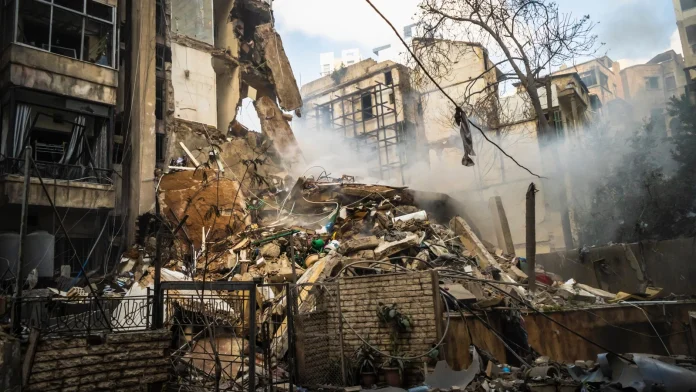
Damage in the Ain el Mreisseh neighbourhood of Beirut, Lebanon, after Israeli strikes

Smoke Over the City: Beirut at a Pause that Feels Like Nothing

The smoke hangs low over Beirut like a bad memory that won’t leave. It curls from rooftops, drifts past minarets and cranes, and carries the sharp, metallic tang of a city under siege. Walking from the airport into town, the hum of drones starts before the trees become visible — a steel lullaby that has been the city’s constant for six long weeks.

“You know it’s real when the sound follows you into your dreams,” said Fatima, a 42-year-old shopkeeper in the southern suburbs, as she wrapped a scarf around her head against the dust. “We sleep with the windows shut and wake to sirens. My nephew hasn’t left the house in a month.”

There is a ceasefire on paper — one negotiated between Washington and Tehran — but in Beirut, paper is not protection. Here the war has taken on its own tempo: sudden strikes that carve open neighborhoods, bridges and villages wiped from maps, and apartment blocks reduced to jagged skeletons of concrete and rebar.

Numbers That Don’t Explain the Noise

Official figures are grim and growing. Lebanese civil defence teams say more than 1,600 people have been killed since March, including over 100 children. Over a million people — roughly one in six of the country’s population — have been uprooted, many now crowded into relatives’ homes or makeshift shelters.

And then there was “the day” — the bloodiest 24 hours of the conflict in Lebanon, when rescue workers said more than 250 people lost their lives, more than 1,000 were wounded, and whole neighborhoods were flattened overnight. “We scrambled ambulances like leaves in a storm,” a civil defence officer told me, voice thick with exhaustion. “There weren’t enough hands.”

Numbers are blunt instruments. They count bodies and buses and buildings, but they don’t tell you that the bakery on the corner of my street kept its oven running for hours to feed sheltering families, or that Tyre — one of the oldest continuously inhabited cities on Earth — was ordered emptied by a notice that felt like exile.

What’s Collapsing, and What’s at Stake

  • Human toll: 1,600+ dead and 1,000+ wounded in recent weeks (civil defence figures).
  • Displacement: over one million people internally displaced — a humanitarian crisis in a country already strained by economic collapse.
  • Geopolitics: the Strait of Hormuz closed, affecting global oil markets — roughly one-fifth of seaborne crude transits this waterway.
  • Territorial ambitions: talk of a new de facto border at the Litani River raises fears of permanent change to Lebanon’s map.

A Region Quaking: From Hormuz to Beirut

On the wider stage, the last six weeks have felt like a different kind of Earthquake. A war between the United States and Iran spilled into every other conversation: economies shuddered, shipping lanes were threatened, and world leaders scrambled for the diplomatic exit ramp. Iran’s closure of the Strait of Hormuz — a choke-point through which an estimated 15-20% of global seaborne oil flows — sent markets into fits and made the war a global economic story as much as a regional one.

“The Hum— the noise from drones — that sound is Beirut’s new weather,” observed Dr. Lina Haddad, a Beirut-based analyst who’s spent decades studying urban conflict. “But the war we’re living in here is not only between Israel and Hezbollah. It’s a spillover of a much larger contest between capitals: Washington, Tehran, and Tel Aviv. The lines are blurred and the civilians pay for that blur.”

Borderlines, Buffer Zones, and the Litani

On the ground, the strategic conversation has taken a tangible form. Israeli forces have been pressing north, creating what they call a “security zone” that stretches to the Litani River — roughly 30 kilometres north of the internationally recognized border. For residents of southern Lebanon, that zone is not a buffer; it is a cordon that severs families from fields, towns from schools, and entire communities from their livelihoods.

“They tell us it’s for security,” said Hassan, a farmer from a village near the Litani, who said he watched tractors and olive trees go up in smoke. “Security for some, not for us. They have maps with new names. They don’t see that behind every plot of land is a family.”

Within Israel, the debate is raw. Some ministers and settler groups have publicly floated maps of southern Lebanon with Hebrew place names. Finance Minister Bezalel Smotrich has been reported as saying, “The new Israeli border must be the Litani.” That kind of rhetoric hints at ambitions that extend beyond temporary buffers, and it terrifies many Lebanese who remember older conflicts and long evacuations.

When Allies Disagree

For weeks Israel and the United States marched toward a common objective; then details started to bite. In a White House meeting earlier in the year, Israeli leaders had urged a broad campaign to dismantle Iran’s strategic capabilities. Washington’s calculus, however, shifted toward a negotiated pause.

“We went into this with different finishing lines,” said an anonymous Western diplomat who has been tracking the talks. “Washington wants de-escalation that stabilizes oil and markets. Israel wants a long-term reset on its northern border. Those aren’t the same thing.”

The ceasefire that exists now was anchored, in part, in Iran’s own 10-point framework — demands that include formal roles for Iranian forces in Hormuz and limits on sanctions. That anchoring has yielded both relief and anxiety: the strait is reportedly set to reopen under arrangements that give Tehran a recognized hand in managing passage, while Tehran’s nuclear advances — including an estimated several hundred kilograms of enriched uranium stockpile — remain politically charged issues.

On the Ground, the Pause Is Fragile

In Beirut’s south, resilience looks like a communal pot kept warm on a rooftop, like a school being used as a clinic, like the way neighbors barter for bottled water. International aid groups have mobilized, but logistical challenges and damaged infrastructure make any response slow. The United Nations has warned that Lebanon faces the combined shocks of conflict, displacement, and a collapsing public service network.

“We are not just rebuilding buildings. We are trying to rebuild trust,” said Miriam Khalil, who coordinates emergency response in a Beirut shelter. “People need to know they can plant their tomatoes again, send their children to school, get a doctor. Until that’s possible, every ceasefire feels temporary.”

What Comes Next?

So where does that leave us? Negotiators are due to convene in Pakistan, with talks framed, at least initially, by Tehran’s terms. Experts worry that the gap between what Iran is asking and what Washington will accept is vast enough to swallow the fragile calm.

“There are few easy exits,” said Maj. Gen. (ret.) Amos Feldman, a former military strategist. “At best we’ll see an extended pause and a geopolitical stalemate. At worst, miscalculation brings a return to open hostilities. The people who will pay are the civilians.”

What does justice look like in a place where borders are imagined on maps by distant politicians and where the echoes of drones are louder than any law? How do we hold accountable those who choose geography over people? These are the questions that Beirut — and the region — will grapple with long after the headlines move on.

For now, Beirut waits. The smoke keeps rising, the drones keep passing, and people keep counting — not just the dead and displaced, but the days until normal sounds like a possibility, and not a fantasy. Will the ceasefire mature into peace? Or will it harden into another temporary arrangement that paper cannot protect?

We owe those who live under the hum an answer that is more than line items and summit photos. Until then, the city breathes on — strained, stubborn, and painfully alive.

Israel launches widespread strikes throughout Lebanon, hitting multiple locations

Israel carries out extensive strikes across Lebanon
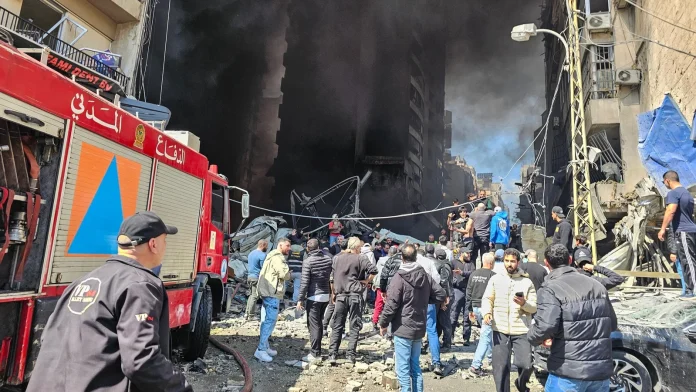
First responders and residents at the site of an Israeli airstrike on Beirut's Corniche al-Mazraa neighbourhood

Beirut in the Shadow of Sudden Explosions: A City That Felt the Sky Collapse

There is a particular quiet that follows a sudden, huge blast — a stunned silence stitched together with the shriek of car horns and the wail of ambulances. On Wednesday afternoon the sky over Beirut filled with smoke, and that silence was broken over and over again by explosions that flattened buildings and shattered lives.

By early night the Lebanese health ministry had given an initial count: 182 people killed and 890 wounded. Those figures, officials warned, were provisional. On the streets, the arithmetic of loss felt immeasurable: apartments collapsed, families displaced, small businesses levelled, and children torn from classrooms and playgrounds. “I saw the blast, it was very strong, and there were children killed, some with their hands blown off,” said Yasser Abdallah, who runs an appliance shop in central Beirut, his voice raw with disbelief.

The day the capital looked more like a battlefield

What was striking — and terrifying — was the simultaneity. Strikes hit neighborhoods across Beirut at once, and in one case a residential block in the Tallet El-Khayat area partially crumpled, trapping people on an upper floor while rescuers clawed through cracked concrete and dust to reach them. AFP journalists described scenes of panic: drivers hooting as they tried to clear paths for ambulances, neighbors dragging shattered window frames away, and the acrid smell of burning rubble and diesel filling the air.

One of the strikes toppled a building on Corniche al-Mazraa, a major artery of the capital that once bustled with joggers and families strolling by the sea. Black smoke rose into the sky as the rubble smouldered — a terrible postcard of a city that has already known too many of these mornings.

Names, Loss, and the Fragility of Truth

The dead included two journalists — Suzanne Khalil of Al-Manar TV and Ghada Dayekh of the local radio station Sawt Al-Farah — bringing home the grim reality that reporters, too, pay with their lives for the public’s right to know. “They were here to tell the story,” a colleague told me, voice low. “Now those stories end in a grave.”

Across southern Lebanon and into the Aley mountains, state media reported strikes that mirrored the devastation in Beirut. Hospitals filled, morgues overflowed, and rescue teams worked into the night with limited equipment. Emergency workers spoke of chaotic scenes and of being overwhelmed; one volunteer medic described transporting children with blast injuries “wrapped in blankets and silence.”

Humanitarian corridors battered and bridges broken

The raids did not only exact immediate casualties. They severed lifelines. Israel struck the last coastal bridge connecting Tyre to Beirut — the seventh bridge over the Litani River hit since the fighting intensified — hampering evacuation routes and aid efforts. In a region where a single river can be the line between safety and siege, the destruction of such infrastructure amplifies the human toll.

Despite evacuation orders that pushed tens of thousands north or inland, humanitarian efforts continued in small, stubborn ways. A Catholic NGO managed to deliver roughly 30 tonnes of aid to Christian-majority villages in the south — a statistical blip against the scale of suffering, but a human one nonetheless. “We could not stand watching children go hungry while waiting for political agreements,” said the NGO’s coordinator as volunteers unloaded boxes in a dusty courtyard.

Politics in the wake of smoke

Wednesday’s strikes came against the fraught backdrop of a US-Iran ceasefire announced overnight. Pakistani Prime Minister Shehbaz Sharif, who has been attempting to mediate among regional players, declared that the two-week pause should apply “everywhere including Lebanon.” But Israel’s government moved quickly to exclude Lebanon from its interpretation of the truce.

“Lebanon was not covered,” Israeli officials stated, and Israel’s defence minister said the strikes had targeted Hezbollah members across the country — calling it the largest operation since the pager-bomb campaign of 2024. Hezbollah, for its part, said it was on the verge of a “historic victory” and insisted it retained the right to resist. Yet since the Iran-US stitch of temporary calm came into force, the group had not announced any operations.

White House Press Secretary Karoline Leavitt later said Lebanon remained on the table for discussion among leaders, acknowledging the diplomatic tightrope the US and its allies are walking. Back in Beirut, President Joseph Aoun described the shelling as evidence that Israel was “pressing ahead with its aggression and dangerous escalation despite international efforts to contain tensions in the region.”

The wider ripple: displacement, statistics, and the human ledger

To grasp what these latest strikes mean, you must step back from the smoke. Since the conflict widened, Lebanese authorities say more than 1,500 people have been killed and over one million displaced. Whole neighborhoods have become mosaics of corrugated roofing and temporary tents. Markets where families once bought zaatar and fresh fish are now replaced by aid distribution points and queues for bottled water.

These numbers are not abstract. Each displaced family represents disrupted education, lost livelihoods, and long-term psychological trauma. Schools converted into shelters do double duty: protecting and depriving. Children who should be learning multiplication tables are counting checkpoints and worrying about missing meals.

  • Reported deaths so far: 182 in Wednesday’s raids (initial toll) and more than 1,500 since the wider campaign began.
  • Reported wounded on Wednesday: 890, with likely undercounting due to overwhelmed hospitals.
  • Displaced persons since the escalation: over 1,000,000, according to Lebanese authorities.

Voices on the ground

Local voices are varied and aching. “My sister’s apartment is gone,” said Rania, a schoolteacher who has been sleeping at a neighbour’s house with three children. “We are not safe anywhere. The whole city feels like it could fall apart at any moment.”

An ambulance driver named Samir told me he had been out all day making impossible choices. “Which house do you go to first? The one closest? The one with smoke coming out? You can only carry so many people in a stretch of an hour,” he said, wiping soot and sweat from his brow. “Sometimes you feel like you are running on prayer more than fuel.”

A regional analyst based in Beirut, Dr. Leila Haddad, framed the moment differently: “This is not just a military operation; it is a continuation of a long, tragic cycle where civilians are the main casualties. If diplomacy excludes whole territories, the diplomacy is failing the people it is meant to protect.”

What does the world owe Beirut?

When cities burn and bridges fall, the instinctive international response is either to convene and contain or to point fingers across noisy diplomatic channels. But between statements and summits, people need water, medical care, shelter, and a map to safety. They need guaranteed humanitarian corridors and the protection of journalists and emergency crews.

So ask yourself: when a ceasefire is negotiated between powers far from the rubble, who gets to decide which towns are covered? When a bridge is destroyed, who is responsible for rebuilding the small economies that cross it daily? And when journalists are killed trying to tell us what’s happening, how much harder does it become to understand the truth?

Beyond the headlines

There is no easy answer. But there is a simple, urgent truth: the scenes in Beirut on that smoke-filled afternoon are not isolated. They are part of a larger pattern where regional rivalries and global diplomacy collide on the faces of ordinary people. If the world wishes to break that pattern, it must choose persistent humanitarian engagement, clear rules of engagement that protect civilians, and a willingness to hold actors accountable when they cross those lines.

For now, Beirut waits under a mantle of dust and resolve. Neighbours share what little they have. Rescue teams keep digging. And outside the city, diplomats weigh public statements and private calls. The question is whether words on paper — ceasefires and declarations — can keep pace with the fragile work of saving lives on the ground.

When the blast dust settles, who will be left to rebuild? And what will remain of the everyday rhythms of a city that thought it could absorb the past and still move forward?

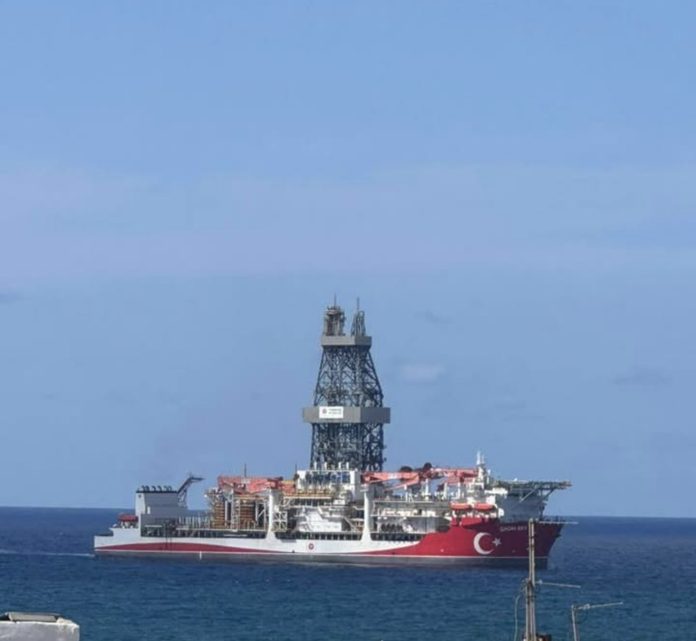
Markabkii Turkiga ee soo saari lahaa Shidaalka Soomaaliya oo kusoo xirtay dekeda Muqdisho

Screenshot

Apr 09(Jowhar)-Markabka Turkiga laga leeyahay ee Çağrı Bey ayaa soo gaaray caasimadda Muqdisho, isagoo qayb ka ah dadaallada lagu baarayo laguna qodayo shidaalka ku jira xeebaha Dowlad-goboleedka Galmudug.

Tehran dismisses peace talks as unrealistic after Israeli strikes

Peace talks 'unreasonable' after Israeli strikes - Iran
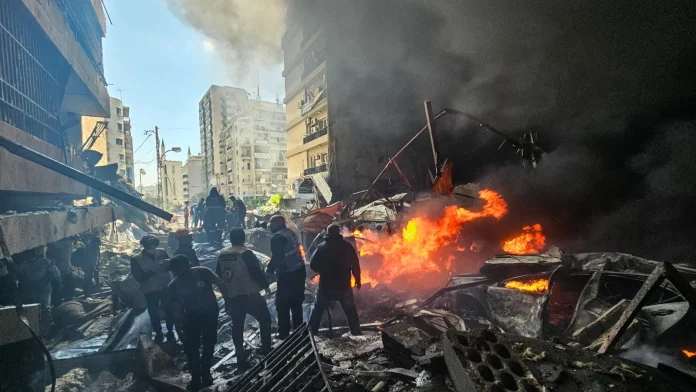
First responders stand amid rubble at the site of an Israeli airstrike in Beirut's Corniche al-Mazraa neighbourhood

After the Fireball: A Fragile Ceasefire, a Region on Edge

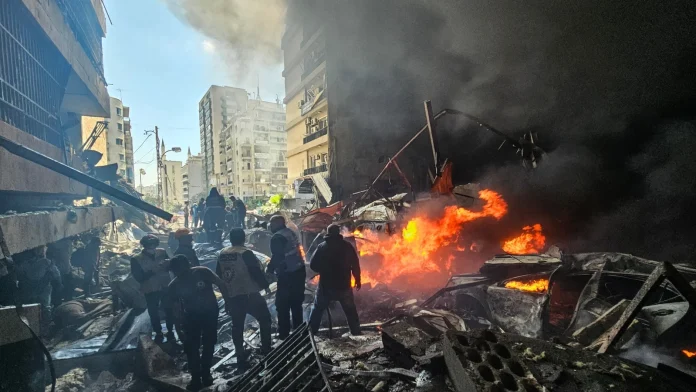
It began, as so many days in this terrible stretch of months have begun, with light. A flash over the low-rise district of Abbasiyeh in Tyre, a column of smoke that clawed at the sky, and then the hollow ache of a city counting the cost of another strike.

By the time the sun fully rose, Lebanon’s civil defence had tallied 254 dead across the country; Beirut alone bore the heaviest burden, with 91 lives lost, according to officials on the ground. Streets that yesterday teemed with vendors, children and the languid commerce of a coastal capital now smelled of dust, petrol and something flinty that comes when glass and concrete meet heat.

What the ceasefire did — and did not — promise

The world had been cautiously awake to the news of a two-week ceasefire negotiated between the United States and Iran, a diplomatic breath that many hoped would pull back a region from the brink. But the fragile peace — if that is what it was — was immediately clouded by competing interpretations.

In Tehran, Iran’s parliament speaker Mohammad Bagher Qalibaf warned that the conditions for diplomacy were already being broken. “In such a situation, a bilateral ceasefire or negotiations were unreasonable,” his office said, pointing to continued Israeli operations and what Iran described as Washington’s insistence that Tehran relinquish nuclear ambitions.

Washington and Tel Aviv, however, drew the lines differently. Both the US and Israel said the ceasefire did not extend to Lebanon, and Israeli Prime Minister Benjamin Netanyahu made plain his readiness to strike again: “We have our finger on the trigger,” he said — a phrase that landed like a challenge in cities still smoldering.

On the ground: warnings, silences, and a human toll

A woman who asked to be called Amal described the moment an airstrike hit a street near her home in Beirut. “There was no orange text on my phone. No message to leave. One moment I was boiling tea, the next the whole building trembled,” she said. “My neighbour lost her husband in the stairwell.”

Rescue workers and medics have repeatedly complained about the difficulty of evacuations during strikes. “In some cases the usual 10-minute warning systems were absent,” said a civil defence volunteer who returned from a night shift with blood on his gloves and exhaustion under his eyes. “People ran into alleys. Children are seeing things no child should ever witness.”

The casualty figures are raw and evolving. This conflict — now more than five weeks old — has cost thousands of lives across multiple countries and uprooted countless families. It has also bent global attention and triggered a cascade of economic and strategic consequences that reach far beyond the Levant.

From Tehran’s streets to oil tankers: the wider fallout

In Tehran, crowds celebrated the perceived diplomatic win. Flags were waved, US and Israeli banners burned, and for a hopeful night there was a collective exhale. Yet among the jubilation was a quiet sense of unease.

“We cheered. But we also know how fragile agreements are,” said one university student marching past the square. “Hope feels like smoke — easy to disperse.”

The conflict’s shockwaves were not limited to human tragedy. Markets wavered, then surged. World stock indices climbed while oil fell sharply — plunging 14 percent at one point and settling near $95 per barrel after dipping to about $90.40. The reason was not simple. Traders reacted to both the promise of a ceasefire and the immediate reality of Iranian strikes that showed Tehran could, if it chose, choke seaborne traffic through the Strait of Hormuz.

Consider the geography: roughly one-fifth of the world’s seaborne oil has historically passed through the Strait of Hormuz. For decades the United States invested heavily in regional military presence to guarantee freedom of navigation. The recent weeks exposed how fragile that control can be when a regional power leverages geography and proxies.

Oil infrastructure beyond Iran also felt the blow. Industry sources reported attacks on a pipeline in Saudi territory — a conduit used to bypass the Hormuz bottleneck — and missile and drone strikes were claimed or reported in Kuwait, Bahrain and the UAE. Meanwhile, the strait remained effectively closed to vessels without permits, sapping commercial confidence and forcing shippers to ask hard questions about the costs of doing business in a war-shaken region.

Words, threats and the theatre of diplomacy

High-stakes diplomacy was slated to resume in Budapest, with the US delegation led by Vice President J.D. Vance. Yet the headlines and the battlefield were not cooperating. Tehran insists its nuclear activities remain within the terms it interprets as acceptable. Washington frames the conversation differently — President Trump publicly said Iran agreed to stop enriching uranium and would hand over existing stockpiles, an assertion Tehran disputes.

And then there were pronouncements that sounded more like campaign speeches than policy: tweets announcing unilateral tariffs — “50% on all goods from any country that supplies arms to Iran,” Mr. Trump wrote — even as analysts questioned the legality and enforceability of such a unilateral move.

“For diplomacy to succeed, there must be mutual confidence, a shared baseline of reality,” said Lara Mendes, a former UN mediator who has worked in the region. “When parties announce victories before verification, or when fighting continues in adjacent theatres, you erode that baseline. The real test of any ceasefire is whether it creates space for daily life to resume — not whether it can be celebrated in sound bites.”

What’s at stake — and what comes next

  • Human security: Thousands killed; hundreds displaced; infrastructure damaged and recovery costs unknown.
  • Energy security: The Strait of Hormuz disruption underscored the region’s outsized role in global energy markets.
  • Nuclear risk: Competing interpretations about enrichment and stockpiles mean the core dispute is unsettled.
  • Regional power balance: Non-state proxies, missile ranges and maritime chokepoints have shifted strategic calculations.

Walking through a Beirut neighbourhood, you notice small signs of endurance: a bakery open by dawn, a child kicking a ball beside a shattered shopfront, an elderly man sweeping glass so his neighbour can return home. These are the quotidian acts that make victory or peace meaningful — not treaties signed under duress, not headlines declaring triumph.

So what should we ask ourselves? When the cameras leave and the ceasefire text is tucked away, who will rebuild the hospitals, the homes, the lives? Can a two-week pause in violence be the seed of a durable settlement, or will it simply reorder the terms of another round of fighting? And as global markets breathe easier for now, for how long will the price of peace be counted only in charts?

The answer, as ever, rests with more than generals and presidents. It rests with those who mend roofs, those who teach children under power outages, and those who continue to speak — loudly, stubbornly — for accountability, aid and long-term reconciliation.

For now, the fires have dimmed in places, but the smell of smoke lingers. Whether that scent will give way to rebuilding or to renewed ash depends on whether leaders can turn fragile pauses into durable, tangible safety for the people who have already given so much.

UN says Lebanon death toll ‘horrific’ — live coverage

As it happened: Scale of Lebanon deaths 'horrific' - UN

When the Dawn Smelled of Smoke: Lebanon’s Quiet Catastrophe

There is a particular silence that follows a bombardment—a thick, settled hush broken only by the metallic groan of a distant generator or the staccato clack of someone sorting through what remains of a life. Walking through neighborhoods that should have smelled of jasmine and frying za’atar, I smelled dust and burned plastic. I saw furniture turned to kindling, a wedding dress yellowed with ash, and children who had learned to count the sound of planes like clockwork.

The United Nations has called the scale of deaths in Lebanon “horrific.” For those who live there, that word lands like a shard. It does not just describe numbers; it describes the raggedness of small, ordinary things—kitchen tables without legs, mothers with lists of names tattooed on their memory, men who used to sell olives refusing to step outside their ruined shops.

Faces and Figures

Official tallies fluctuate in fast-moving crises. But there is no ambiguity in the human math: hundreds killed, many more wounded, tens of thousands uprooted from homes overnight. Hospitals once proud with white corridors are now triage tents, their generators rationed like water. The Lebanese Red Cross and UN agencies report that whole communities—families that have been on the same street for generations—are now scattered across a fragile coast and into the hills, sheltering in schools, mosques, and anything that will keep the rain off.

“We are patching bodies and trying to patch lives,” said a surgeon at a field clinic, wiping her hands on a towel smeared with dust. “We do not have enough blood, we do not have sleeping pills for the children who cannot sleep. The medicine is older than the babies.”

Old Wounds, New Smoke

Lebanon has long been a place where regional conflicts leave deep footprints. The scars of 2006, of civil strife, and of decades of political fracturing are visible in the crumbling façades and the wary, knowing looks of elders. Yet what makes this episode especially brutal is the way it has bled into the fabric of daily life—markets that once hummed with bargaining voices now lie in ruin; fishermen who once traced the coast with nets now peer out from behind shutters.

“We’ve survived many things,” said Fatima, a grandmother in her sixties reclining on a plastic chair amid rubble where her home had stood. “But losing the rhythm of our days—that is what hurts. The sound of my grandson playing with a tin can, that is what I miss.”

Humanitarian Strain: A System Stretched Thin

The human impact is compounded by Lebanon’s broader vulnerabilities. The country hosts one of the highest proportions of refugees per capita in the world—some 1.5 million Syrians among a population of roughly six million—putting long-term pressure on housing, water, and services. A deep economic crisis that began in 2019 has already hollowed out public institutions: pensions are pinched, fuel is scarce, and hospitals run on donated supplies.

“We were already on the edge,” a UN humanitarian coordinator told local reporters. “Conflict doesn’t just break buildings; it breaks supply lines, it breaks expectations, it breaks the fragile trust people have in institutions that should be there for them. When hospitals are overwhelmed and an ambulance takes hours to arrive, that is what makes a crisis catastrophic.”

Statistics underscore that fragility. The World Bank and international monitors have documented a collapse of Lebanon’s currency and a spike in poverty since 2019. Food prices have soared, and electricity outages are regular—conditions that make displacement and recovery exponentially harder.

Inside the Displacement

In a school-turned-shelter on the outskirts of a southern town, room numbers no longer mean privacy. In one classroom, quilts become walls between families. In another, a group of young men shared news on a cracked smartphone screen, plotting how to get water for the day.

Children, in particular, bear a heavy burden. “My daughter asks when her house will come back,” said Omar, a father of three. “How do I tell her houses are for the living? How do you explain war to a five-year-old who just wants to go to school?”

Voices from the Ground

It is easy to reduce stories to headlines. But the people I met insisted on being seen as more than victims. A volunteer teacher turned aid worker, Hala, explained why she keeps returning to the shelters despite the danger: “We speak, we listen, we teach small things—counting, letters. It sounds so small, but it reminds them they are not numbers.”

Local shopkeepers, too, hold on to dignity with quiet acts of solidarity. One grocer offered free bread to anyone who could not pay. “My shop is small,” he said, “but bread is bread. People need it.”

International Response and Limits

Governments and NGOs have mobilized support—funding pledges, relief flights, and diplomatic pressure. Humanitarian corridors and ceasefire calls have been urged by the UN and regional players. Yet aid often arrives delayed, constrained by security concerns and bureaucratic bottlenecks.

Humanitarian organizations list immediate needs:

  • Emergency medical supplies and equipment
  • Clean water, sanitation, and shelter materials
  • Psychosocial support for children and families
  • Fuel for hospitals and relief operations

What Does ‘Horrific’ Ask of the World?

When a UN official uses a word like “horrific,” they are issuing more than an observation; they are issuing a moral summons. The international community can respond with money, with diplomacy, with pressure on warring parties to respect civilian life. But the longer-term questions are harder: How do you rebuild trust? How do you help communities heal? How do you ensure that aid reaches those who need it most, especially in a country already strained by economic collapse and refugee flows?

Ask yourself: if your neighbor’s roof collapsed tonight, would you know where to send help? If a familiar market went quiet, would you recognize the signs of a wider unraveling before it becomes a global crisis?

Beyond the Headlines

This story is not merely about bombs and statistics. It is about the small acts of resilience that persist even when roofs tumble and markets fall silent. It is about a baker who insists on turning out morning loaves for children in the shelter, about a teacher who draws maps for displaced kids to reclaim their sense of place, about the old man who waters the surviving olive tree every morning like a ritual of defiance.

That is the human truth behind the UN’s stark language: violence fractures lives in the moment, but a quieter and equally vital work—of care, patience, and community—begins in the rubble.

How You Can Help

If you want to help from afar, consider supporting reputable humanitarian organizations working on the ground—UN agencies, the Red Cross, medical NGOs, and local Lebanese charities. Donate to verified appeals, amplify trusted reporting, and pressure policy-makers to prioritize protection for civilians and unfettered humanitarian access.

The immediate crisis will pass; the scars will stay. How we respond now will shape whether the scars become sources of learning and rebuilding—or seeds for another heartbreaking chapter.

When you next sit down to a quiet cup of coffee, spare a thought for the streets lined with crushed rosaries and singed hymnals. Think about the tiny acts of kindness that stitch a life back together. And ask yourself: how can we write a different ending for those who have already read too much tragedy?

Iran brands peace talks ‘unrealistic’ after Israel’s recent strikes

Peace talks 'unreasonable' after Israeli strikes - Iran
First responders stand amid rubble at the site of an Israeli airstrike in Beirut's Corniche al-Mazraa neighbourhood

When the sky over Beirut lit up: a fragile ceasefire, a region holding its breath

The night air pulsed with a sound that residents in southern Beirut said they had learned to dread. Bright orange blossoms of fire peeled away from concrete facades and a column of smoke rose black and furious, like the exclamation point of a sentence that refused to end.

By morning, Lebanon’s civil defence tallied 254 dead across the country; Beirut alone bore the brunt with 91 fatalities in the capital, rescuers said. Streets once filled with vendors and afternoon chatter had turned into a jagged gallery of scorched cars, collapsed shopfronts and the heady, metallic smell of burned fuel.

“There was no warning this time,” said Amal Haddad, a schoolteacher who lived through the blast. “We are exhausted — not just tired. You can’t sleep when you wonder if the next dawn will be your last.”

The ceasefire that wasn’t

What was announced as a two-week pause in fighting between the United States and Iran — a ceasefire that many hoped would be the first step toward a broader settlement — was immediately fragile. Washington and Tehran both claimed tactical victories after a five-week war that left thousands dead and reshaped calculations across the Gulf. But a crucial loophole unraveled fast: Israel made clear it did not consider Lebanon part of the ceasefire, and it unleashed what military analysts described as the heaviest strikes on Lebanese soil in years.

“We do not see Lebanon as covered by this arrangement,” said an official close to Israel’s security briefing. “Our operations against Hezbollah will continue as long as the threat persists.”

That stance sent ripples through the negotiations already scheduled to begin in Budapest, where U.S. Vice President J.D. Vance — leading the American delegation — told reporters that the ceasefire terms had been misunderstood by some parties. “I think some assumed the pause included every theatre,” he said. “It did not.”

Words of warning from Tehran

Tehran’s response was blunt. Mohammed-Bager Qalibaf, a senior Iranian official and parliament speaker, warned that recent Israeli operations across Lebanon violated key conditions of the pause and that Washington’s insistence on curbing Iran’s nuclear work was itself a breach of the spirit of the truce. “Under present conditions, moving to bilateral talks would be unreasonable,” he said in a televised statement.

For Iran, one non-negotiable piece of the puzzle is nuclear enrichment: Iranian officials insisted they retain the right to continue certain enrichment activities under whatever arrangement is struck. American leaders, on the other hand, are publicly framing the negotiation as a chance to roll back Tehran’s nuclear advances — a standoff that has proved one of the hardest to bridge.

Markets, shipping lanes and the new geography of power

While missiles fell and families fled, global markets responded in an almost paradoxical way. World stock indexes rallied, and oil prices plunged roughly 14%, settling near $95 per barrel after dipping to around $90.40. The volatility reflected markets balancing two things at once: relief that a wider war might be avoided and fear about the fragility of supply lines in the Gulf.

The Strait of Hormuz — the narrow maritime throat through which roughly one-fifth of the world’s seaborne oil moves — remained effectively closed to vessels without permits, shipping agents said. Iran demonstrated an ability to interdict flows by targeting pipelines used to skirt the choke point, and attacks on energy infrastructure were reported in Saudi Arabia, Kuwait, Bahrain and the UAE.

“What we saw is not simply the cost in barrels,” said Dr. Aisha Rahman, an energy and geopolitics scholar. “It’s a wake-up call: decades of expensive military presence in the region did not eliminate asymmetric leverage. Iran has shown it can disrupt flows in ways that matter to global economies.”

Crowds, flags and the strange comfort of survival

Back in Tehran, the night’s atmosphere was a complicated stew of triumph and unease. Crowds took to the streets waving the national flag, burning images of Israel and the United States, but there were also quieter, more private conversations about how long this fragile calm might hold.

“We cheered because the shelling stopped for a while,” said Alireza, 29, who works in a municipal office and joined relatives on a narrow balcony to watch the lights over the city. “But everyone knows the deal could change tomorrow. You don’t celebrate like normal when your neighbours can be hit at any time.”

What remains unresolved

For all the talk of ceasefires and delegations flying to negotiate, the core strategic questions remain stubbornly open. Iran retains stockpiles of uranium enriched to high levels and a vast missile and drone arsenal that can reach several neighbours. The clerical leadership in Tehran, which had weathered mass protests before the war, shows no visible signs of collapse. And across the Levant, local militias such as Hezbollah continue to complicate the landscape.

“Both sides are declaring victory, but neither has solved the underlying issues,” said Marcus Leone, a retired diplomat who now advises an international peace NGO. “You can pause the fighting — that’s necessary — but durable peace needs mechanisms to manage proxies, verify nuclear commitments, and rebuild trust. None of that is overnight work.”

The human ledger

Beyond geopolitical chess there is an immediate, brutal arithmetic: hospital lists, missing-person appeals, children who will carry nightmares forward. Ambulance sirens, street vendors sweeping rubble into neat piles, neighbours opening doors to shelter those displaced — these are the small acts that constitute survival.

“What matters most is not what maps or leaders decide,” reflected Amal Haddad as she returned to her shattered classroom to collect what books she could salvage. “It’s whether our children can go back to school without fear.”

Where do we go from here?

So what should the rest of the world do while this fragile interlude holds? Should mediators press for immediate, verifiable steps on nuclear materials and cantonments for armed groups? Or should they focus first on a humanitarian pause to tend to the war’s immediate victims?

Those questions aren’t only political; they’re ethical. They force us to ask what we value in a world where asymmetry in means does not necessarily translate into asymmetry in effects. They also compel citizens far from the region to reckon with how global markets, energy choices and foreign policy are threads in a single, tangled fabric.

For now, Beirut lits its candles, Tehran its flags, and diplomats fly to Budapest with agendas that, at best, only partially overlap. The ceasefire is a breathing space — fragile, contested, and painfully brief. The real work of peace, as ever, begins where the headlines end: in hospitals, classrooms, and the quiet rooms where families decide whether to stay or leave.

How would you begin to stitch peace from this patchwork? What would you demand of leaders, negotiators and global institutions? Think of the children on Amal’s street — what kind of stability would you want for them?

Maritime Shippers Seek Clear Guidance on Transit Through Strait of Hormuz

Shippers seek clarity on Hormuz passage
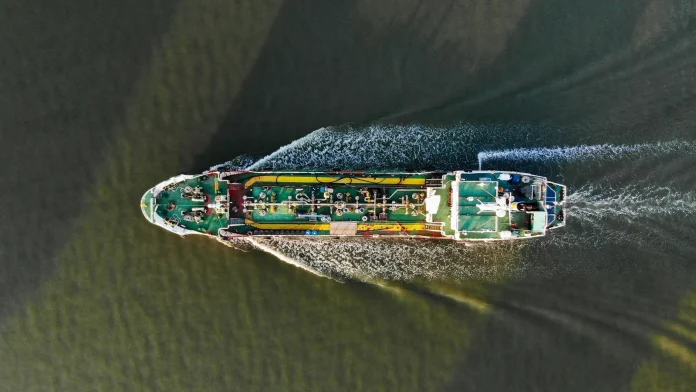
The six-week conflict brought traffic through the strait close to a standstill (Stock image)

At the edge of the world’s oil highway: waiting for permission to breathe

The morning fog over the Strait of Hormuz smelled of diesel and sea salt. On the deck of a Greek-owned bulk carrier bobbing off the Iranian coast, a small group of crew members huddled around a static-laced radio as a terse message crackled through: no ship moves without a permit. A coastguard voice—flat, official—warned that any vessel attempting to transit without clearance would be “targeted and destroyed.”

It felt like a line from an old maritime thriller, but this was 2026, and the stakes could not be more immediate: roughly one-fifth of the world’s seaborne oil and liquefied natural gas squeezes through this narrow choke point. For six weeks, the strait had become a no-man’s-land of stalled tankers, rerouted cargoes and spiking energy prices. Now, after a tentative US–Iran ceasefire, the waterway is technically open in one sense—and closed in another.

Permission required: who gets to sail?

Iran’s position is blunt. State authorities say they will coordinate safe passage through their armed forces and will allow ships to transit—but only those that have explicit permission. Ship operators and insurers, already burned by recent attacks and near-misses, are not rushing back. “We need to see certainty on the ground,” said a senior operations manager at a European liner. “A radio bulletin is one thing. Guarantees and verified procedures are another.”

Two Greek- and two Chinese-owned bulk carriers were recorded making the transit after permission was reportedly granted. That first trickle of movement is being watched like a canary in a mine. For the rest of the fleet—tens of thousands of seafarers and the companies that depend on them—words still carry the weight of whether a ship will sleep safely at anchor or sail into harm’s way.

Major carriers move cautiously

Global names in shipping are signalling caution. Denmark’s Maersk described the ceasefire as a potential window for resuming routes but added that it did not yet translate into “full maritime certainty.” German carrier Hapag-Lloyd has told customers it will only accept new bookings for selected markets once the ceasefire demonstrates staying power. “We’re not sitting on our hands, but we’re not jumping back into the fire either,” a Hapag-Lloyd spokesman said.

Frontline’s chief executive, Lars Barstad, summed up the sentiment plainly: “I want to see the fine print.” Those words echoed the broader industry mood—curiosity tempered by a healthy dose of skepticism.

What the numbers say

Context matters. Since the flare-up began on February 28, maritime watchdogs and navies have catalogued nearly 30 incidents involving commercial vessels and offshore infrastructure across the region. As of the most recent ship-tracking data, roughly 187 laden tankers — carrying about 172 million barrels of crude and refined products — were taking shelter inside the Gulf.

That stockpile, idle at anchor or loitering in ports, is not an abstract statistic; it is gasoline in the ambulances, jet fuel at regional airports, diesel for power plants. When shipments stall, prices climb and refinery schedules scramble. Analysts warn that even after a diplomatic pause, returning to pre-conflict flow rates could take time—Hapag-Lloyd’s CEO estimated a six- to eight-week timeline for significant normalization.

Asia’s refineries lean in, warily

Asian buyers—India, China, South Korea, Japan—are the largest consumers of oil passing through Hormuz. Signs of renewed interest trickled in quickly: traders reported inquiries from Asian refiners and big commodity houses like Glencore, and even major oil firms were quietly assessing cargoes. “When there’s uncertainty, buyers position themselves conservatively,” said Anoop Singh, head of shipping research at Oil Brokerage. “We expect vessels heading to Iran-friendly ports to be the first to move. The math suggests more than 50 VLCCs (very large crude carriers) and a couple dozen Suezmaxes could clear the Gulf in the weeks ahead.”

But loading plans are only part of the puzzle. Vessels leaving the Gulf without prior coordination with both US and Iranian authorities face elevated peril, warned Jakob Larsen, Bimco’s chief safety and security officer. “It’s not just a bilateral issue,” Larsen said. “It’s an operational game of chess with insurers, flag states and naval forces all watching each other’s moves.”

Life at the margins: voices from the docks

On the wharves of Bandar Abbas, days have been long and business thin. “We’re used to busy berths, stacked containers, crews changing shifts over tea,” said Reza, a longshoreman who asked that only his first name be used. “Now you get silence, and the smell of engines without the sound of engines.”

Across the Gulf in Dubai, a shipbroker lit a cigarette and shrugged at his laptop. “We make our living predicting the unpredictable,” he said. “Right now, everyone’s pricing in premiums for risk. Charter rates jump, insurance premiums climb. That’s the invisible toll—costs that ripple down to consumers.”

What governments are doing

Political capitals are moving behind the scenes. Britain said it would coordinate with shipping, insurance and energy sectors to restore confidence in the strait. Other western and regional navies have increased patrols and intelligence sharing, while some countries have quietly reopened diplomatic channels with Tehran to secure guarantees for merchant traffic.

Yet maritime law, flag state responsibilities and the granular mechanics of issuing permits remain thorny. Who checks paperwork? Which naval vessel provides an escort? Which insurers are willing to underwrite voyages? The answers will determine how quickly ships return to the lanes they once took for granted.

Bigger themes: supply chains, geopolitics, climate

The Hormuz standoff is not merely a regional crisis; it’s a symptom of a global system baked into vulnerability. Energy markets have been buffeted by the transition away from hydrocarbons, the geopolitics of supplier markets, and more recently by the fragile interdependence of shipping lanes. For countries with tight import dependencies—particularly parts of Asia and Europe—disruptions here are acute.

Consider the climate paradox: as nations race to cut fossil fuel reliance, short-term shocks to oil supply still have outsized effects on inflation, transport and energy security. The Strait of Hormuz, narrow and strategic, sits at the intersection of that tension.

What happens next—and what we should be watching

The ceasefire has opened a sliver of daylight. But whether that light becomes a steady beam or a flicker depends on the mechanics of trust: permits issued and honored, insurers willing to return, port facilities taking crews, and navies willing to deconflict in real time.

Watch these signals over the coming weeks:

  • Clear, verifiable coordination protocols between Iran and international navies;
  • Insurers publishing amended risk ratings for the Gulf and the Strait;
  • Renewed bookings on major carriers and bulk trades reversing detours;
  • Price stabilization in international oil and LNG markets.

And ask yourself: how resilient are our global systems when a few miles of water can rattle markets and livelihoods across continents? When a fisherman in Hormuz worries about his catch being swept up in geopolitics, or when a refinery manager in Mumbai recalculates runs based on a risk bulletin—these are not distant effects. They are immediate, human, consequential.

Closing thoughts: patience, prudence, and the human ripple

Out on the deck where the radio hissed, the crew shuffled and the day warmed. Someone handed around a thermos of sweet tea; another crewman joked about the bureaucracy of a permit that could decide when they would see home. The joke was thin comfort.

As commerce and diplomacy begin a careful dance to restore the inlet’s flow, the world watches. The Strait of Hormuz is more than a shipping lane—it is a living artery for goods, energy and the livelihoods tied to them. For now, the passage is reopened in principle, but the real test will be whether the words on a radio become safe, sustainable motion through one of the planet’s most vital waterways.

Need to get 'facts straight' around Aughinish - Kallas

Kallas urges clear, accurate facts about the Aughinish situation

0
As scrutiny intensifies over claims involving a major Irish refinery and Russia’s war effort, EU foreign policy chief Kaja Kallas says the priority is...
US World Cup chief defends visa ban for Somali referee

U.S. World Cup official backs visa ban blocking Somali referee

0
A visa denial that stopped a decorated Somali referee at a US airport has drawn fresh attention to how the White House says it...
Iran targets US base in Jordan after Trump orders strikes

Iran Strikes U.S. Base in Jordan Following Trump-Ordered Attacks

0
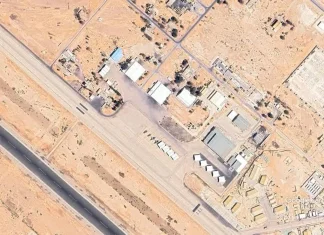
Missiles and drones streaked across the Gulf after Iran’s Revolutionary Guards said they struck a US base in Jordan and hit 21 other targets...
Hegseth to visit Guantanamo as US puts pressure on Cuba

Hegseth to tour Guantanamo as US ramps up pressure on Cuba

0
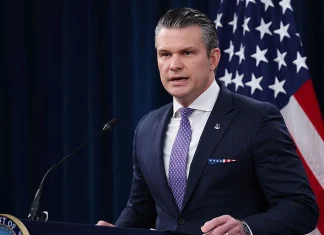
Defense Secretary Pete Hegseth is heading to the US naval base at Guantanamo Bay, Cuba, with the Pentagon saying he will make the trip...
US has "completed" strikes in response to Iranian attack


                    Middle East


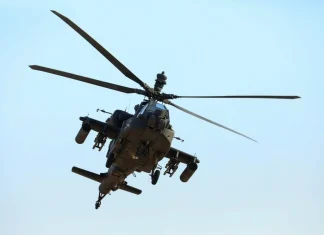
            The US military has said that it "completed" its retaliatory strikes against Iran over the downing of an attack helicopter.

US Military Says Retaliatory Strikes on Iran Are Now Completed

0
US forces have wrapped up a new round of strikes on Iran, a response Washington says was triggered by the downing of an American...