When the Dawn Became a Rubble: Airstrikes, Children and a Border That Won’t Stay Quiet
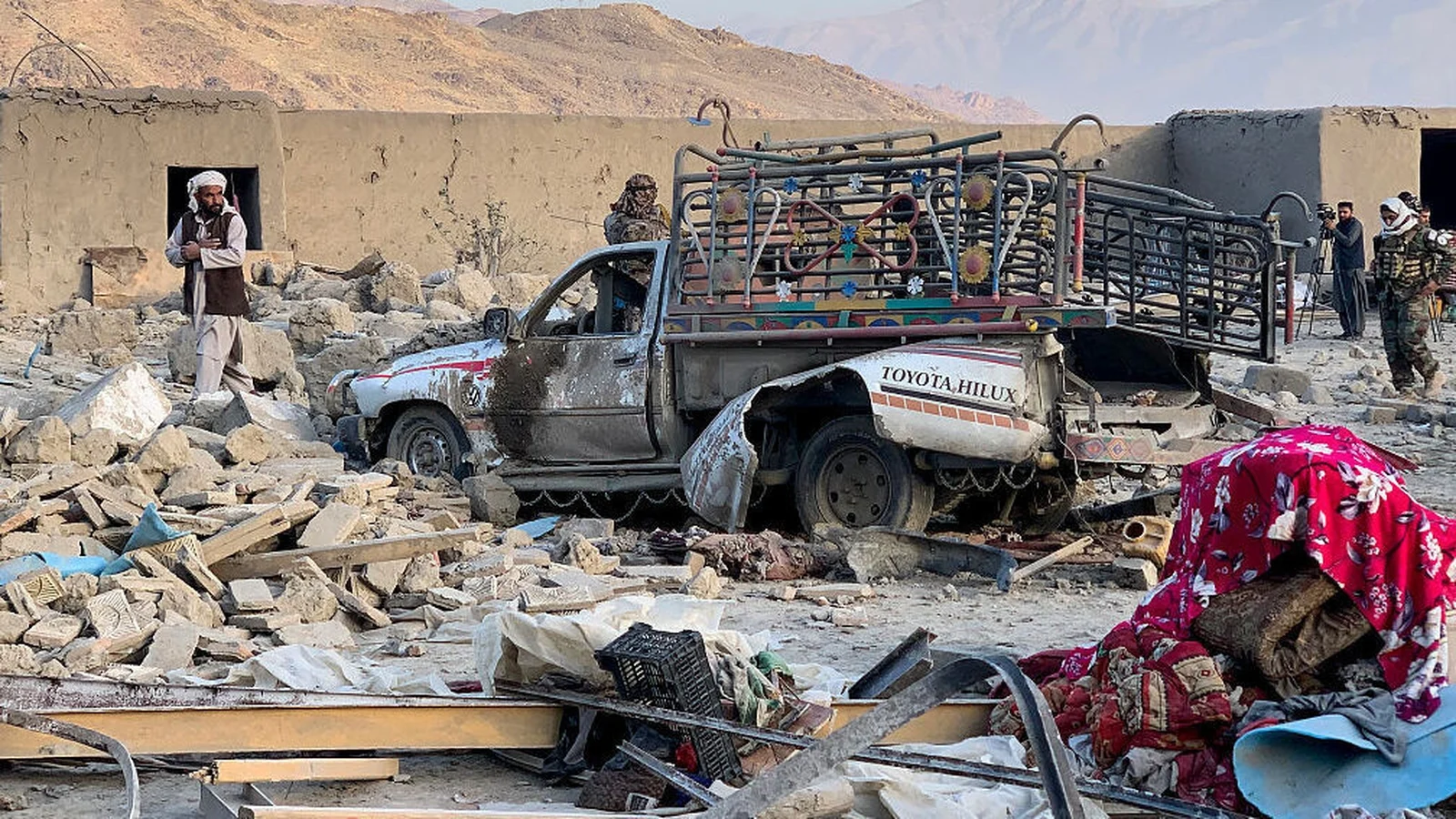
The sun rose on a scene that is becoming tragically familiar along the Afghanistan–Pakistan frontier: dust clouds, broken beams, and families who had only minutes earlier been getting ready for the day. In Bihsud district of Nangarhar province, a bulldozer clawed through the wreckage of a house while neighbours called names into the concrete, hoping against hope to hear an answer.
“We were inside. One minute the children were laughing, the next the whole house collapsed,” said a woman who gave her name as Mariam, her shawl still flecked with dust. “They are not soldiers. They are my sons and daughters.” Her voice broke as the machine heaved another slab of concrete aside.
What Happened — The Official Lines
Pakistan announced it had launched multiple overnight air strikes that it says targeted militant hideouts in Afghanistan. Islamabad’s Ministry of Information and Broadcasting said seven sites along the border were hit, aimed at the Pakistani Taliban and associated groups, including an affiliate of the so‑called Islamic State.
Afghan officials reported strikes in Nangarhar and Paktika provinces. Local sources in Bihsud told reporters that a house had been hit, killing 17 people, among them 12 children and teenagers. An AFP journalist at the scene described frantic rescue efforts and neighbours using heavy machinery to search for survivors under the rubble.
On social media, Zabihullah Mujahid, a spokesperson for the Afghan authorities, condemned the operation: “Pakistani generals try to compensate for their country’s security weaknesses through such crimes,” he wrote on X. The tone was bitter, an echo of the deeper diplomatic rupture between Kabul and Islamabad since 2021.
Casualties, Context and Competing Claims
The strikes were framed by Pakistan as retaliation for a string of suicide bombings on Pakistani soil, including a devastating attack at a Shia mosque in Islamabad that killed at least 40 people and wounded more than 160 — the deadliest assault on the capital since 2008. The Islamic State’s regional affiliate claimed responsibility for that mosque bombing.
Islamabad has also pointed to other recent attacks in northwest Pakistan as part of the justification for cross‑border strikes. Pakistani officials say they have repeatedly urged Afghanistan’s new authorities to act against groups using Afghan territory as a base, and now, they say, they have taken matters into their own hands.
For Kabul, the narrative is different: these strikes violate Afghan sovereignty and primarily harm civilians. “Our people suffer when tensions turn into explosions,” said Dr. Noorullah, a physician at a clinic in Jalalabad. “Children die, schools close, and families disappear.”
Numbers that Tell a Story
- Reported deaths in this incident: at least 17, including 12 children and teenagers (local Afghan security source).
- Previous border clashes in October left more than 70 people dead on both sides and wounded hundreds.
- Mosque suicide bombing in Islamabad: at least 40 killed, over 160 wounded — claimed by Islamic State affiliate.
- Pakistan says it struck seven sites across Nangarhar and Paktika provinces.
On the Ground: Grief, Anger, and Quiet Resolve
Travel through these frontier districts and certain things mark themselves on your senses: the smell of strong tea at roadside stalls, the small iron coffee‑pots, men who measure distance in minutes rather than kilometres, and a resilience so practical it can seem almost stoic. Yet after the strikes, that stoicism split into raw grief.
“We are used to hearing gunfire. We are not used to seeing our children under the stones,” said Haji Khan, a schoolteacher who had come to help pull bodies from the wreckage. Beside him, a teacher’s satchel lay abandoned, a small chalkboard dusted with fine grey grit.
Local elders convened under a poplar tree to decide how to bury the dead, to make space for a funeral in a town where funerals have become too frequent. “When will this end?” one elder asked, looking at the horizon where border ridges meet the sky. “Do the people on the other side not have children?”
Diplomacy on the Brink: Failed Talks and Fragile Ceasefires
The latest strikes come after months of uneasy relations. The bloodiest confrontation in recent memory was last October when border fighting killed more than 70 people overall. That episode ended with a ceasefire brokered by Qatar and Turkey, but subsequent talks in Doha and Istanbul failed to yield a durable solution.
Analysts say the problem is structural. “You cannot resolve a border security problem by airstrikes alone,” explained Miriam Habib, an independent conflict analyst focusing on South Asia. “There are layers here: cross‑border militant networks, local grievances, competition between regional powers, and an Afghan state (however it is structured) that itself is still consolidating authority.”
What’s Really at Stake?
- Sovereignty vs. security: Pakistan frames action as self‑defence; Afghanistan says it’s an infringement on its territorial integrity.
- Civilian protection: When strikes happen in populated border areas, the fallout is often non‑combatant deaths, displacement, and long-term trauma.
- Regional stability: Escalation risks dragging in mediators and neighbors, complicating already tense relations between Islamabad, Kabul, and Tehran, with Turkey and Qatar playing diplomatic roles.
Beyond the Headlines: What This Means for Ordinary People
Numbers and press releases fail to capture the slow unravelling of normal life. Children who survive such strikes carry invisible wounds; schools close or shift hours; markets shrink because people are too afraid to travel. Aid agencies warn that repeated cross‑border violence will worsen an already dire humanitarian picture in eastern Afghanistan, where infrastructure is thin and winter months are unforgiving.
“Two things keep me up — the sound of explosions and the thought that there may be no one left to inherit this valley,” said a farmer named Qader, watching his goats pick over flattened wheat stubble. “Is not peace cheaper than a hundred funerals?”
Questions to Carry With You
As you read this from wherever you are — a city apartment, a university dorm, a seaside town — ask yourself: what responsibility do distant states have when their security measures spill over borders? How should the international community balance a country’s right to defend itself with the imperative to protect civilians? And perhaps most urgently: what mechanisms exist for credible investigation and accountability when children lie dead beneath rubble?
Closing Scene: The Long Haul
Negotiations will likely resume in diplomatic durbars and hotel conference rooms. There will be statements, condemnations, and perhaps another fragile ceasefire. Meanwhile, in Bihsud, people will bury their dead, fix a roof where a missile fell, and attempt to coax seedlings into the cracked earth. That is the stubborn, sometimes heroic, work of ordinary life under extraordinary strain.
For now, the border remains a bruise on the map — red, swollen, and tender. How we respond to those kinds of wounds is a measure of our shared humanity.