When a Quiet Town’s Night Sky Went Dark: A Vigil, a Community, and Questions That Won’t Go Away
It was the kind of place where people left their doors unlocked and the sound of a pickup truck was more likely to be the evening news than a headline. Tumbler Ridge, a small town hemmed by dark fir and limestone ridges in northeastern British Columbia, is the sort of community that measures time by school bells and shift changes at the mine. On a night that should have been ordinary, a pall settled over that rhythm: eight members of the town were killed, and the name of the person police say responsible — 18‑year‑old Jesse Van Rootselaar — threaded through conversations like a sour aftertaste.
By the time the embers of the candlelight vigil cooled, the facts were both sharp and incomplete. Police later confirmed nine people died in the attack, including Van Rootselaar, after revising an earlier toll. Two dozen people were injured; two remained in critical condition in hospital. The victim list reads like a small town’s census: a 39‑year‑old teacher, children as young as 12, a mother and an 11‑year‑old stepbrother. The shooter had also been a student once — someone who walked the same hallways as the children whose lives were cut short.
Minutes that Changed Everything
What unfolded reads like a sequence from which there can be no rewind. Authorities say the first bullets were fired inside a home, where a mother and her 11‑year‑old son were killed. The attacker then moved to a school, where multiple students and a teacher were shot. Police, who say they arrived at the scene within two minutes of the initial call, encountered active gunfire and later found the suspect dead of a self‑inflicted wound.
“Our officers were met with gunfire upon arrival,” Deputy Commissioner Dwayne McDonald told reporters. “This was chaotic and terrifying, and we have a lot of work still to do to understand what happened.” McDonald also said the suspect had been detained on more than one occasion under mental health legislation for assessment, adding an uncomfortable layer to a conversation many in Tumbler Ridge were already having: what happens when warning signs appear but the system can’t — or doesn’t — stop the slide into violence?
Faces, Names, and the Public Grief
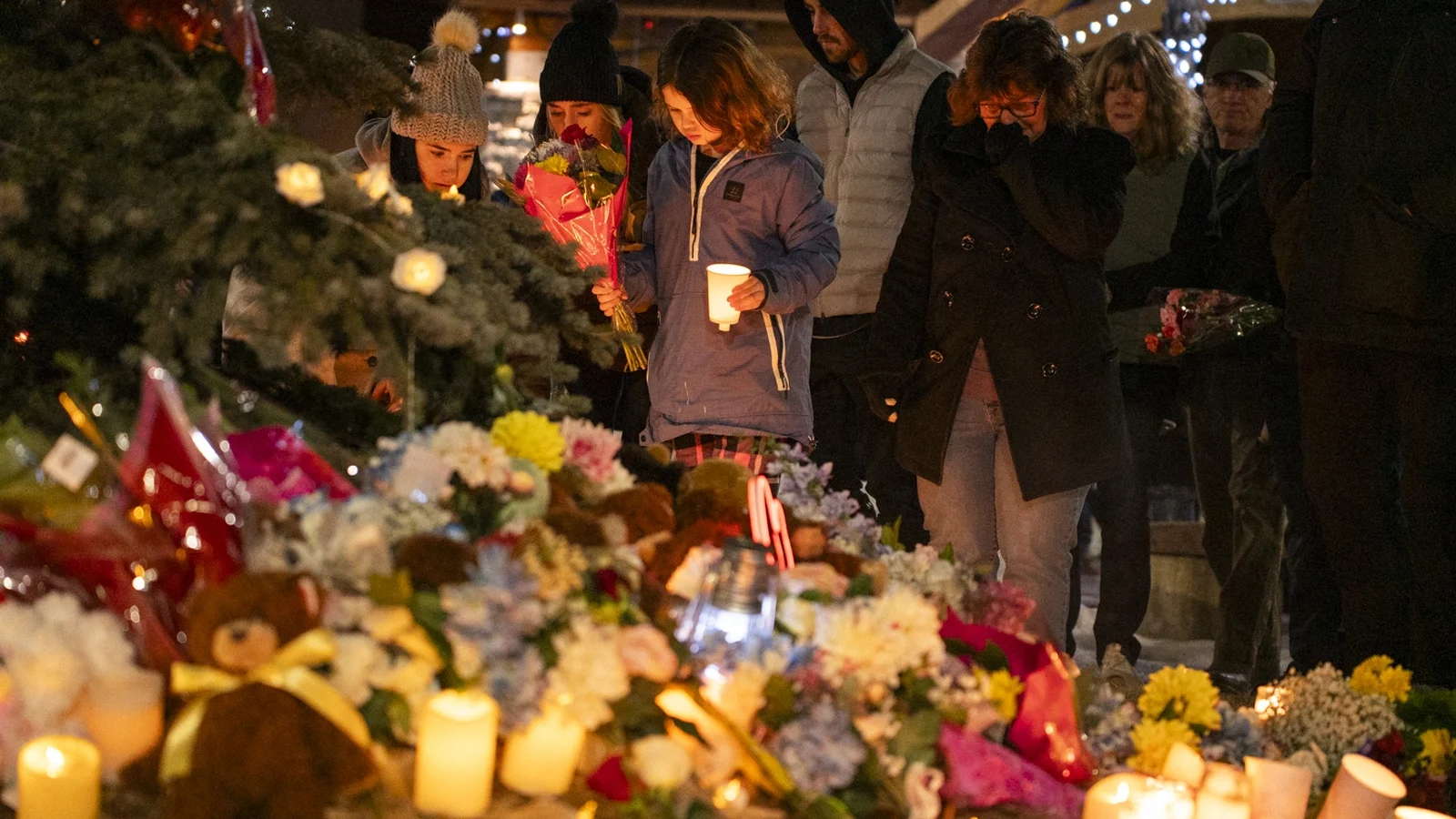
Grief in small towns does not stay behind closed doors. It floods the square, the grocery store, the diner. Within hours of the attack, hundreds gathered under an enormous tree in the town centre. They lit candles, placed photos and stuffed animals at its base, and sang softly because silence alone felt inadequate.
“We will get through this. We must learn from this,” the prime minister said in a sombre statement, asking a nation to grieve from coast to coast. Flags at government buildings were lowered to half‑mast for seven days, a formal gesture that felt both necessary and insufficient to many who had lost someone.
Tumbler Ridge’s mayor, Darryl Krakowka, spoke not as a politician but as one neighbour to another. “We are one big family,” he said, voice breaking at times. “Give somebody a hug. Lend an ear. That is how we will carry each other.”
A local resident, Gigi Rejano, wiped her cheeks and urged action. “Schools should be safe,” she said. “If it means locking the front door or having someone at the entrance, then that’s what we should do.” Her words echoed a larger debate that has rippled across the country: how do you keep children safe in places that were designed to be open and welcoming?
Small Town, Big Questions
There are practical questions, and there are harder, moral ones. How did weapons enter this space? Were the prior mental health interventions enough? Could deeper community support have diverted this course?
Police disclosed that firearms had been seized from the family residence roughly two years earlier but were returned after an appeal. Van Rootselaar’s firearms licence had expired in 2024. Canada’s system allows licensed firearm ownership — and, notably, allows youth between 12 and 17 to hold a minor’s licence after completing safety courses — but the balance between civic freedoms and public safety is under intense scrutiny.
“We need to examine every point along that chain,” said Dr. Lena Hoffman, a psychiatrist who has worked in rural British Columbia. “From access to mental health care, to the speed of interventions, to the way firearms are stored and regulated. Rare events like this are devastating precisely because they feel so preventable in hindsight. The work is to learn without scapegoating.”
Echoes of the Past, Urgency for the Future
School shootings remain rare in Canada compared to the United States, but their rarity has not made them any less wrenching when they happen. Canadians carry the memory of other dark days: the 2020 Nova Scotia rampage that killed 22 people, and the 1989 École Polytechnique massacre in Montreal that claimed 14 lives. Each incident reshaped policy debates, public health responses, and the national conversation about violence.
“These events are inflection points,” said Kiran Patel, a policy analyst who studies rural safety. “They force us to confront uncomfortable trade‑offs: between civil liberties and security measures, between emergency response and long‑term mental health investments. But what we can’t do is pretend there’s a simple policy lever that will stop every tragic act.”
Local Stories of Bravery
Amid the sorrow, there are stories of courage that have become a balm for a grieving town. One account — verified by family members — tells of a 12‑year‑old named Maya who tried to lock the library door to protect others before she was shot. Maya remains in critical condition. An aunt described how the girl put others ahead of herself: “She tried to save the other kids. That is who Maya is.”
These acts of selflessness are not unusual in communities where neighbours know one another’s children by name. In times of calamity, the familiar acts of kindness — someone bringing soup, someone staying with a family, people offering to pick up groceries — become the skeleton on which recovery is built.
What Comes Next?
There is official work underway: investigators piecing together a timeline, public health officials reviewing prior interactions with the health system, and elected leaders promising to “do everything we can” to prevent a recurrence. But healing will be slow, uneven and intensely personal.
And there are broader questions here for every reader, whether you live in a sleepy mountain town or a teeming city: How do you build safety without turning schools into fortresses? How do you ensure mental health support is accessible and trusted in places where anonymity is limited and stigma can be crushing? How do you balance rights to own guns with the collective duty to protect children?
- Do we invest more in early intervention and mental health services in rural communities?
- Do we reconsider licensing and storage requirements for firearms?
- How do communities ensure rapid response while preserving warmth and openness?
These are not questions that yield to simple answers. They require hard, sustained conversation — grounded in data, informed by compassion, and guided by the voices of those most affected.
Tonight, in Tumbler Ridge, the tree in the square still holds photographs and melted wax. People will gather again; they will talk about the victims by name. They will list the small, human details that statistics cannot contain — a laugh shared at recess, a favourite cookie at a bake sale, the way the school bell sounds in autumn.
For the rest of us, the moment offers a stark invitation: to listen closely, to hold our communities accountable, and to act with urgency where we can. Because when a town’s quiet life is ruptured in an instant, the work of repair is not just local — it is a national duty and a human one. What will you do in your corner of the world to make sure the next vigil is unnecessary?