Beirut at Dawn: A Pope, a City, and a Fragile Hope
The Mediterranean sun had barely cleared the skyline when the waterfront of Beirut came alive with flags, umbrellas and a kind of brittle joy that only a city accustomed to survival can display.
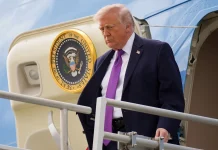
It was not just any crowd. Tens of thousands—Vatican figures put the number at 150,000—had gathered where modern glass meets Ottoman stone to hear Pope Leo XIV, the first American elected to the papacy, deliver what felt less like a homily and more like a plea: for unity, for justice, for a country that can remember its better angels.
“Cast off the armour of our ethnic and political divisions,” he implored, voice steady under the hot sky. “We must unite our efforts so that this land can return to its glory.”
Scenes from the Waterfront
Students, shopkeepers, priests in cassocks and pensioners in sun hats clustered along the esplanade. They waved tiny Vatican and Lebanese flags in the same palm as their phones. Men and women shielded themselves from the strong Mediterranean light with umbrellas that fluttered like small sails.
“We came before dawn,” said Maroun al‑Mallah, a university volunteer with a tired, hopeful smile. “You can feel it’s a reset. Even if it’s a small one. We’ve had pain after pain—especially after the port blast. Today felt like the city was saying, ‘Maybe we can breathe again.'”
The scene was cinematic: the pope touring the crowd in an enclosed popemobile, stopping to bless, to nod, to meet faces lined with history. The spectacle masked the deeper, quieter weight that every Lebanese soul carried—grief, anger, and an almost scientific exhaustion at promises unkept.
At the Edge of Rubble: Memory and Demand for Justice
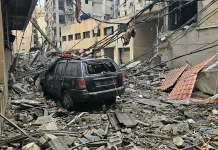
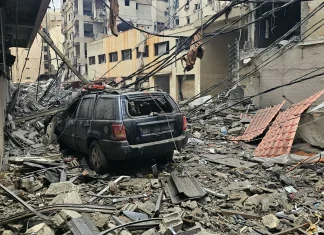
Hours before the mass, Pope Leo paused at the scar of Beirut’s 2020 port explosion, laying a wreath at a memorial where photographs of the dead fluttered in the wind. The blast, which killed more than 200 people and caused billions of dollars in damage, still sits in the national consciousness like an unhealed wound.
He walked slowly among survivors and relatives from different faiths, greeting them and offering rosaries tucked in pouches embossed with his coat of arms. A woman who lost her brother reached out to embrace him; she sobbed. He embraced her back.
“He will raise his voice for justice, and we need justice for all the victims,” said Cecile Roukoz, who holds a photograph of her brother like a small, stubborn lantern. “We need someone to say we will not forget.”
When Faith Meets Accountability
The pope’s gesture at the blast site carried symbolic weight. Investigations into the explosion have been repeatedly delayed or obstructed, and no one has been held accountable. For many Lebanese, ritual without remedy feels like salt in an old wound.
“Faith can comfort, but faith cannot replace the work of institutions,” said Dr. Leila Haddad, a Beirut‑based political scientist. “Religious leaders can convene a conversation across sectarian lines, but the hard, technocratic steps—justice, reforms, rebuilding—must follow. Otherwise, this momentum fizzles.”
Lebanon’s Intertwined Crises
It is impossible to paint the pope’s visit without tracing the tangle of crises that brought Lebanon to this moment. The country hosts roughly around a million Syrian and Palestinian refugees, a demographic pressure that has strained public services. Since late 2019, Lebanon has endured a dramatic economic collapse: the local currency has lost much of its value, unemployment has soared, and a large proportion of families now live in multidimensional poverty, measured not just by income but by access to health, education and basic utilities.
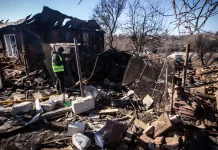
Then add the spillover of regional conflict. Last year’s intense exchanges between Israel and the Iran‑aligned Hezbollah left neighborhoods shattered and nerves raw. The threat of renewed hostilities hangs like a low, constant thunder.
- 2020 Beirut port explosion: over 200 fatalities and billions in damages (official estimates vary)
- Refugee presence: approximately one million Syrian and Palestinian refugees in Lebanon, placing strain on infrastructure
- Economic collapse: currency depreciation and widespread poverty since late 2019 with long‑lasting social effects
Voices on the Ground
“People ask, ‘What can one visit change?’” said Father Georges Nassar, a Maronite priest whose parish sits in a neighborhood scarred by the explosion. “Change isn’t instant. But when a global religious leader kneels where we knelt and names what’s wrong—corruption, impunity, division—it validates our grief and puts pressure on those who govern.”
“This place has long been a mosaic of religions,” said Nour al‑Amin, a teacher who keeps a small icon in her classroom. “We are Christians, Muslims, Druze. But that diversity has been used as a political lockbox. Can faith free us from that lock? Maybe. But faith has to be paired with courage from politicians and accountability from institutions.”
Experts Weigh In
“Religious leadership can act as a bridge in fragmented societies,” said Dr. Michael Turner, an expert in conflict resolution at an international think tank. “But bridge building must be followed by structural investment—transparent courts, functioning public services, and economic opportunity. Without those, the bridge becomes a spectacle, not a pathway.”
Beyond Beirut: A Mirror for Fragile States
Lebanon’s story resonates well beyond its shores. It is a compact case study of how climate, conflict, economic mismanagement and displacement can conspire to hollow out a country’s institutions. It is a cautionary tale and, to others, a call to empathy.
How do societies stitch themselves back together after trauma? Can religious figures catalyze political redemption? In an age where populism and sectarian politics are surging in many parts of the world, Lebanon asks a question we all must answer: what do we owe each other when the systems we trusted fail?
The pope’s visit did not produce policy roadmaps or immediate indictments. It produced something quieter, and perhaps more crucial: a public naming of pain, a shared mourning, and, for a moment, a crowd that believed—just for a day—that unity was possible.
What Comes Next?
After the crowds dispersed and the last flags were folded, Beirut settled back into the difficult business of daily life. The port’s ruins remain, the economy still teeters, and political rivalries endure. But the visit left behind small sparks: survivors who felt seen, volunteers who felt emboldened, politicians gently nudged by the optics of global attention.
Will those sparks catch? Can rhetoric be translated into reform? Those are questions that will be answered in months and years, in courts and parliaments, in hospital wards and classrooms.
As you read this from wherever you are—city, suburb, or island—ask yourself: when a nation asks for unity, what does solidarity mean in practice? How do you show up? Lebanon’s story is an invitation to consider the hard work of rebuilding trust, brick by brick, prayer by policy.
For now, the memory endures: a waterfront awash in flags, the pope’s steady voice, a woman’s desperate embrace, and a city that refuses to let go of hope. That, perhaps, is the most human thing of all.