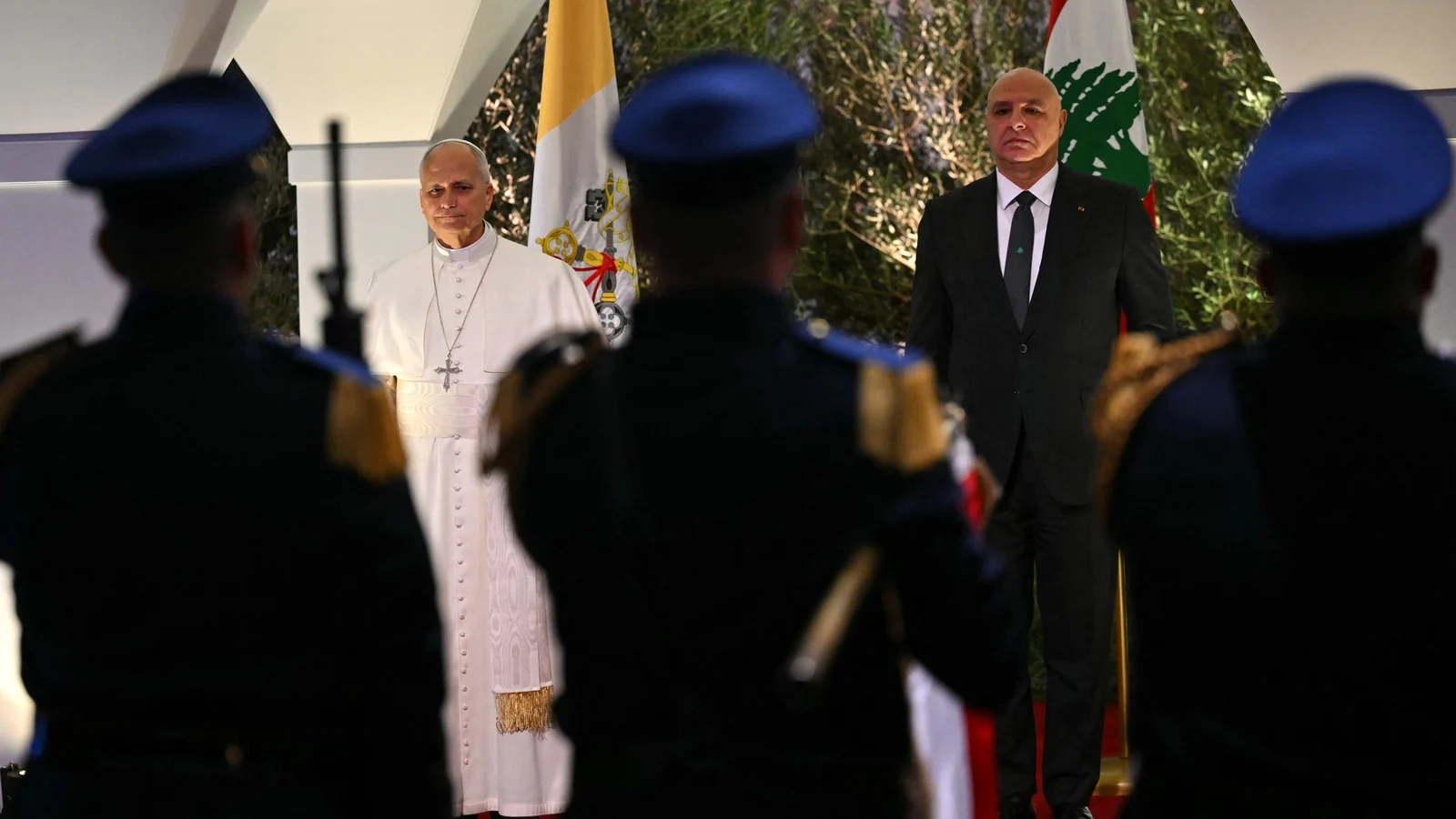
A fragile arrival: a pope steps into a country on edge
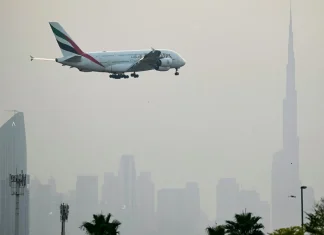
When the plane carrying Pope Leo XIV touched down in Beirut, it was like a soft exhale in a room that has been holding its breath for years.
The morning air smelled of citrus and diesel; city sounds—minibuses honking, the distant call to prayer, a dog barking—folded into the cadence of security vans and motorcades. Flags fluttered on poles. A few dozen residents lined the route, some with flowers, some with hands raised in blessing, others simply watching as if trying to memorize a moment they’d been waiting for.
“We need a sign that life can go on,” said Rania Haddad, a schoolteacher from the Ashrafieh quarter, her eyes fixed on the convoy as it passed. “Not a political bandage. A real breath of peace.”
Why the world is watching
Lebanon is a mosaic of communities and contradictions: a country of roughly six million people, including around one million Syrian and Palestinian refugees, where centuries-old religious traditions sit alongside a modern cityscape scarred by 21st-century crises.
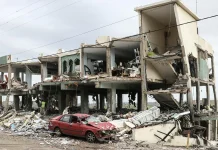
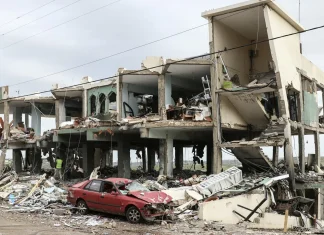
Since 2019, Lebanon has been reeling from a financial collapse that plunged much of the population into poverty, with more than three-quarters of households reporting dire economic strain. The 2020 Beirut port explosion, which killed over 200 people and caused billions of dollars in damage, remains a fresh wound in the city’s collective memory. Add to this the regional spillover of the Gaza conflict and the intermittent clashes between Israel and Hezbollah in the south, and you have a nation that often feels perched on the edge.
That precariousness is precisely why Pope Leo’s two-day visit feels larger than its schedule: the pontiff arrives as a moral and diplomatic signal, a personification of global attention placed upon a small country carrying outsized burdens.
A message of peace amid the rumble of rockets
In a region where headlines frequently turn to violence, a religious leader’s words can be both balm and accelerant. Lebanon’s officials and civil society leaders have been eager to frame the visit as a plea for restraint.
“We welcome any voice that can pierce the fog of hatred,” said Naim Qassem, a senior figure in Hezbollah, in a brief televised comment, adding that he hoped the pope’s presence would press for an end to attacks. “Every human life should be shielded from war.”
“This is a chance for the world to look at Lebanon’s suffering, not just our geopolitics,” President Joseph Aoun told aides prior to their meeting. “We are a people with a history of coexistence; we want that story to continue.”
At the same time, many Lebanese worry about what may come next. Recent months have seen renewed hostilities along the southern border, and the fear of escalation is constant in the villages that fringe the Blue Line. “We sleep with one ear open,” said Karim, a 42-year-old farmer from the south who asked that his surname not be used. “Every time the sky darkens, my children ask if the rockets are for them.”
On the ground: neighborhoods, hospitals, and a nation’s heartbeat
Pope Leo’s itinerary is densely packed: five cities and towns across the country, an outdoor Mass on the Beirut waterfront, a meeting at the presidential palace, and a prayer at the ruins of the port—one of the most potent symbols of Lebanon’s recent trauma.
He will also visit a psychiatric hospital, one of the few such institutions in Lebanon, where caretakers speak of growing demand and shrinking resources. “Mental health has been the silent victim of the past years,” said Dr. Layla Mansour, a psychiatrist who has worked at the facility for over a decade. “Trauma doubled with economic despair. People come in for treatment and leave to face a currency that buys less every day.”
At the hospital, staff prepared small handwritten signs in Arabic and French, welcoming the pope with messages that blended faith and plea: “Pray for our children,” read one. “Pray for our dignity,” read another.
Visiting a city of scars
The port site where the pope will pray is a place of ritualized mourning. Families have installed memorials; photos hang on cracked walls; rusted containers stand like sentinels. “We come here when the world is too loud,” said Amina, a widow who lost her brother in the blast. “We come to remember him with people who understand sorrow.”
Interfaith bridges and uneasy lines
Before landing in Beirut, Pope Leo visited Istanbul’s Blue Mosque and attended an Orthodox liturgy—a small but deliberate sequence of gestures toward interfaith engagement. Ecumenical Patriarch Bartholomew, presiding at the Orthodox service, underscored what many hope the papal trip will spell out: “Christians must stand together in unequivocal condemnation of war and violence,” he said.
In Lebanon, where Christians, Muslims, Druze, and others share neighborhood streets and family ties, such appeals resonate. Sheikh Sami Abi al-Muna, a leading Druze cleric, described the visit as “a glimmer of hope”—a phrase repeated by many who long for a renewal of trust among communities.
But bridges are fragile. The pope will not travel to the south—areas that have borne the brunt of strikes—so his reach has symbolic limits. Still, for many locals, the symbolism matters. “This is not about politics alone,” said Mireille Khoury, a baker whose shop sits near the waterfront. “It’s about saying to the children who watched flames last year that the world still cares.”
Numbers that matter
Context sharpens the moment: Lebanon’s economy shrank by roughly 60% in the first years after the currency collapse, according to World Bank estimates, and unemployment has remained stubbornly high. Food and fuel prices have surged; hospitals have cut back; public services tremble. Against this backdrop, a global religious leader’s visit is an intervention in narratives as much as in policy.
How much can a papal visit change geopolitics? Not much in the immediate sense. But soft power is not nothing. It can influence diplomats, remind international media of human stories behind policy decisions, and inspire local conversations about reconciliation and reconstruction.
What happens next—and what the visit could mean
There will be speeches, prayers, and handshakes. There will be photographs that travel the globe. And then the motorcade will depart, and life will continue in the small shops, the UN tents, the refugee camps, and the neighborhoods where ordinary resilience keeps the city alive.
“We don’t expect miracles,” a volunteer at a community center told me as the pope’s motorcade passed by. “We hope for attention that leads to action—funds for rebuilding, support for mental health, pressure for ceasefires. We want the world not to look away.”
So I ask you, reader: in a world where conflicts flare and faith is often politicized, what do we owe to places like Lebanon? Is a visit from a global religious figure a balm, a bargaining chip, or both? And how do we turn moments of international focus into sustained commitment to human dignity?
Pope Leo’s two days in Lebanon will be measured in speeches and shared moments. But the true test is what comes after—the policies, the aid, the quiet work of rebuilding trust between neighbors. For a nation that knows how to survive, hope is not a prediction; it’s a practice. Let’s watch, listen, and—if we can—help keep the practice alive.