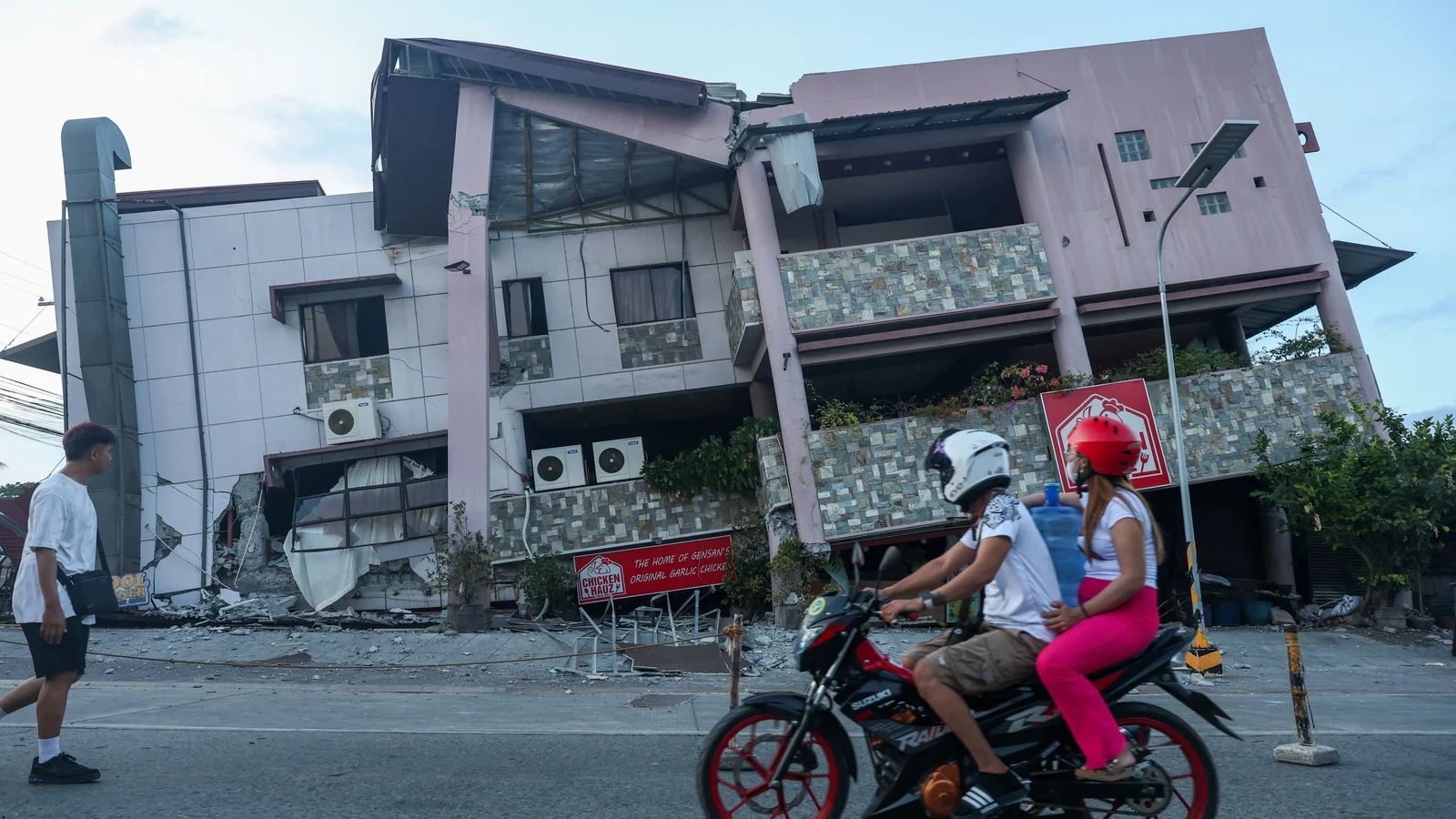
A massive 7.8‑magnitude earthquake off the southern Philippine island of Mindanao has pushed the confirmed death toll to at least 32, disaster officials said, as Manila intensified search and rescue efforts and assessed widespread damage.
The quake — strong enough to prompt tsunami warnings in multiple countries — struck early in the morning roughly 20 km off the coast of Sarangani province. Tremors were felt across Mindanao and as far as Manado, about 420 km away on Indonesia’s Sulawesi island.
In General Santos City, the hardest-hit area and home to around 700,000 people, residents described a terrifying jolt unlike anything they had previously endured.
“It was the first time I experienced something that strong, that I really couldn’t stop myself from tearing up. I thought about my children and my niece, what if something had happened to them?” said Jojo Calma, 44, who was driving his motorised tricycle taxi in front of a building when it collapsed.
Building collapse caught on video
Local government video captured the moment the building — which housed a fast-food outlet — gave way, sending onlookers running as a thick cloud of dust billowed into the street.
Mr Calma said his children were at school when the earthquake hit and are safe, though his sibling’s home was destroyed. “Thank God they’re okay,” he said.
The quake struck just as schools were returning from a long break.
Watch: Roof collapses on Philippine school amid earthquake
The Philippines deployed military units and disaster response teams while authorities worked to confirm initial reports of 32 deaths and 134 injuries across Mindanao, civil defence officials said. Most casualties were linked to falling debris and landslides.
Tsunami warnings were lifted after more than six hours in the southern Philippines, northern Indonesia and Malaysia’s Sabah state on Borneo, where coastal residents had been ordered to move immediately to higher ground.
The latest disaster comes eight months after the Philippines recorded its deadliest quake in 12 years: a shallow 6.9 magnitude tremor off the central island of Cebu that killed 79 people.
Two powerful quakes struck Mindanao two weeks later, the strongest registering magnitude 7.4.
‘We will not leave Mindanao behind,’ president says
President Ferdinand Marcos Jr ordered an immediate emergency response for Mindanao, instructing agencies to ready relief supplies and evacuation centres and to prepare for possible rescue operations.
“The national government is moving and we will not leave Mindanao behind,” MrMarcos said in a statement.
The Philippines and Indonesia are hit by hundreds of earthquakes each year and lie along the Pacific “Ring of Fire”, a vast, seismically active zone stretching from South America to the Russian Far East.
Officials were still gauging damage to buildings, utilities and infrastructure in other provinces. However, disaster officer Bong Dacera told a media briefing that structural checks in General Santos could not begin yet because of continuing aftershocks.
‘No electricity or water’
According to the Philippine seismology agency, more than 200 aftershocks followed, including at least nine that were strong and felt across Mindanao. The largest measured magnitude 6.7.
In General Santos, shops and buildings suffered damage — some with shattered glass and broken signage, others collapsing into heaps of concrete and rubble.
One hospital was evacuated over concerns about cracks on upper floors. A building at Notre Dame of Dadiangas University in the city also collapsed, though no-one was inside.
Infographic map shows shake intensity on Mindanao Island
Footage shared by a school showed the moment the quake hit: children seated on the floor swayed sharply side to side, some clutching their teachers, before rushing out together as a makeshift shelter fell behind them.
Benjie Ancheta, police chief in Alabel town in Sarangani, said the shaking struck during a police flag-raising ceremony, causing some people to faint.
Indonesian islanders move to higher ground
The US Tsunami Warning System said several countries could be affected, and Australia initially cautioned that tsunami waves were possible along its northern coasts.
Japan’s meteorological agency issued an advisory, reporting a tsunami of 0.2 m or lower and noting ferry disruptions and precautionary beach closures.
In Indonesia, witnesses in Manado said the quake was felt strongly.
Only minor damage was reported, said Abdul Muhari, spokesperson for Indonesia’s disaster mitigation agency.
In parts of North Sulawesi, a tsunami with waves up to 0.75 m was detected. Residents began moving to safer areas, including people in the remote Sangihe Islands, among the closest Indonesian communities to the Philippines.
Earthquake rattles Cuban capital Havana
Elsewhere, a strong earthquake struck off western Cuba on Monday, with journalists in Havana describing about 20 seconds of shaking that drove people out of buildings and into the streets.
The US Geological Survey said the quake measured 6.1 magnitude and hit about 62 miles (100 kilometres) off the island’s western tip.