Delhi’s Long Embrace: Oil, Occasions, and the Art of Diplomatic Balance
New Delhi rolled out a ceremonial carpet this week—flags snapping, brass gleaming, an honour guard in starched uniforms—yet the pomp was only the prelude to a far quieter, more combustible drama: the flow of oil that keeps factories humming, buses moving, and political engines burning on two continents.
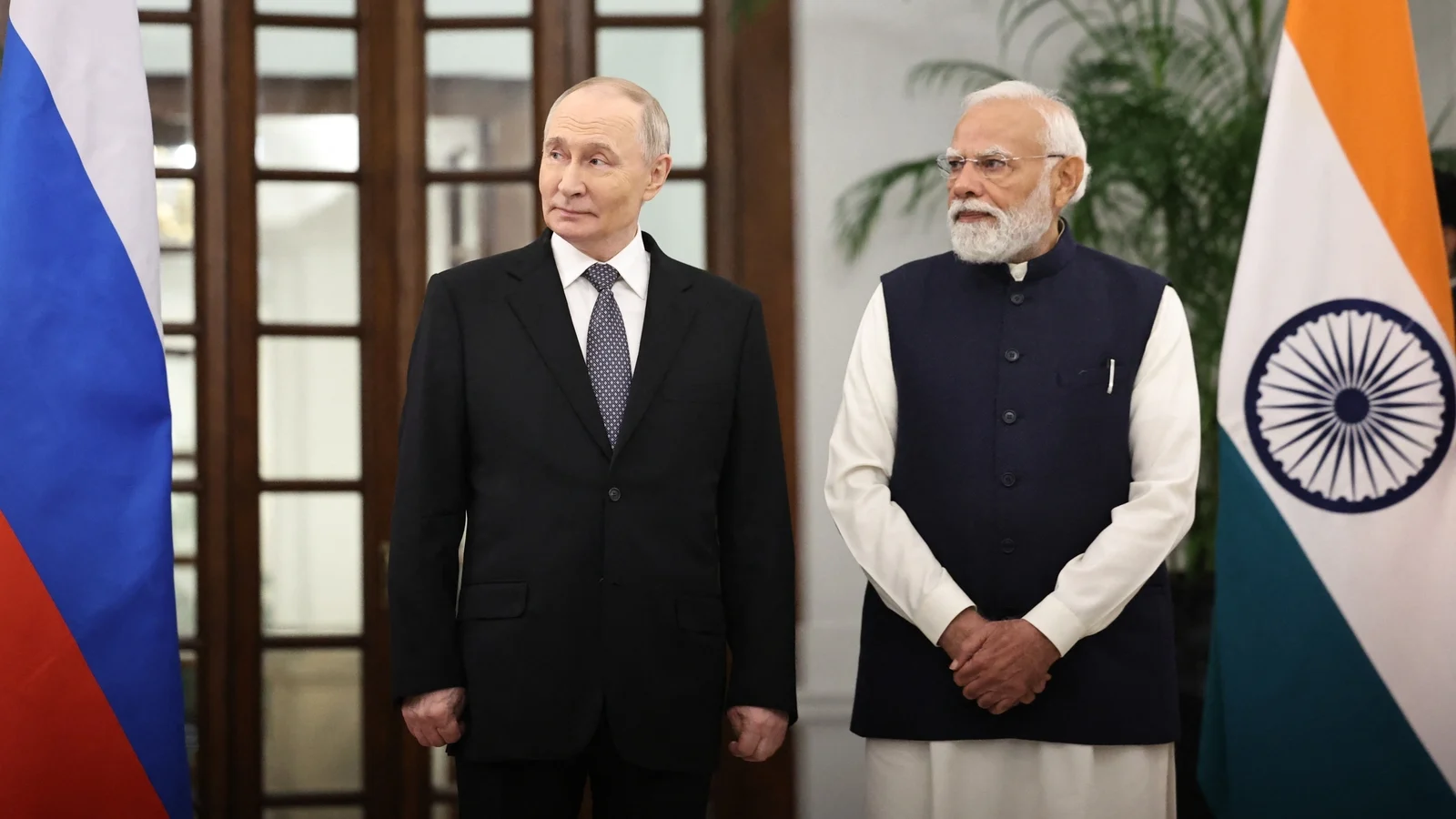
President Vladimir Putin arrived under a 21-gun salute and tight security, a state visit that felt both historic and fraying at the edges. For a country that has long prized strategic autonomy, the summit was a study in contradictions—handshakes and banquet halls shadowed by sanctions, tariffs, and an American ultimatum that has put New Delhi in a diplomatic vise.
Energy first, always
“Energy security is not an abstract policy; it’s a daily fact,” said a veteran oil analyst in Mumbai, watching the motorcade from his office window. “When refineries need crude, you do not negotiate morality—you negotiate pipelines, pricing, and delivery dates.”
India’s appetite for crude has turned Moscow into a central supplier. In 2024, nearly 36% of India’s total crude imports — roughly 1.8 million barrels per day — came from Russia, much of it at discounted rates that have helped refiners lock in margins even as global prices oscillate.
That dependence is the hinge around which this summit spun. Behind closed doors, trade delegations agreed to expand economic ties through 2030, and government officials sketched plans to deepen cooperation in nuclear energy, shipping, and technology. Yet for many Indians on the street, the literal image of tankers lining up at western ports is what mattered most.
“If the price is right, my factory can run, my workers can be paid,” said Meera Patel, who runs a small textile unit in Gujarat. “I don’t want politics to make my machines stop.”
Tariffs, pressure, and a diplomatic tightrope
The pressure on New Delhi is unmistakable and public. In August, the United States slapped a sweeping 50% tariff on most Indian products, citing India’s continued purchases of Russian oil as revenue that helps fund Moscow’s war in Ukraine. The punitive measure forced New Delhi to make adjustments—imports from Russia have been reduced in recent months—but it did not sever the relationship.
“India has to walk a balancing act,” explained a former diplomat familiar with Indo-Russian ties. “We are navigating strategic needs—defence, energy, long-term partnerships—while also trying not to collapse a more valuable commercial relationship with the US.”
That balancing act is visible in the figures. Bilateral trade between India and Russia surged to $68.7 billion in 2024–25—almost six times the level before the pandemic—but Indian exports to Russia were modest by comparison, totaling about $4.88 billion. The asymmetry fuels a sense that the relationship is tilted toward Russian exports—oil above all—while India seeks more balanced reciprocity.
Beyond the bouquets: defence, industry, and diversifying suppliers
Russia has long been a principal supplier of military hardware to India. But that dependence has been changing. Data from the Stockholm International Peace Research Institute shows the Russian share of India’s arms imports fell from 76% in 2009–13 to 36% in 2019–23, a sign that New Delhi is opening its doors to alternative suppliers and boosting domestic production.
“We are not breaking old friendships; we are broadening them,” said an Indian defence official. “Our procurement policies are pragmatic. We buy what we need, where we can get the technology, transfer of know-how, and domestic industrial benefits.”
This summit, then, was less about romance and more about transaction—intellectual property, joint ventures, and access to markets. Delegations signed deals covering jobs, health, chemicals, and shipping, and sketched joint programmes that New Delhi hopes will reduce its trade gap while maintaining energy and defence ties.
- Trade and investment framework to 2030
- Agreements on shipping and maritime cooperation
- Collaborations in nuclear energy and research
Voices from the capital and the coast
On a narrow lane not far from the presidential palace, an auto-rickshaw driver named Arjun watched the televised ceremonies and shrugged. “They talk about strategy,” he said, “but my family worries about diesel prices. Diplomacy must come home.”
At the Jamnagar refinery complex in Gujarat—one of India’s largest—the hum of pumps and boilers tells its own story: global geopolitics is processed into diesel and jet fuel, refined into everyday life. A site manager there commented, “When you lose a supplier, you scramble. With Russian crude, we have certainty of tonnage and often price. If that changes overnight, the shock is felt across the board.”
Meanwhile, an energy economist in Delhi warned against simplifications. “Discounted Russian barrels are not a free lunch,” she said. “They alter market signals, affect the viability of other suppliers, and complicate India’s relationships with Western powers—especially when those powers tie oil purchases to geopolitical objectives.”
What does the world see?
For Washington, India’s purchases of Russian oil are not merely commercial; they are part of a larger conversation about sanctions, accountability, and the cost of war. For Moscow, India has become both a customer and a diplomatic counterweight. For India, it is a pragmatic choice in a world of limited options.
“We want to be friends with everyone,” the former diplomat said quietly. “But sometimes being friends means tolerating differences. India’s calculus is shaped by geography, development needs, and domestic politics.”
The bigger picture: energy, sovereignty, and the new maps of power
Ask yourself: should energy policy be insulated from moral judgments, or is it inevitably political? As nations try to insulate their economies from shocks, the modern map of influence is sketched not with borders but with pipelines, ports, and payment mechanisms. India’s choices reflect a growing global reality—middle powers asserting agency amid competing pressures from old allies and new coalitions.
Putin’s message here was plain: Russia can keep the taps open. New Delhi’s reply was subtler: it will keep buying where it serves its needs, but it will also expand partnerships, diversify arms suppliers, and pursue domestic manufacturing.
“This isn’t a romance novel,” said a political analyst in New Delhi. “It’s an economic ledger with pages being written in real time.”
By the time the state banquet ended and the last toasts were made, the headlines had been written. But the real story will be measured in shipments, contracts, and decisions made in boardrooms and ministries over the coming months.
Will New Delhi find a path that satisfies both its strategic autonomy and its commercial relationships? Or will global politics force a sharper choice between friends? Keep watching the tankers—their itinerary may tell you more about the future than any summit speech.