“I tell you, it will go well. It will be a super event. That’s what they’re good at, the Americans. They know how to organise stuff.
“I hope it will be affordable for everybody at the end of the day. I hope that ticket prices still come down. I see the reasons why everybody is sceptical but go there first and make up your own mind.”
That was former Germany striker Jürgen Klinsmann, speaking recently on the ‘Stick to Football’ podcast as he weighed in on how the FIFA World Cup in the US, Canada and Mexico might unfold.
Klinsmann, who has lived in the United States since the early 2000s and previously coached the US national team from 2011 to 2016, may be looking at the tournament with more optimism than many supporters currently feel.
FIFA President Gianni Infantino said the 2026 World Cup will be ‘ground breaking’
Even as war, inflation and travel bans form part of the wider backdrop — including the case of Somali referee Omar Artan — FIFA has forecast enormous financial returns from a tournament that will be the biggest World Cup ever. The 2026 edition expands the field from 32 teams to 48 and stretches the schedule to 104 matches.
In December 2025, the FIFA Council signed off on a record financial contribution of $727 million tied to the 2026 World Cup.
That decision also reflected a sharp increase in prize money, with the overall pot rising by 50% compared to Qatar 2022.
The champions will take home $50 million and the runners-up $30m, while payments extend down the table to $9m each for teams finishing between 33rd and 48th.
From the $727m package, $655m represents the prize-money allocation for the tournament itself.
Teams also received $1.5m to cover participation costs, ensuring every side at this year’s World Cup will collect at least $10.5m.
Mexican fans celebrate as they watch their team score against South Africa
Those sums, staggering as they are, pale next to FIFA’s own projections for what the event will generate. The organisation expects revenues of $13 billion across this four-year World Cup cycle.
For context, the 2022 World Cup cycle produced $7.5bn — a figure that made Qatar FIFA’s most profitable World Cup to date, a mark 2026 is expected to surpass.
“The FIFA World Cup 2026 will also be ground breaking in terms of its financial contribution to the global football community,” FIFA President Gianni Infantino said.
After the final draw, also held in December, Infantino went further, calling it “the greatest event humanity has ever seen”.
“This is like 104 Super Bowls in one month – this is the magnitude of what we are organising,” he added.
Yet beyond the rhetoric and record numbers, one question keeps surfacing: will the World Cup feel like a festival for fans inside the stadiums — or an exercise in sticker shock?
Ticket prices
Ticket costs have become one of the most persistent controversies in the months leading into this year’s World Cup.
For group-stage matches in the US, listed starting prices range from $600 (€518) up to $5,000 (€4,319).
And that is for standard purchases. On FIFA’s official resale platform, the picture is different — and highlights the scale of inventory still circulating.
The Financial Times reported that nearly 180,000 group-stage tickets remain available for resale, with more than 4,000 still on offer for the US’ opening match against Paraguay at the time of writing.
When South Korea came from behind to beat the Czech Republic in the tournament’s second match, much of the post-game conversation focused not on the comeback but on visible empty seats at Guadalajara’s Estadio Akron.
Fans and observers have also pointed to price swings driven by FIFA’s use of the widely criticised dynamic pricing model, which adjusts costs based on demand.
South Korea players celebrate after defeating the Czech Republic in their opening game
State officials noted complaints from supporters who said they paid premium prices only to be seated in a different area than the one they believed they had purchased.
At the end of May, FIFA was served subpoenas by the states of New York and New Jersey as part of an investigation into ticket structures.
Texas joined that effort this week, with the Attorney General’s office opening its own investigation into ticket sales for matches scheduled in Dallas and Houston.
“New Yorkers have been waiting years for the World Cup to come to their backyard, and they deserve a fair shot at affordable tickets,” New York Attorney General Letitia James said in a statement.
She added: “No one should be manipulated into paying sky-high prices for seats, and fans should be able to trust that the tickets they purchased will be the ones they receive.”
Texas Attorney General Ken Paxton struck a similar tone.
“I will work to ensure that FIFA is engaging in ethical and honest business practices so that Texas fans are treated fairly.
“Sports have a unique power to bring people together, and FIFA must understand that Texans take their competition – and their consumer right – seriously,” he said.
Iran’s players take part in a training session at their training base in Mexico
Away from stadium gates and ticketing platforms, geopolitics has also intersected with the controversy. Iran has said the US revoked its ticket allocation only days before the tournament began.
Reuters reported that the Iranian federation (FFIRI) said it had already started selling tickets for matches but could no longer provide them to supporters.
“This is despite the fact that many Iranian football fans, relying on the officially announced process, had already made the necessary plans to attend the matches,” the FFIRI said.
The federation added: “Depriving Iranian supporters of access to their lawful and official allocation of tickets is an action contrary to the spirit governing international competitions and the principle of equality among participating countries.
“This development raises serious questions about the interference of non-sporting and political considerations in the organisation of the world’s biggest football event.”
According to tournament rules, each participating federation receives 8% of the tickets for each of its matches to distribute to fans based on its own criteria.
Match day
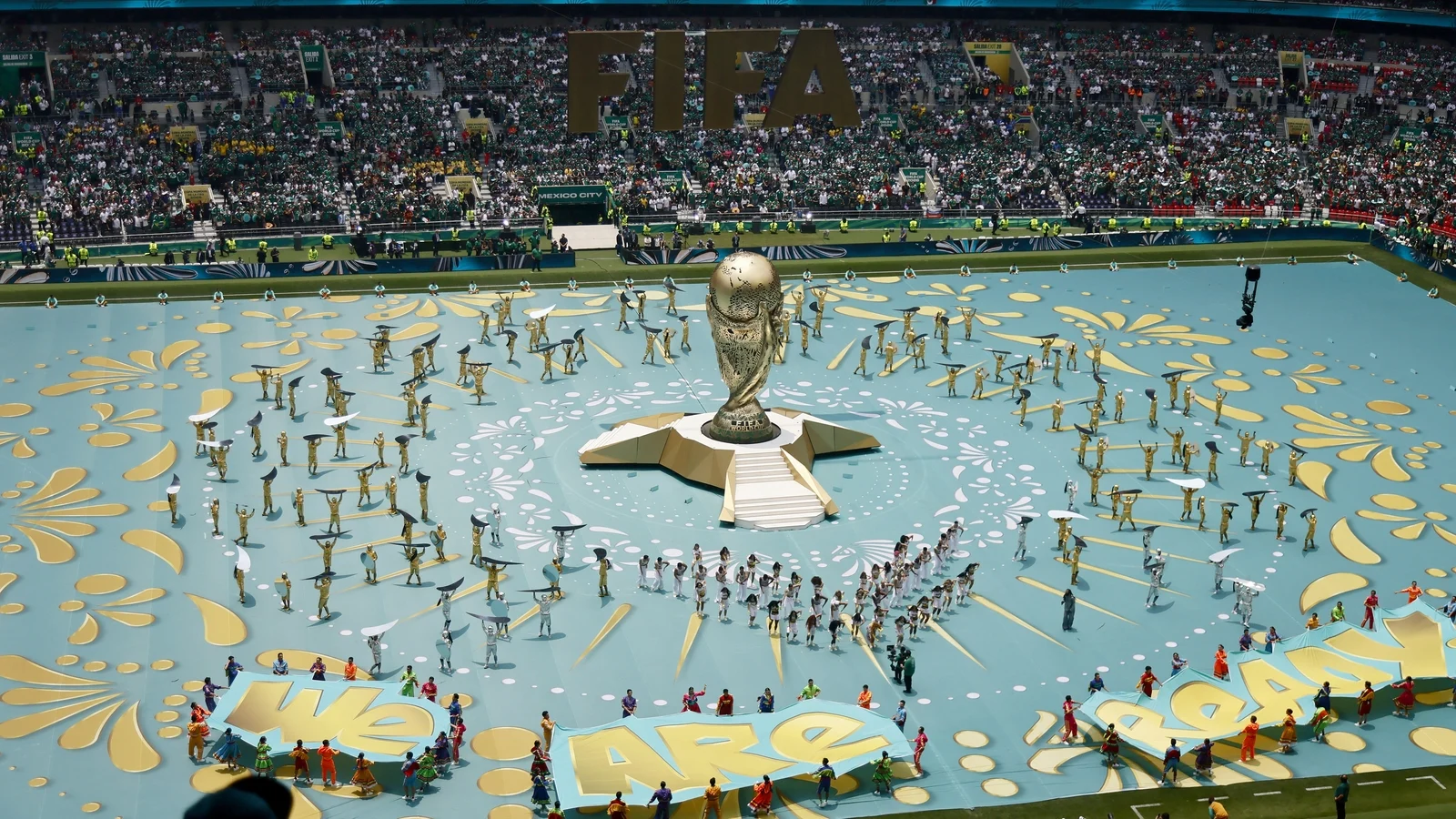
For supporters who have managed to secure tickets — whether through official sales or at steep resale prices — the matchday experience begins with a new look and a heavy dose of spectacle.
FIFA has billed the updated opening sequence as a “bold new vision”, with teams now entering the pitch via their own dedicated arch.
As shown since the tournament began at Mexico’s Estadio Azteca, players then gather around the centre circle, facing the referee as national anthems play.
FIFA says its new “360-degree ceremony” is designed to include spectators throughout the stadium, regardless of where they are seated.
As the tournament progresses, the pre-match routine will add features including coloured smoke and pyrotechnics.
“Having all players and referees face each other in the centre circle during the national anthems will create a moment of unity, pride and emotion that truly belongs to the teams and to everyone in the stadium.
“The FIFA World Cup is about every player and every fan, and this new pre-match ceremony reflects that,” said Infantino.
The comparison to the Super Bowl feels increasingly deliberate.
A view of FIFA’s new pre-match ceremony before matches kick off
The showmanship peaks at the final, where FIFA will stage the first World Cup half-time show.
Shakira is set to perform with Madonna and K-Pop band BTS — a line-up that will, by necessity, extend half-time beyond the standard 15 minutes.
With matches scheduled in high temperatures, fans will be able to bring reusable water bottles after FIFA reversed course on a late attempt to prohibit them in stadiums.
The proposed ban drew widespread criticism, and FIFA rolled it back one week before the tournament began.
FIFA had said the restriction was introduced “to prevent risk and injury to players and attendees”.
Supporters are now permitted to carry one factory-sealed, transparent 590ml bottle, rather than repeatedly paying around $4 for drinks in the heat.
Vuvuzelas, though, remain prohibited — still synonymous with their loud legacy from the 2010 World Cup in South Africa.
Transport
Even with a valid ticket and a permitted water bottle, the cost of simply reaching a venue can be another hurdle.
Earlier this year, reports said train fares were rising across the US in the lead-up to the World Cup.
On the day of the final, a train ticket from Penn Station in New York to Metlife Stadium is expected to cost $98.
After an initial jump set the fare at $150, the price was reduced following another wave of backlash.
Before the increase, that same trip cost $12.50.
US Senator Chuck Schumer, a New York Democrat, said FIFA should shoulder more responsibility.
“Charging more than 11 times the normal fare for a train ride is a rip off, plain and simple.
“FIFA is making billions from this World Cup,” he said in a statement after the original price for the ride to New Jersey’s MetLife Stadium was announced.
“FIFA should cover the ride, not stick New York fans with the bill,” he said.
Now that the tournament is under way, it is possible Klinsmann’s prediction will prove accurate.
The 2026 FIFA World Cup may indeed be a super event — and on scale, spending and staging, it could be the most “super” of them all.
Still, his nod to public scepticism lands for a reason.
For most fans, the hope is simple: to experience the biggest World Cup in history without feeling like they are being fleeced.