Daylight on the Hunt: Nearly 1,000 Drones Turn Ukraine’s Skies into a New Front
On a bright spring day in western Ukraine, the ordinary textures of city life — cafes filling with students, pensioners sweeping stoops, church bells chasing pigeons from rooftops — were ripped open by an unusual, terrifying sound: the whine of hundreds of tiny engines. Sirens blared. People ran for basements and metro platforms. For many, daylight no longer felt safe.
Ukraine’s air force said the scale was staggering: “Taking into account the night attack … the enemy used almost 1,000 strike drones,” it reported, describing the broad geography of the strikes that reached far from the front lines into western regions. In a single daytime salvo, Kyiv’s forces said 556 drones were launched and 541 were shot down — but the tally since the night before reached a record 948. The numbers are cold; the scenes on the ground are not.
Scenes from Lviv and Ivano-Frankivsk: A City Centre on Fire, a Maternity Hospital Damaged
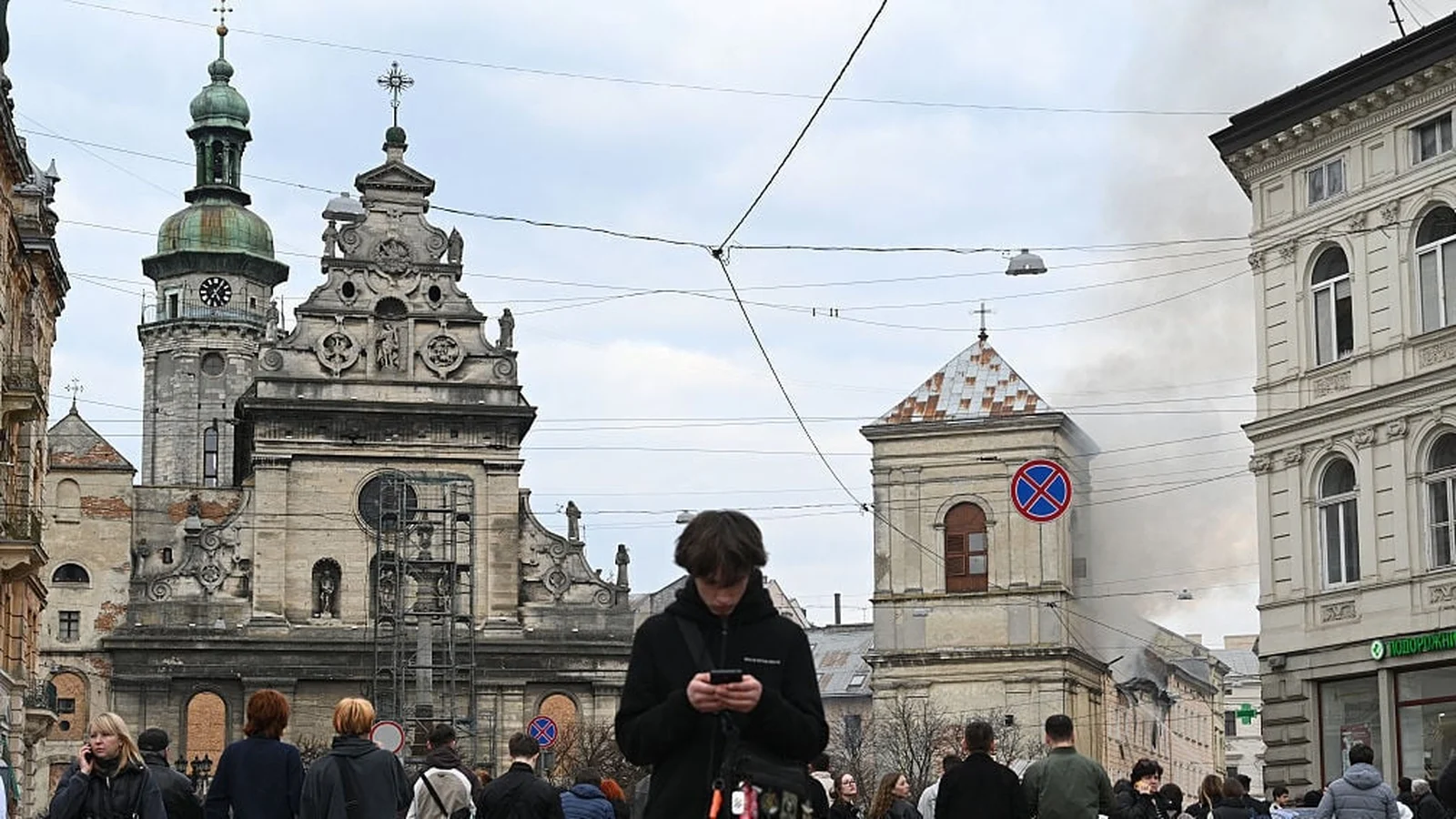
In Lviv, the historic centre — a UNESCO-listed tapestry of baroque facades and cobbled lanes — filled with smoke. Local officials reported a strike against a residential building and a nearby 17th-century church within the old quarter, and the city’s mayor posted images of flames licking through upper floors. Two people were wounded, according to municipal sources.
“We were sitting in the kitchen, and suddenly the whole window rattled,” said Olena, a teacher who lives a few blocks from the old town. “People were shouting ‘to the basement’ as if the city had been turned into a battlefield overnight. My neighbour didn’t want to leave his cat; he carried it like a child.”
Farther east, in Ivano-Frankivsk, the head of the region reported a worse toll: two people killed and several wounded, including a six-year-old, after strikes hit the city centre. Officials said about ten residential buildings and a maternity hospital sustained damage.
“We are used to alarms at night. Daylight is different — it takes something else from you,” said Hanna, a volunteer nurse who helped evacuate patients. “I helped a woman in her sixties down three flights of stairs. Her hands were still shaking when we got her to the shelter.”
Numbers, Responses, and the Machinery of War
The Ukrainian air force’s interception rate — shooting down 541 out of 556 daytime drones — is remarkable and underscores both the effectiveness of air defences and the relentless pressure on them. Yet even when interceptors prevail, the debris, the psychological toll, and the few that get through carry consequences for civilians.
A senior defence analyst in Kyiv, who asked to remain unnamed for security reasons, offered a blunt assessment: “Drones have changed the cost calculus. They’re cheap, expendable, and can be launched in swarms to saturate defences. Shooting them down is possible—but it taxes systems and people. The next wave might hit where they least expect it.”
- Reported drones used by Russia since the night before: ~948
- Daytime drones launched (reported): 556
- Daytime drones shot down: 541
- Confirmed deaths in reported daytime attacks: at least 3
Heritage at Risk: Old Stones, New Weapons
Something else is at stake beyond lives and buildings: memory. Lviv’s historic centre is more than pretty architecture. It is a living archive of centuries — churches, coffeehouses, and markets that have survived empires. When shells or drones strike in the shadow of a UNESCO plaque, the loss is cultural as well as human.
“My grandmother used to bring me here when I was small,” said Artem, who works at a nearby bakery. “To see smoke rising from the roofs made me feel like a thief stealing my own past.”
Moscow’s Domestic Shifts: Arming Private Guards and Fortifying Refineries
As Kyiv reels from drone attacks, Moscow is tightening its own security measures. The Russian government has enacted a law permitting private security firms to carry firearms — including assault rifles such as Kalashnikovs — to defend critical energy facilities. The change takes effect immediately and comes after a series of strikes on Russian refineries and key export infrastructure that have disrupted fuel supplies and stirred panic in some regions.
In parts of the Urals, refinery operators have started installing anti-drone nets and other physical countermeasures. A refinery worker in Bashkortostan told a local journalist: “We wake up to new instructions every morning. Last month it was ‘report suspicious drones.’ This month it’s ‘build a net.’ It’s surreal.”
Diplomacy under Pressure: Security Guarantees and a Complicated Geopolitical Canvas
At the same time, Kyiv and Washington continue to haggle over the shape of security guarantees Ukraine seeks post-war. President Volodymyr Zelensky has insisted for months that a binding security pact is crucial — a promise from allies that would deter future aggression once active hostilities end. Kyiv’s negotiating team met with American counterparts in Florida to push for final details; Zelensky later said more work remained to be done.
“The most important task is to develop security guarantees in a way that brings us closer to ending the war,” he said in a social media update after the talks. But the geopolitical map is shifting: the broader Middle East conflict and Iran’s entanglements have, officials warn, emboldened Moscow.
What This Means Beyond Borders
These events are not merely a regional tragedy. They are a reminder that modern war is messy and multipolar. Drones—sometimes supplied by third parties—lower the barrier to aggression. Private security with military-grade weapons blurs the line between public defence and privatized force. And diplomatic promises, once inked, must be credible enough to deter the next round of attacks.
Ask yourself: what does deterrence look like in a world where a handful of motors can terrorize a city in daylight? How should international law adapt when cultural heritage, civilian hospitals, and playgrounds become contested spaces?
Faces in the Rubble: How People Are Living Through It
Amid the political chess, the human rhythms persist. Volunteers ferry food to shelters. Metro stations become impromptu clinics. Priests ring church bells for the missing and the dead. A young father in Ivano-Frankivsk, pushing his toddler in a stroller, summed it up simply: “We talk about normal life like it’s a future tense. Today, we are surviving.”
Ukraine’s resilience is not mythic; it is everyday: neighbours sharing warm bowls of stew, students teaching children who missed school, an elderly woman knitting by candlelight in a basement shelter. Those small acts are the glue, fragile and fierce.
As the world watches the statistics climb and the diplomatic language thicken, these personal moments remind us what is actually at stake: ordinary lives, ordinary joys, and the fragile scaffolding of community that keeps them aloft. Will global powers step up with guarantees that can hold? Will new defensive technologies outpace the threat? For now, people in Lviv, Ivano-Frankivsk and beyond are answering with the most human of responses—courage, kindness, and the stubborn refusal to be broken.