Brussels at Dawn: When Money Became a Battleground for Europe’s Future
The hallways of the European Council in Brussels felt like the lounge of a warship—tense, dry, full of maps and the sound of many clocks. Outside, winter pressed its face against the windows; inside, leaders were wrestling over a different kind of cold asset: billions of euros frozen in the chaotic aftermath of an invasion.
For weeks, the debate had been framed as a technical fix—how to unlock cash to keep Ukraine alive. At its heart, however, were questions much bigger than finance: who decides the limits of sovereignty in wartime, what risks is a union of 27 willing to shoulder for a neighbour, and when does law bend to necessity?
Three Ways to Keep Ukraine Afloat
By mid-December, EU officials were quietly circulating three options to channel support to Kyiv.
- Joint EU debt: Brussels borrows on capital markets, backed by remaining EU budget headroom.
- Direct bilateral loans: Member states individually lend to Ukraine.
- The “Reparations Loan”: Use immobilised Russian central bank assets as a guarantee to underwrite lending.
Each option carried its own legal tangle and political poison. Each would define Europe’s appetite for collective risk.
Frozen Funds, Fiery Politics
When Russia invaded in February 2022, EU sanctions froze roughly €210 billion in Russian central-bank assets. About €185 billion of that pot sat in Euroclear’s securities depository in Belgium—a symbol now of both leverage and liability.
“This is money that’s not merely numbers on a balance sheet,” said an EU diplomat who asked not to be named. “It has become leverage in negotiations, but it’s also a tinderbox. If you touch it wrong, it explodes in your face.”
Some capitals, notably Dublin and Berlin, saw a moral case for converting these immobilised reserves into a tool for Ukraine’s reconstruction and defense. Others—Belgium above all—warned of legal and political blowback. “You cannot make a rule today that legitimises seizing another state’s central-bank holdings and expect no consequences,” Belgium’s prime minister told colleagues, according to people in the room.
Legal Lines and Courtroom Shadows
Legal advisers were split, but one theme emerged: there is no neat international court that will deliver an unequivocal answer about the legality of turning frozen central-bank reserves into a quasi-reparations fund.
“In theory, Russia could sue, and in practice, enforcing a favourable judgment against a state that refuses to recognise a court is exceedingly difficult,” said an international-law scholar at a major European university. “At the same time, you cannot pretend the risk is zero—companies, banks, and politicians may face pressure points that are hard to quantify.”
That uncertainty was sharpened when Russia’s central bank filed a claim in Moscow seeking roughly €190 billion in damages from Euroclear. The filing was theatrical—and strategically aimed at countries that might be receptive to Russian jurisdiction. The legal paper trail multiplied the anxiety inside capitals that had already lost businesses and investments because of the war.
A Fracture Line Runs Through the Union
What could have been an orderly, technocratic choice morphed into a referendum on solidarity. Hungary and Slovakia—both with leaders who have kept warmer ties to Moscow—were reluctant to endorse anything that might financially bind them for Ukraine’s debt. Ireland and several northern states pushed for bold action. Belgium insisted on ironclad guarantees that any legal-claims fallout would be mutualised across the Union.
“We’re asking our citizens to accept a risk we don’t fully control,” said a Belgian finance official. “If a Belgian company loses property abroad as retaliation, who pays? That’s not a theoretical exercise. That’s a family that loses a pension.”
On the other side of the argument, voices of urgency grew louder. “It is money today, or blood tomorrow,” said an Eastern European leader at the summit, echoing a sentiment that was part moral calculus, part plea. The phrase—brisk, stark—captured how some saw the debt decision as a short-term financial trade for longer-term life-and-death consequences.
A Summit Stretched Into the Small Hours
Negotiations pushed into the night. Technical teams rewrote legal texts, lawyers debated Article 122 of the Lisbon Treaty, and suddenly familiar rules looked optional—if you could find a legal pathway to justify them.
Belgium’s demand for a blanket indemnity—covering corporate losses, legal claims, even retaliation—proved the deal-breaker for the plan that would have leveraged Russian assets directly. Modified draft language that appeared shortly before dinner essentially made Belgium’s indemnity unlimited. It was a non-starter for nations that had asked businesses to exit Russia and had already accepted the pain of lost market share and assets.
“We were asked to guarantee other people’s risks without a clear cap,” said a finance minister from a southern member state. “It subverts the principle of proportionality; it’s not sustainable.”
When the Deadline Is 3 a.m.
At around 3 a.m., exhaustion and pragmatism found common ground. Leaders abandoned the novel reparations construct and instead resurrected a more traditional route: joint EU borrowing. The compromise would raise roughly €90 billion over two years, using an enhanced-cooperation mechanism to sidestep unanimity rules that would have allowed a single member state to veto the initiative.
Under the deal, Russia’s assets remain frozen and could later be used to service the debt if reparations are ever enforced. For Ukraine, the result was a guarantee of funding for the coming years, an insurance policy against immediate economic collapse.
Faces at the Table, Voices on the Street
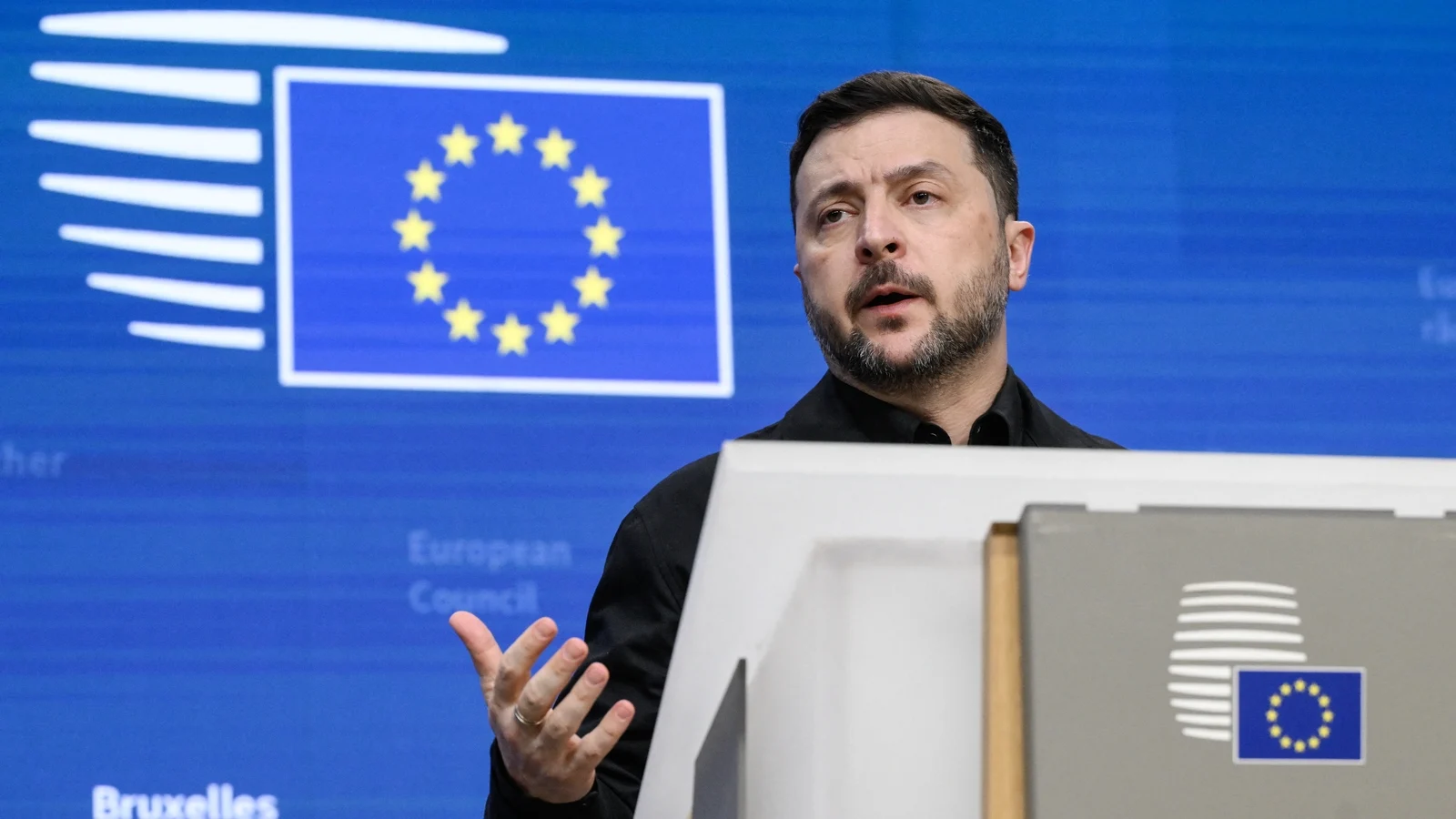
After the vote, Kyiv’s president posted gratitude on social media; European leaders praised unity. EU officials framed the result as a sober, realistic response—one that preserved legal safeguards and secured short-term financing.
In Brussels cafés the next morning, the conversation felt like a Greek chorus: relief threaded with worry. “It’s a victory, but a cautious one,” said Elena, a Ukrainian café owner who fled Kharkiv and now runs a small bakery near the EU quarter. “We still live day to day. The money helps, but the war continues.”
At a factory in Poland that had begun producing drones for Ukraine’s front lines, an engineer wiped his hands and conceded, “This will buy us time. But time alone won’t win this. We need strategy, not just loans.”
Bigger Questions Remain
What did the summit truly settle? A short-term funding gap, yes. But also a larger question about Europe’s geopolitical maturity: can a union with diverse histories and interests translate moral commitments into collective risk-taking without fraying under pressure?
The episode exposes the growing phenomenon of financial statecraft—where reserves, sanctions, and legal instruments are as much weapons as tanks and missiles. It also underscores how fragile alliances can be when domestic politics and legal realities collide.
So what should you watch next? Look to court dockets, corporate boardrooms, and the unusual legal theories that emerge when politics and money intersect. Watch how enhanced cooperation will be used—or weaponised—going forward. Observe which firms bear losses, and how governments balance the cost of standing with what they say they defend.
In the end, Brussels produced an imperfect solution—messy, human, necessary. It was a reminder that in geopolitics there is rarely a clean answer. There are choices. There are trade-offs. And there are people—bakers, engineers, lawyers, and leaders—who must live with them.