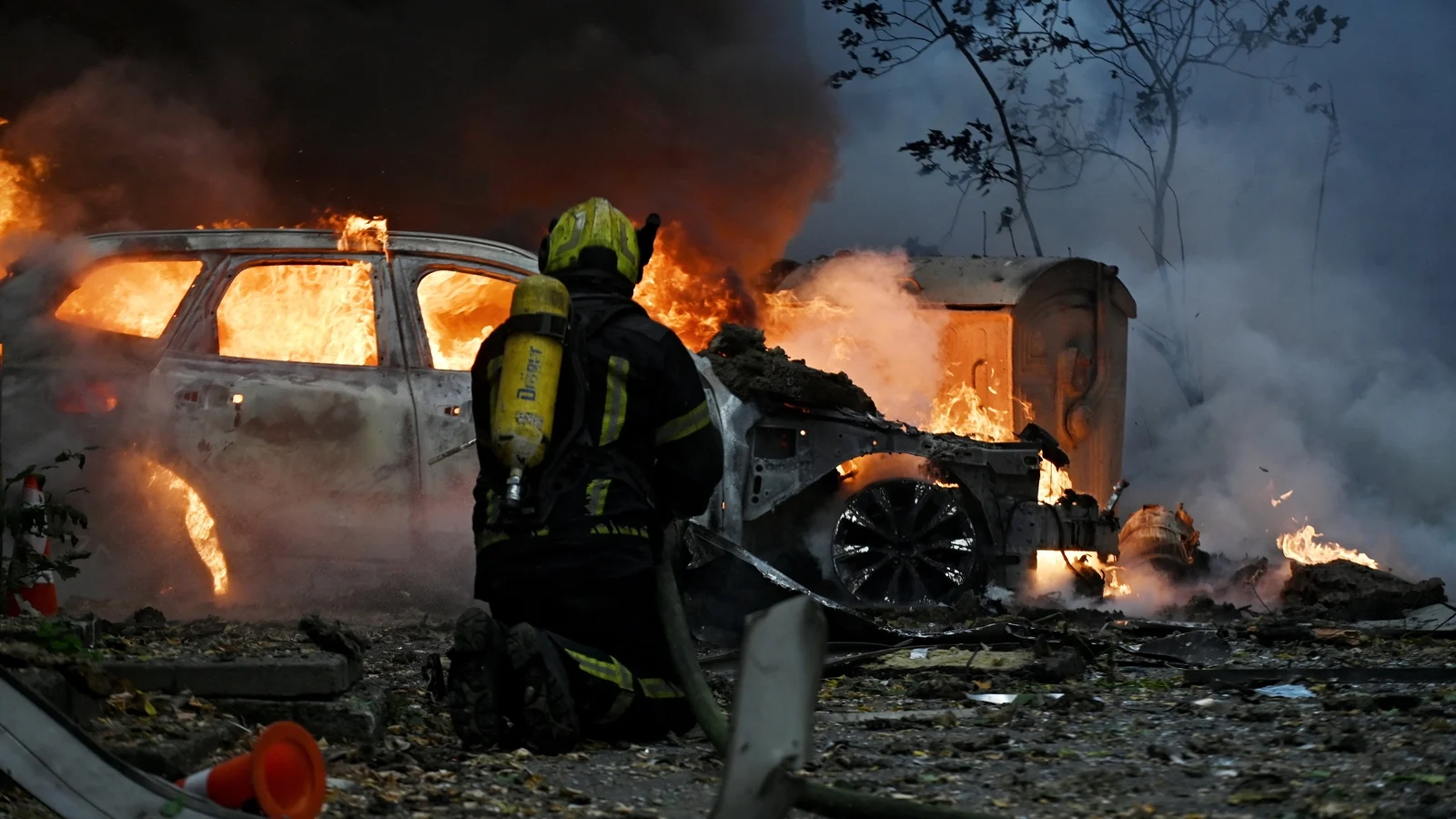
A Russian drone slammed into Ukraine’s National Academy of Sciences in central Kyiv today, striking one of the capital’s best-known institutions in a deadly daylight attack that sent smoke and flames into the sky.
One person was killed and four others in attacks on Dnipro, in the south east.
Kyiv has increasingly faced Russian drone and missile attacks as Europe’s worst conflict since World War II grinds through its fifth year.
Video footage shared online appeared to show a high-speed drone hitting the National Academy of Sciences at a steep angle before detonating, with a plume of acrid smoke rising into the clear blue sky.
In the same images, people could be seen leaning out of windows as bright orange flames tore through part of the building.
Ukraine’s former national security and defence council secretary Volodymyr Gorbulin told state broadcaster Suspilne that he was at work at the academy at the time and was slightly wounded.
Mr Gorbulin, who is 87, was the first Director General of the National Space Agency of Ukraine and is a highly respected academic.
He said that his assistant, who was near the building, was killed.
Volodymyr Gorbulin, pictured in 2017, when he was in charge of Ukraine’s National Institute for Strategic Studies
The National Academy of Sciences is situated close to the German embassy, a cathedral, the national opera and government buildings.
Kyiv’s cultural sites, government buildings and schools have all been targeted before, according to Ukrainian authorities.
In a statement, the academy denounced the strike as “Russian terror” and “barbarity”, saying it had hit “peaceful people who were simply at their workplaces… Ukrainian science, education and culture”.
President Volodymyr Zelensky said a separate strike in the capital hit a medical facility.
More Russian attacks in the east
Outside Kyiv, Russian strikes killed four people and wounded at least 19 at a business centre in the central city of Dnipro, while authorities reported an unspecified number of fatalities in a strike on a residential area in eastern Kharkiv.
Prime Minister Sergiy Koretsky said Russian forces damaged an ice cream factory in the Zhytomyr region west of Kyiv, and residential buildings in Sumy in the north, Rivne in the northwest and Odesa in the south.
Thirty civilians were wounded, three of them seriously, in strikes on Zaporizhzhia in southeastern Ukraine, the regional military administration said.
“The danger persists in many regions. The enemy is intensifying its terror. I urge citizens not to ignore the alerts and to stay in safe places whenever possible,” warned Mr Koretsky.
Russia has been deploying newer jet-powered drones that move faster and are harder to intercept than traditional models based on Iranian Shahed drones.
Mr Zelensky last week renewed his appeal to Ukraine’s Western allies to step up military support, including US-made Patriot interceptors capable of downing powerful ballistic missiles.
Firefighters work at the site of a the latest Russian attack on Kyiv
His request comes as Ukrainians weigh their options with winter approaching, after Russian attacks last year on energy infrastructure cut power and heating as temperatures plunged to as low as -20C.
In an interview broadcast on Ukrainian television on Sunday night, Mr Koretsky stopped short of urging all residents to leave cities before winter, calling that an “extreme step”.
But he indicated that vulnerable people should consider relocating to avoid putting additional strain on emergency services already stretched by the aftermath of repeated Russian strikes.
“If a person lives, for example, on the 16th floor and for instance the power gets cut, why at that moment, when the state emergency service specialists need to focus on dealing with the consequences, should we be … handling people who need extra attention?” he told TSN television.
“For such people, it’s worth finding an alternative place to stay for the winter period.”
EU discusses NATO-style defence clauses
Meanwhile, European defence ministers weighed whether the European Union should develop its own NATO-style emergency mechanism, aiming to tighten coordination against what they describe as Russian “hybrid attacks”.
EU High Representative for Foreign Affairs and Security Policy Kaja Kallas (L) talks with the Minister for Foreign Affairs Helen McEntee (R) prior the start of an European Defence Agency meeting in the Europa building in Brussels today
On arrival, the Minister for Foreign Affairs Helen McEntee said the question of several hundred billion euro in frozen Russian assets should be “kept on the table” as the EU searches for ways to meet Ukraine’s defence needs.
European governments say Moscow is stepping up its campaign of sabotage and interference against Ukraine’s supporters as Kremlin forces struggle to make headway on the front line.
In another incident today, a Russian jet-powered drone struck a Ukrainian village near the Polish border, damaging a border checkpoint, a regional Ukrainian official said.
The official did not give details about the nature of the checkpoint or the extent of the damage.
Russia has launched multiple attacks near Ukraine’s border with Poland in recent weeks, drawing condemnation from Warsaw and its European allies.
Earlier this month, a Russian drone hit a Warsaw-bound train in the same area, an attack Poland’s foreign minister described as an “escalation”.
“Unfortunately, there was an impact near the border with Poland in the village of Starovoitove,” acting Volyn governor Roman Romaniuk said on Telegram.
“The blast wave damaged the checkpoint building at the entrance to the terminal,” Mr Romaniuk said.
There were no immediate reports of deaths or injuries, he added.
The village of Starovoitove lies about 2km from the Polish border, close to Ukraine’s Yagodyn border crossing.
Poland’s defence minister Wladyslaw Kosiniak-Kamysz also reported the strike in a post on X.
“There was no violation of Polish airspace. Our air defence systems and aircraft were ready to respond,” Mr Kosiniak-Kamysz said.
Russia did not immediately comment.
The Kremlin said earlier this month it would keep striking targets across the “whole” of Ukraine when asked about a drone strike near the Polish border.
US General Alexus Grynkewich, NATO’s Supreme Allied Commander Europe
US General condemns of Russia’s ‘brazen’ attacks
Separately, NATO’s top military commander said today that Russia’s sabotage campaign in Europe was not discouraging countries from backing Ukraine.
“State-directed sabotage is growing increasingly brazen,” US General Alexus Grynkewich, NATO’s Supreme Allied Commander Europe, told a committee of EU lawmakers.
Gen Grynkewich pointed to recent incidents including the discovery of an explosive-laden drone at a German airport and a Russian naval ship firing flares at a Danish helicopter.
“These are clear examples of attempts to instil fear and fracture our unified support to Ukraine. It isn’t working,” he said, noting Denmark’s fast-tracking of new assistance for Ukraine after the flare incident.
“If there is a hybrid attack on your country, reinforcing the will to support Ukraine will show the Russians that their strategy isn’t working and maybe have them back off that strategy,” he added.
Gen Grynkewich said NATO countries acting together “can handle these threats, and we are handling them”.
“Our information sharing and our coordination mechanisms are growing stronger every day, and while we can’t talk about everything we’re doing, I can say we are detecting, attributing and responding as these hybrid threats arise,” he said.
European governments say Moscow is intensifying sabotage and interference against Ukraine’s backers as Kremlin troops continue fighting on the front line more than four years after the February 2022 invasion.
Gen Grynkewich urged officials to publicly attribute incidents once responsibility had been confirmed and to coordinate any response with allies.