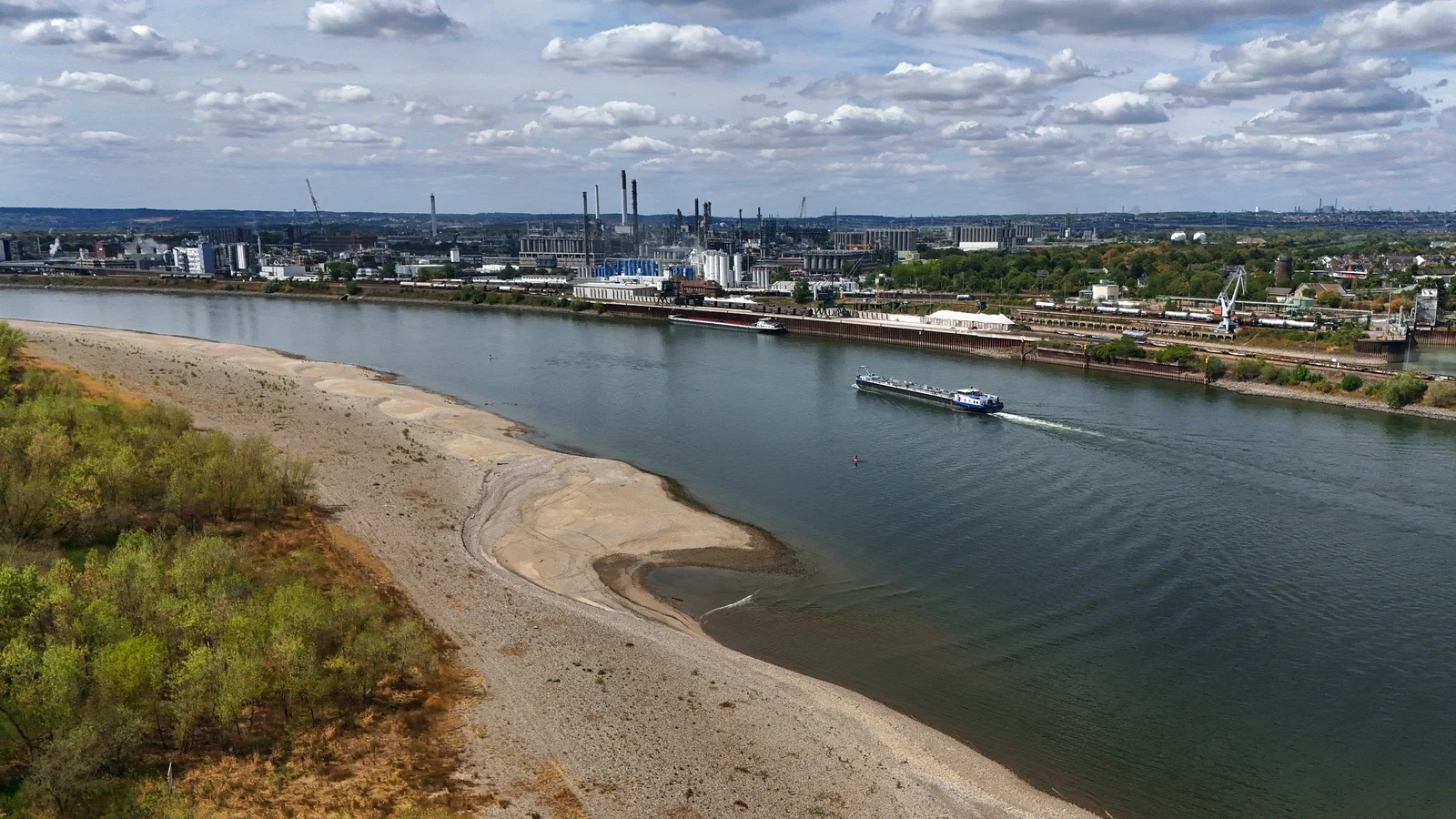
The Rhine, one of Europe’s busiest commercial arteries, is at risk of grinding to a halt this week as falling water levels threaten to stop cargo vessels on a crucial stretch effectively cutting the river into two separate operating zones, Germany’s federal association of inland shipping (BDB) has warned.
BDB managing director Jens Schwanen told the Rheinische Post newspaper that readings at Germany’s Kaub gauging station—a notorious choke point for Rhine navigation—were expected to slip into single digits for the first time, after weeks of insufficient rainfall.
Kaub sits south of Koblenz along one of the Middle Rhine’s shallowest sections, where even modest drops in water level can quickly restrict ship movements.
“Commercial shipping will no longer be able to transport goods in the region at such low water levels,” Schwanen said.
“The same goes for day trips and cruise shipping.”
“In principle, the Rhine is then no longer navigable along its entire length and thus split in two,” he added.
Schwanen said shipping would still be possible on the northern routes linking the ports of Amsterdam, Rotterdam and Antwerp with the northern part of the German Rhine and the west German canal network. Farther south, he said, traffic would continue on tributaries such as the Main, Moselle and Neckar rivers, as well as via the Main-Danube Canal.
Over the weekend, Germany’s most populous state, North Rhine-Westphalia, along with Lower Saxony, Rhineland-Palatinate and Saarland, eased trucking curbs in a bid to relieve transport pressures triggered by low water on rivers including the Rhine.
The disruption comes as Europe—described as the world’s fastest warming continent—has been battered by record-breaking heat this Summer.
Last week, parts of the Danube, Europe’s second longest river, fell to a record low after successive heatwaves that have dried out large swaths of the continent since May.