When Celebration Turned to Mourning: The Night the Alps Stood Still
There are certain images that steal your breath: the sharp line of the Alps under a winter moon, the glow of a resort alive with New Year’s cheer, and then a sudden, bewildering darkness where laughter used to be. That is the image the small Swiss resort of Crans-Montana will not easily forget after the fire that swept through a packed bar in the early hours of New Year’s Day, leaving 40 people dead and a community searching for answers.
The numbers are stark and relentless: 40 people killed, including 20 minors. One hundred and nineteen injured, many with severe burns. Victims ranged in age from 14 to 39 and included citizens from at least a dozen countries — roughly 21 Swiss, nine French, six Italians, and others from Belgium, Portugal, Romania, Turkey and beyond — the variety of passports reflecting the resort’s international pull.
The scene
It was 1:30am when revellers in Le Constellation, a basement bar owned by a French couple, suddenly found a celebration turned to catastrophe. Videos posted on social media show a low wooden ceiling, laced with soundproofing foam, catching light. What began as sparks — reportedly from celebratory sparklers affixed to champagne bottles — became a wall of flame that spread with terrifying speed.
“People were shouting, throwing chairs, smashing windows. We thought it was a prank at first,” said Marcella, a local waitress who rushed to help after fleeing the bar. “Then the smoke hit. It was like being in an oven.”
Fire and rescue teams arrived within minutes, but not quickly enough to stop a flashover — a near-instantaneous ignition of everything in an enclosed space — that experts say is consistent with the way the flames behaved. The foam covering the ceiling, designed to deaden sound, is under scrutiny for being highly flammable.
Grief in the streets
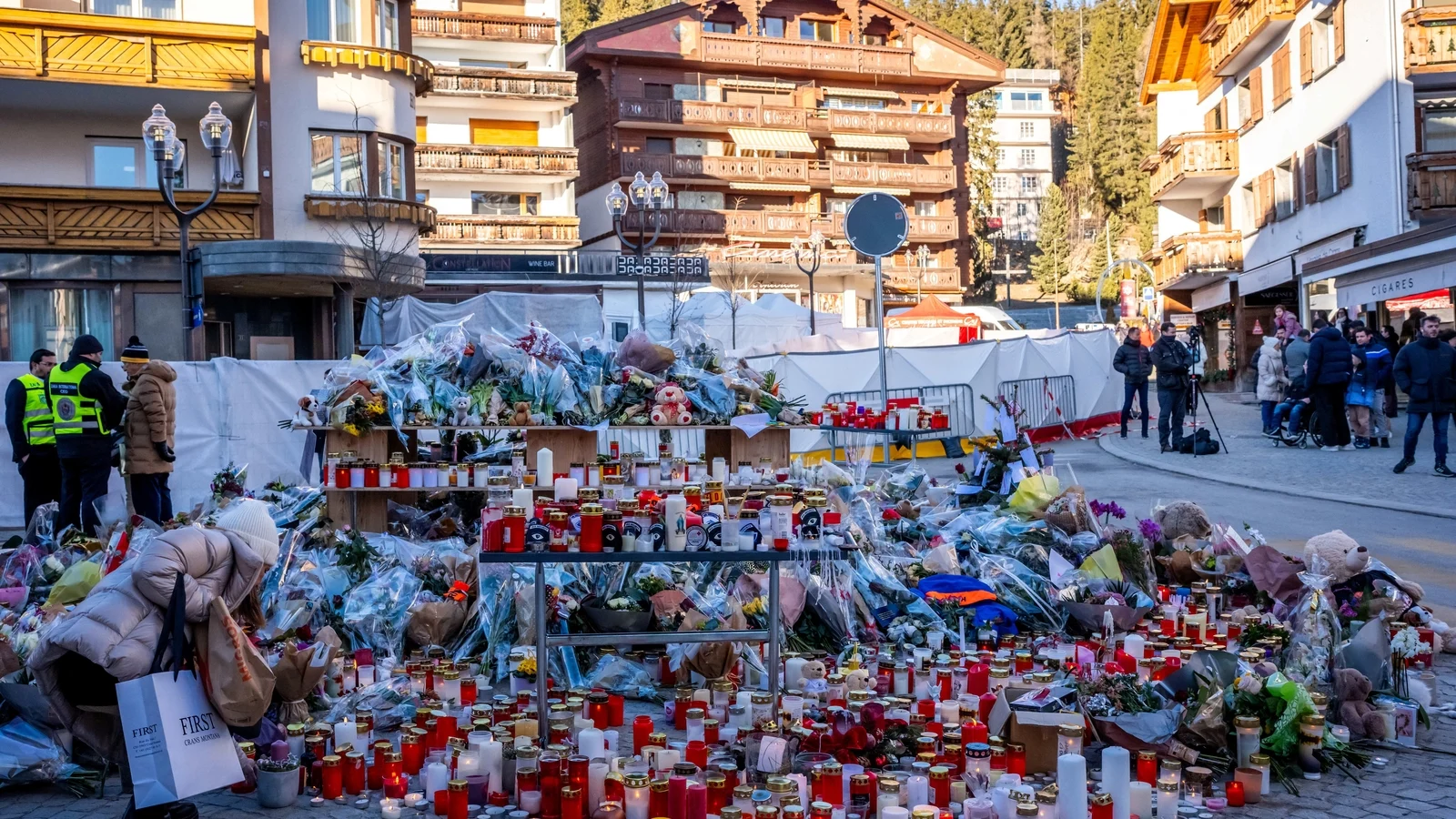
Within days, the town’s rhythm changed. At a packed memorial service held in a chapel just 300 meters from the bar, people stood in the cold — temperatures around -9°C — clinging to bouquets or a single red rose. A giant screen outside relayed the service for those who could not fit inside. Hundreds walked in silent procession to a nearby chapel of rest. Switzerland has declared a national day of mourning on January 9, with church bells nationwide set to toll at 14:00.
“We are here to say that in the face of the unspeakable, we refuse to look away,” Pastor Gilles Cavin told the assembled crowd. “We are here for the apprentices, the high-school students, the young people who came from many places to celebrate life and were met with death.”
Bishop Jean-Marie Lovey, speaking after the service, appealed for privacy and compassion. “The world’s media have descended upon our valley,” he said. “Please seek the grieving with mercy, not spectacle.”
Names, nationalities, and the human tally
Police in Valais canton have worked to identify the victims, a painstaking and heartbreaking process. Among those named: young apprentices, university students, and school pupils. Authorities released a list of nationalities to help families connect — a chilling reminder of the resort’s international character and of how quickly tragedy can cross borders.
- 40 killed, including 20 under 18
- 119 injured, many with severe burns
- Victims aged between 14 and 39
- Nationalities represented include Swiss (21 among the deceased), French (9), Italian (6), plus citizens of Belgium, Portugal, Romania, Turkey and others
“My son was only nineteen,” said Anna, a parent of a victim who asked that her surname not be used. “He loved the mountains. He loved life. There are no words.”
Accountability and the court of law
The bar’s owners, Jacques and Jessica Moretti, have been placed under criminal investigation and are charged with negligent manslaughter, negligent bodily harm and negligent arson. Jacques Moretti has maintained to local press that safety norms were followed and that the venue’s official capacity — listed online as 300 inside plus 40 on the terrace — was not exceeded.
Mayor Nicolas Feraud told Swiss broadcaster RTS that the municipality was cooperating with investigators and that the town had not been negligent. “Our priority is finding the truth,” he said. “We will ask all the hard questions about oversight and compliance.”
Experts weigh in
Fire safety specialists point to patterns that have already become painfully familiar. “Enclosed spaces with combustible acoustic foam and an ignition source like pyrotechnics are a recipe for a flashover,” said Dr. Elise Morel, a fire dynamics specialist at the Federal Institute for Fire Prevention. “The Station nightclub fire in Rhode Island in 2003 taught us that lesson the hard way — pyrotechnics and foam do not mix.”
Global statistics underline the risk: in night-time entertainment venues around the world, fires caused by pyrotechnics and overloaded exits have repeatedly led to mass casualties. Codes exist to prevent these scenarios, but enforcement varies. Where oversight lapses, the consequences can be catastrophic.
Culture, tourism and the cost of a night out
Crans-Montana is a ski resort known for its lively après-ski and international clientele. This tragedy raises difficult questions about the cost of fun, the culture of late-night partying, and the responsibility shared by venue owners, local authorities, tour operators and revelers themselves.
Who shoulders the blame when joy becomes danger? Is it the owners who lit sparklers? The suppliers who sold combustible foam? The regulators who enforce capacity and fire-code compliance? Or the broader social appetite for ever-more sensational nightlife experiences?
“We must mourn, of course,” said Dr. Morel. “But we must also learn and implement. Regulations are only as good as the willingness to enforce them and the cultural determination to value safety over spectacle.”
How a town moves forward
For now, Crans-Montana is holding tight to rituals of remembrance. Bells will toll. Names will be read. Families, many from other countries, will grappling with loss far from home, relying on consular services and the generosity of local volunteers. Hospitals in the region are caring for the wounded, and burn units elsewhere in Switzerland have taken patients as needed.
A crisis helpline has been set up; crisis counselors are on site. Volunteers bring food and blankets. Younger people hang candles and notes on fences. The scene is at once intimate and global: a fjord-side slogan in Norwegian could be replaced by a French postcard, a Swiss flag next to an Italian one, as strangers become the bedrock for families in shock.
As you read this, perhaps you’re thinking of a night out — a memory, a friend, a child. How do we celebrate without courting danger? How do communities keep their doors open and their people safe? These are painful, necessary conversations.
There will be investigations. There will be trials. And there will be funerals. But beyond legal outcomes, the lasting test will be whether this valley — and the wider world of nightlife and leisure — chooses to carry forward lessons so these names do not become another footnote in a long catalogue of preventable tragedies.
For the families, the question is simpler and unbearably immediate: how do you continue after losing a child, a sibling, a friend? For the rest of us, the question is this: what will we change?