Smoke Over the Strait: A Day When Rockets Wrote the Headlines
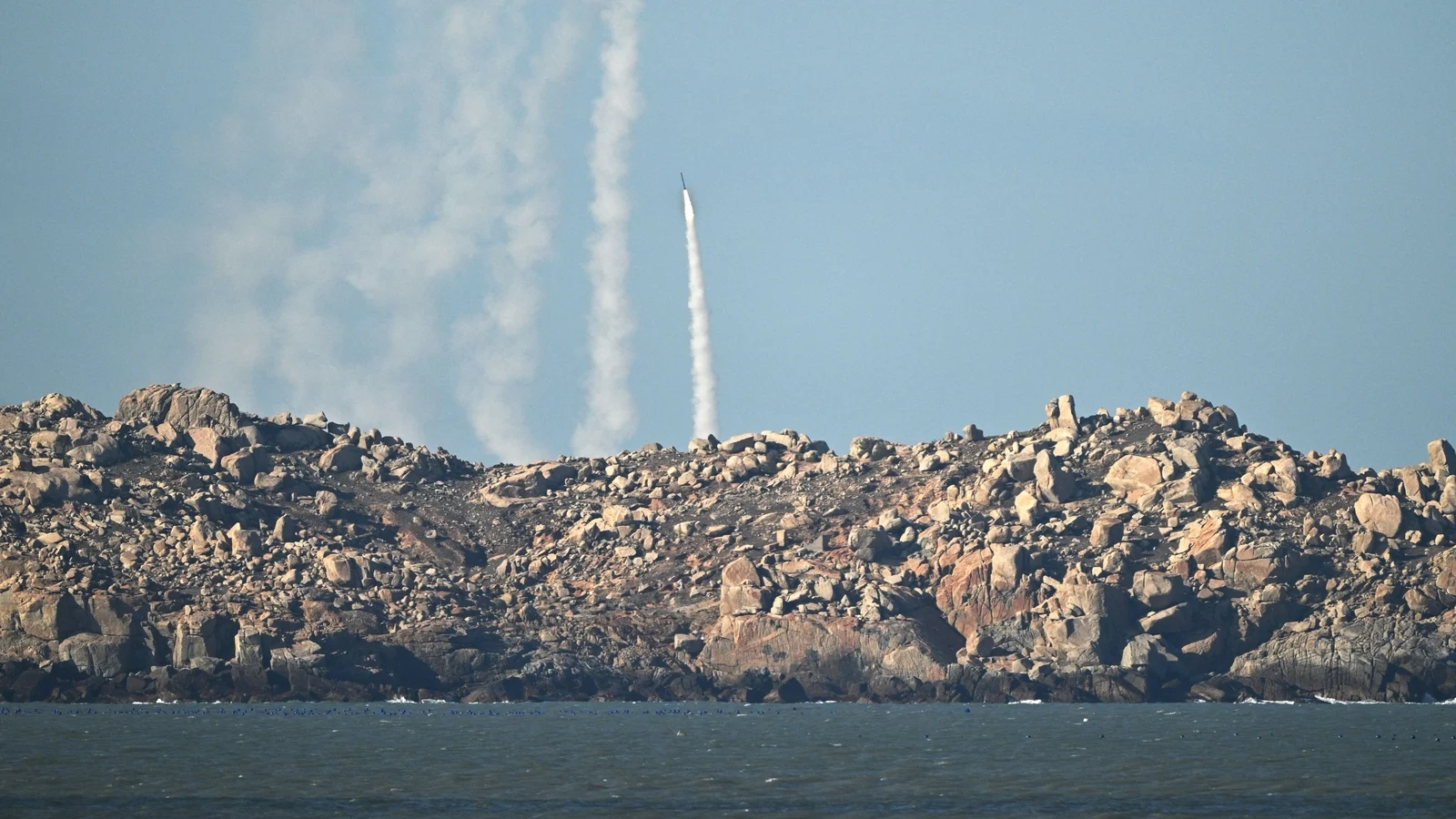
On a wind-whipped morning in Pingtan, the air tasted faintly of salt and diesel. Tourists pressed against wooden railings, phones held high like lighthouses, as a volley of rockets stitched white scars across the sky and thundered into the Taiwan Strait. For a few surreal minutes, a coastal town that usually trades in ferry schedules and seafood menus felt like the front row of a military exercise.
“It sounded like the mountains were coughing,” said Lin Mei, a schoolteacher who had come for a weekend visit. “Children started to cry, some people laughed nervously. We all took pictures. It felt unreal — like watching a war movie that we’re not allowed to blink at.”
That spectacle was no film effect. Beijing had launched a second day of live-fire drills — a drill package baptized “Justice Mission 2025” by state channels — aimed at simulating a blockade of the self-ruled island’s key ports and strikes on maritime targets. The maneuvers involved warplanes, bombers, destroyers and frigates and were mapped into five large zones around Taiwan, some reported to be within 12 nautical miles of the island’s coast.
What Happened — In Numbers
According to Taiwanese officials, the past 24 hours saw the detection of roughly 130 Chinese military aircraft, alongside at least 14 navy ships and a handful of government vessels. Taiwan’s coast guard shadowed dozens of ships with 14 of its own boats. Flights to the offshore Kinmen and Matsu islands were cancelled, and shipping lanes were reported disrupted in parts of the strait.
The People’s Liberation Army (PLA) said it had achieved “desired effects” from long-range live-fire drills to the north of Taiwan. State broadcaster CCTV framed the exercises around the idea of a blockade, singling out major ports like Keelung in the north and Kaohsiung in the south as potential choke points in a simulated conflict.
Voices From the Islanders
Back in Taipei, life moved with a stubborn normalcy. At a wet market in Beitou, fishmonger Chiang Sheng-ming, 24, shrugged while arranging mackerel on ice. “There have been so many drills like this over the years that we are used to it,” he said. “If you stand your ground, there’s nothing to be afraid of.”
Nearby, 80-year-old fruit seller Tseng Chang-chih smiled and shook his head. “War? Impossible,” he said. “It’s posturing. If they really attacked Taiwan, they would have to pay a price.” Their voices framed the attitude of a community resilient by habit — people who arrange their lives around tension because history has taught them how to do it.
Politics, Provocation and the Global Chessboard
Taiwan’s president, Lai Ching-te, used the strongest possible terms, condemning the drills as “highly provocative and reckless” and saying China was deliberately undermining regional stability. Beijing, for its part, has long insisted that Taiwan is part of its sovereign territory and has not ruled out the use of force to bring the island under its control.
Chinese foreign minister Wang Yi warned that large-scale U.S. weapon sales to Taiwan would be “forcefully countered” and that any attempt to obstruct unification would “inevitably end in failure.” The flashpoint was touchingly mundane: a U.S.-approved arms package for Taipei, reportedly worth around $11 billion, landed like kindling on an already smoldering geopolitical log pile.
Even global leaders felt compelled to weigh in. Japan’s prime minister suggested that the use of force against Taiwan could trigger a response from Tokyo, and U.S. President Donald Trump — asked whether he feared an invasion — answered, “I don’t believe he’s going to be doing it,” a comment that many analysts saw as cavalier given the stakes.
Expert Take: What a Blockade Would Really Mean
“A blockade is more than a show of force,” said Dr. Mei-Ling Chen, a defense analyst with the Island Security Institute in Taipei. “It is an attempt to throttle trade, create fear, and degrade confidence in the island’s economy. Taiwan’s lifelines — ports, air routes, and undersea cables — are strategic infrastructure. Damaging or severing them would have ripple effects far beyond its shores.”
To put that into perspective: Taiwan is home to roughly 23.5 million people and anchors a global high-tech supply chain centered on semiconductors. Taiwan Semiconductor Manufacturing Company (TSMC), the island’s crown jewel, produces a substantial share of the world’s most advanced chips — estimates vary, but industry watchers often cite that Taiwan manufactures the lion’s share of leading-edge semiconductors. Any disruption to that production could stall manufacturing worldwide, from cars to smartphones to medical devices.
Everyday Lives, Extraordinary Risk
Beyond the abstract geopolitics, the drills eventually showed up in people’s daily rhythms. Fishermen rerouted nets and waited at harbors. Airlines rerouted or cancelled short-hop flights to the outlying islands. Small businesses, already jittery from global economic uncertainty, braced for any shock that could disrupt supply lines or consumer confidence.
“We plan our lives in months, not in headlines,” said Hsu Chao, a ferry operator who runs a route between Taipei and the Matsu islands. “When exercises close sea lanes, it becomes real: prices rise, fuel costs go up, and people miss doctor appointments. Those are the quiet costs of military posturing.”
Why the World Watches
Because Taiwan sits at an intersection of power politics and indispensable industry. It is a democracy that runs its own institutions, yet China views it as a renegade province. The United States, Japan and other democracies have interests — strategic, economic, and moral — that complicate any simple resolution.
So what are readers to make of this? Is this the new normal, a slow attrition of stability by repeated displays of force? Or a dangerous escalation that could one day outgrow the bounds of staged maneuvers?
Ask yourself: how comfortable are you with the idea that a tiny island could suddenly become the pivot of a global supply-chain crisis or a flashpoint for military conflict affecting millions? Would trade partners intervene when commerce is at stake? Are diplomatic channels robust enough to temper the spiral from gesture to engagement?
Between the Lines: The Human Aftertaste
Walking away from the railings in Pingtan, the sound of the rockets faded faster than the unease. A vendor sold warm sweet potatoes to tourists who had come for the seaside breeze and left with a picture of white smoke in their phones. Children returned to school. Workers returned to shifts. The machinery of daily life, stubborn and necessary, continued.
But beneath that persistence are deeper currents: a modern island whose geopolitical value is measured in microchips, shipping routes, and strategic alliances. A population that views drills with a mix of cynicism and quiet defiance. And a neighborhood of nations whose choices in Washington, Beijing, and Tokyo will ripple through ordinary mornings like the thunder of rockets over the strait.
We watch, we photograph, we debate. And in the spaces between those acts, people simply try to go about their lives. How would you? What would you do if your morning commute became the next headline?