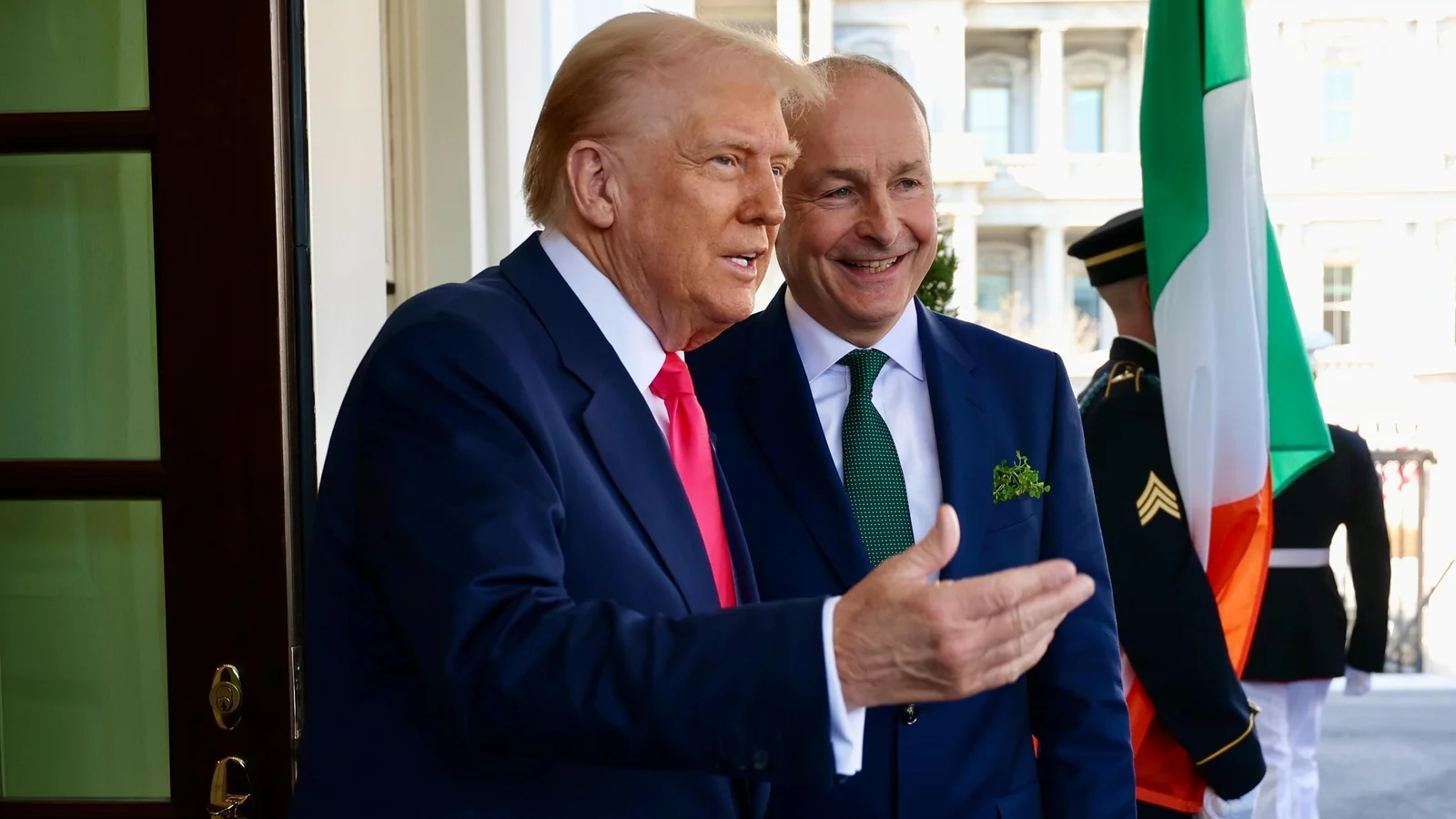
A transatlantic barb and a European rebuttal: what Trump’s words stirred in Dublin and beyond
When the former US president described the European Union as “weak” and accused member states of letting Ukraine fight “until they drop,” the echo ricocheted from Washington halls to Dublin cafés, Brussels committee rooms and the frontline emails of aid coordinators in Kyiv.
That line — raw, blunt, and meant to provoke — arrived at a moment when Europe is already juggling the aftermath of a pandemic, a grinding war on its eastern border, and an uneasy internal debate about migration and identity. Standing outside Government Buildings in Dublin, Taoiseach Micheál Martin didn’t sugarcoat his response.
“Europe is strong, not weak,” he told reporters, voice steady with both national pride and what sounded like impatience. “We are the world’s largest single market, we are among the strongest trading blocs — and our collective response to challenges, from Covid to our support for Ukraine, shows that.”
Streetside reactions: what ordinary people hear
Down a narrow lane near the River Liffey, where the honk of buses competes with the clink of teaspoons in a busy bakery, people offered a chorus of voices that complicated the binary of strength or weakness.
“We trade with the world. My shop ships to Spain and Germany,” said Aoife Byrne, a 42-year-old owner of a small craft chocolate business. “If anyone thinks Europe is falling apart, they haven’t tried to run a business here.”
A Ukrainian student, Kateryna, who arrived in Dublin two years ago, sounded the weariness many feel. “We see money and hardware arriving, but the war continues. It’s frustrating. Every day here I wonder if that support will be long-term,” she said, staring at a steaming cup of tea as if it might answer the question.
From rhetoric to policy: what’s really at stake
What began as a political broadside is also a test of institutions. The United States and the EU are bound by shared history, defense partnerships and intertwined economies — the EU is home to roughly 447 million people and, together, its members form one of the world’s largest trading blocs, with a combined GDP in the ballpark of the world’s leading economies.
So when President Trump — in an interview that revived debates about migration and sovereignty — suggested parts of Europe were “decaying” and failing to control migration, EU leaders bristled. European Council President António Costa’s retort was pointed and public: “Allies must act as allies. Washington should not interfere with our internal matters.”
It’s not just about rhetoric. Earlier this month, a new US national security strategy raised eyebrows in European capitals by urging the cultivation of “resistance” within the EU against what Washington framed as overly liberal migration policies. The strategy’s language, and the suggestion that bilateral support could hinge on policy alignment, set off alarm bells from Lisbon to Riga.
Security, migration, and the shadow of populism
Migration remains one of the thorniest forces reshaping politics on both sides of the Atlantic. Speculation about the durability of alliances based on immigration stances is not theoretical: it feeds into a larger web of nationalist narratives, electoral strategies and, crucially, the real lives of migrants seeking safety and work.
“This isn’t about abstract theory,” said Dr. Anja Müller, a migration policy analyst in Berlin. “When leaders weaponize migration, they reshape the parameters of cooperation. It can diminish trust — and trust is the currency of alliances.”
In a small market stall in Brussels, an Algerian vendor named Karim mirrored that sentiment. “People here worry about borders and jobs, but they also remember when Europe worked together — when it mattered,” he said. “Words that break that memory are dangerous.”
Ukraine, frozen assets and the long arithmetic of war
At the center of the current row is support for Ukraine, an issue that forces Europeans to balance moral clarity with legal complexity. The European Commission, led by Ursula von der Leyen, has proposed a plan to try to plug a gap in Ukraine’s future budget needs — offering around €90 billion for 2026-27 against an IMF estimate of roughly €137 billion for the same period.
To help finance that package, negotiators have been discussing using “frozen” Russian assets. It’s a seismic move: converting seized or immobilized assets to support reconstruction and defence is legally and politically fraught, and some member states, notably Belgium, have publicly fretted about legal exposure and financial risk.
“This is not looting; it is a legal tightrope,” said María Lopes, a Brussels-based legal adviser on international sanctions. “We are attempting to convert punitive financial measures into predictable funding for a country under assault. But the rule of law can’t be sacrificed for expediency.”
European Council President Costa said negotiators were “working hard” to fine-tune a deal that could win a qualified majority in Brussels — a reminder that within the EU’s 27-member architecture, unanimity is often elusive and compromise, messy.
Why the argument matters beyond Europe
Ask yourself: why does a spat between an American political heavyweight and European leaders matter to someone on the other side of the world? Because the norms being contested — how allies talk to one another, what counts as acceptable pressure, how migration and security are governed — have ripple effects.
Trade partners watch. Governments planning defence budgets watch. Refugees and migrants watch. In an era of strategic competition with China and an assertive Russia, the cohesion of transatlantic ties is more than grandstanding; it’s a strategic asset.
And yet, cohesion cannot be conjured by decree. “Alliances are not just signed; they are sustained,” noted Fiona O’Connor, a retired Irish diplomat. “They need mutual respect and a recognition of each other’s democratic choices.”
What comes next: negotiations, decisions, and questions for the reader
This week, EU leaders will return to Brussels with a slate of decisions on the table: whether to finalise the mechanics of redirecting frozen assets, how to align support for Ukraine with long-term fiscal planning, and how — if at all — to respond to renewed pressure from Washington about migration policy.
These are not merely bureaucratic items. They will shape whether Europe emerges from this chapter more united or more fragmented, and whether the transatlantic relationship becomes one of conditional cooperation or renewed partnership.
So here are the questions I leave you with: Should allies tie security assistance to ideological alignment on domestic policy? Can Europe reconcile the immediate demands of a brutal war with the long-term disciplines of law and finance? And finally, what kind of global order do we want — one where disputes between allies play out in public barbs, or one where they are managed with discreet diplomacy and shared purpose?
Whatever the answers, today’s exchanges are a live reminder that power is not only about tanks and money. It’s also about narrative, credibility and the quiet work of politics — the kind that happens in cafes, parliaments and negotiation rooms across the continent. Watch closely: the next moves will tell us a lot about the future of Europe, the nature of the transatlantic bond, and whether strength is measured in words or in the will to act together.