On a quiet Florida lane, a sudden, sharp turn in the life of a sporting icon
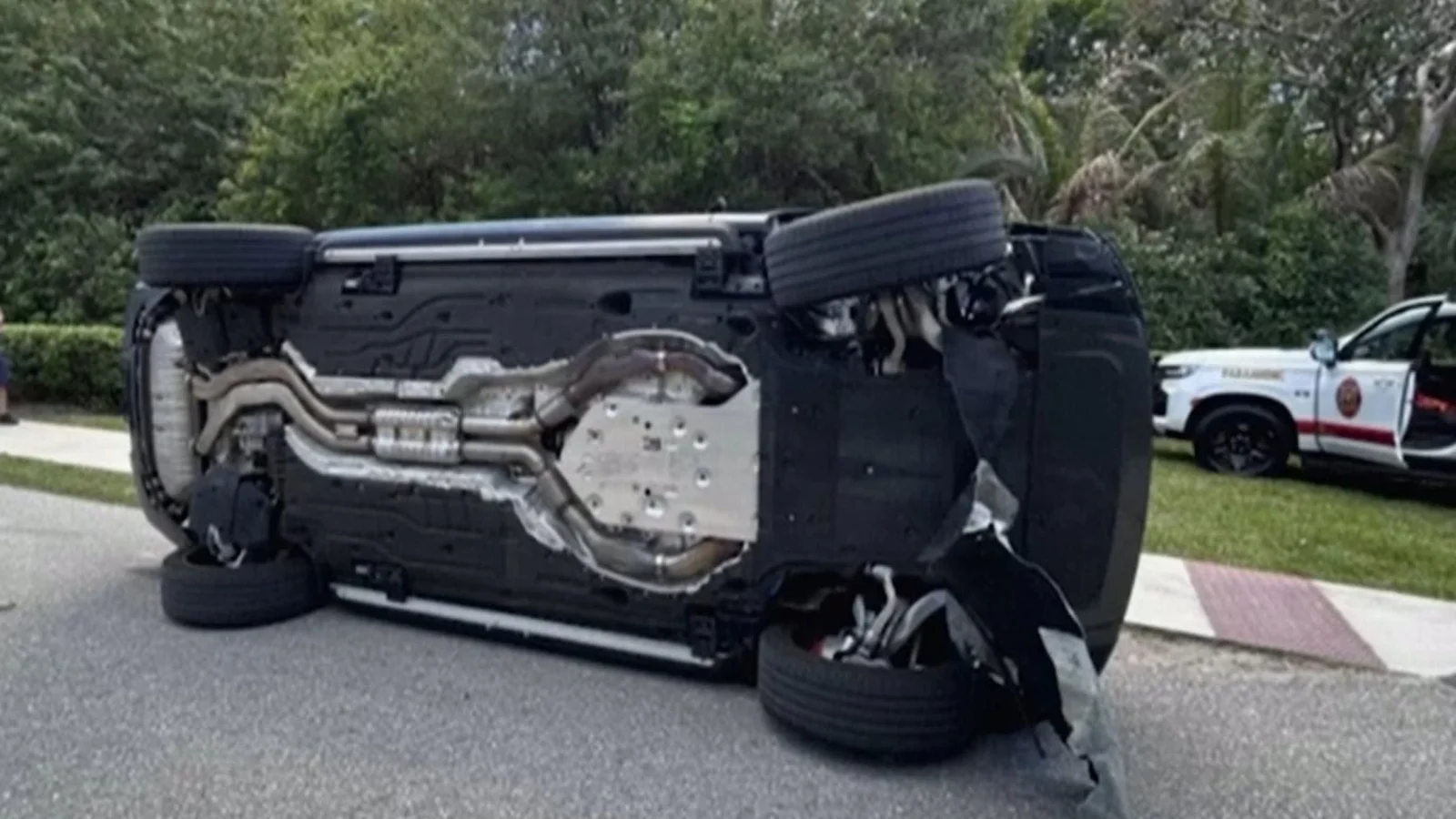
It was the kind of morning that feels ordinary until it is not: a thin strip of pavement winding along dunes and sea oats on Jupiter Island, palm fronds barely moving, the hush of an exclusive community that hosts mansions and the ghosts of golf legends. Then a roar, metal on asphalt, and a Land Rover turned on its side like a storybook come undone.
Inside that vehicle was Tiger Woods — the 50-year-old whose name has defined modern golf. He walked away unbroken physically, but not untouched. Within hours he was booked on a charge of driving under the influence and for refusing a lawful test, his arrest adding a jagged new line to a life that has long been public property: victories, recoveries, scandals and comebacks.
What happened on the road
According to accounts from law enforcement and bystanders, Woods’ vehicle clipped a pickup as it attempted to pass on a narrow residential street. The impact sent the SUV sliding on its side before it came to rest. Nobody in either vehicle was seriously hurt — a fact that one local officer, who watched the scene unfold, called “remarkable.”
“This could have been an awful lot worse,” a deputy from Martin County told reporters later, voice tight with what sounded like relief and concern. “There were no pedestrians, no opposing traffic at that exact moment. That was luck.”
Drug recognition experts who evaluated Woods at the scene reported signs of impairment: slowed speech, lethargy, and other observations consistent, they said, with being under the influence of some substance. A breathalyzer administered at the site returned a negative result for alcohol. When deputies requested a urine test — often used to detect a broader range of substances — Woods declined, a right guaranteed under Florida’s implied-consent framework for chemical testing.
That refusal carries consequences. Under Florida law, declining to submit to certain tests can lead to immediate administrative penalties, including suspension of driving privileges, and separate criminal counts can be filed for refusal. Woods was held in the county jail under state procedures and released after the mandated period, photographed leaving in the dark. The booking images — a red-eyed, stubbly-chinned man who has spent decades under photographic scrutiny — circulated within hours.
A closer look at the legal and medical pieces
To many, the sequence will look familiar. “When you combine a history of major surgeries, pain medications, and the physical toll of elite athletics, it complicates how we evaluate impairment,” said Dr. Elena Morris, a toxicologist and professor who has studied drug recognition for two decades. “A field sobriety check and a breath test won’t always capture the full picture. If someone refuses a blood or urine test, it can be a dead end for investigators trying to pinpoint the substance.”
Experts note that modern pain management regimens can include medications that impair coordination even at therapeutically recommended doses, and that age affects how the body metabolizes drugs. “At 50, recovery and reaction times are not what they were at 25,” Dr. Morris added. “Add multiple surgeries and medications into the mix and you have a high-risk combination on the road.”
History, headlines and the hard work of coming back
Woods’ life has always been a mosaic of triumph and trouble. The world watched in 2009 as his private life unraveled publicly; they watched again when a 2021 single-vehicle crash in California nearly severed his professional trajectory. That accident left him with catastrophic injuries to his right leg — surgeons inserted pins, plates and a rod — and required intensive rehabilitation. Since then, Woods has had additional interventions, including a follow-up procedure in 2023.
He has also been relentless. He returned to compete at Augusta in 2022 and again has pushed onto fairways and simulators: he played in the TGL indoor golf league last week and has not shut the door on returning to the Masters in a few weeks, where five of his 15 major titles were won. “This body… it doesn’t recover like it did when it was 24,” he once said. “It doesn’t mean I’m not trying.”
Neighbors, fans and the sound of a small town calling
On Jupiter Island, where the population sits in the low hundreds and celebrity homeowners are part of the landscape, reaction was a mix of shock and sympathy. “You never expect to hear those sirens here,” said Maria Torres, who runs a small café near the bridge to the island. “He’s part of our scenery now, but at the same time, this could happen to anyone. It’s a reminder to be careful.”
A longtime club member at a nearby course, speaking on condition of anonymity, framed it differently: “He’s a legend, but legends are still people. We all want him to be okay. We also want rules to apply evenly.”
Why this matters beyond a name on the front page
Ask yourself: why does the fall of a public figure grip us so tightly? Is it a hunger for spectacle, a search for accountability, or a human urge to understand how those who seem invincible break? Woods’ latest episode sits at the crossroads of several larger societal threads.
First, the plight of aging athletes and the medical aftermath of long careers. Professional sports demand everything of the body; the bills often come due later. Second, the role of medications in daily life and on the road; a rough benchmark from traffic safety researchers is that tens of thousands die each year in the U.S. due to impaired driving, with alcohol and drugs both contributors — a sobering backdrop to any crash.
Finally, the tension between public fascination and privacy. A name like Tiger Woods will inevitably be a public concern — people want answers, not least because the man has been one of golf’s most transformative figures. Yet there is also the plea for compassion, especially when health or addiction may be in the mix.
Looking ahead: courts, questions and consequences
Legally, the case will move through the normal processes: possible formal charges, court dates, and the question of whether prosecutors will secure additional evidence. Practically, there will be administrative actions over driving privileges if the state pursues them. For Woods’ career, it adds uncertainty to his schedule and to the broader narrative about longevity in sport.
“We have to let the facts sort themselves out,” said a criminal defense attorney in West Palm Beach. “But we also have to remember the public safety angle. When famous people break the law, it makes headlines. When average people do, it makes victims.”
What do we do with moments like this?
The story is not simply about a crash or the celebrity of the man involved; it asks us to reflect on how we care for athletes after their careers peak, how we balance empathy with accountability, and how communities treat those who fall from grace.
Will the Masters — a place where Tiger has threaded some of his most intimate chapters — become, once again, a stage for comeback? Or will this be another, quieter chapter of consequence and reflection? Only time will tell. For now, the images of a still Land Rover on a sunlit Florida lane and a booking photo tucked into the evening news are reminders that even the most storied lives are, in the end, human.