Three Leaders, One Ball: A Washington Meeting That Was More Than a Photo Op
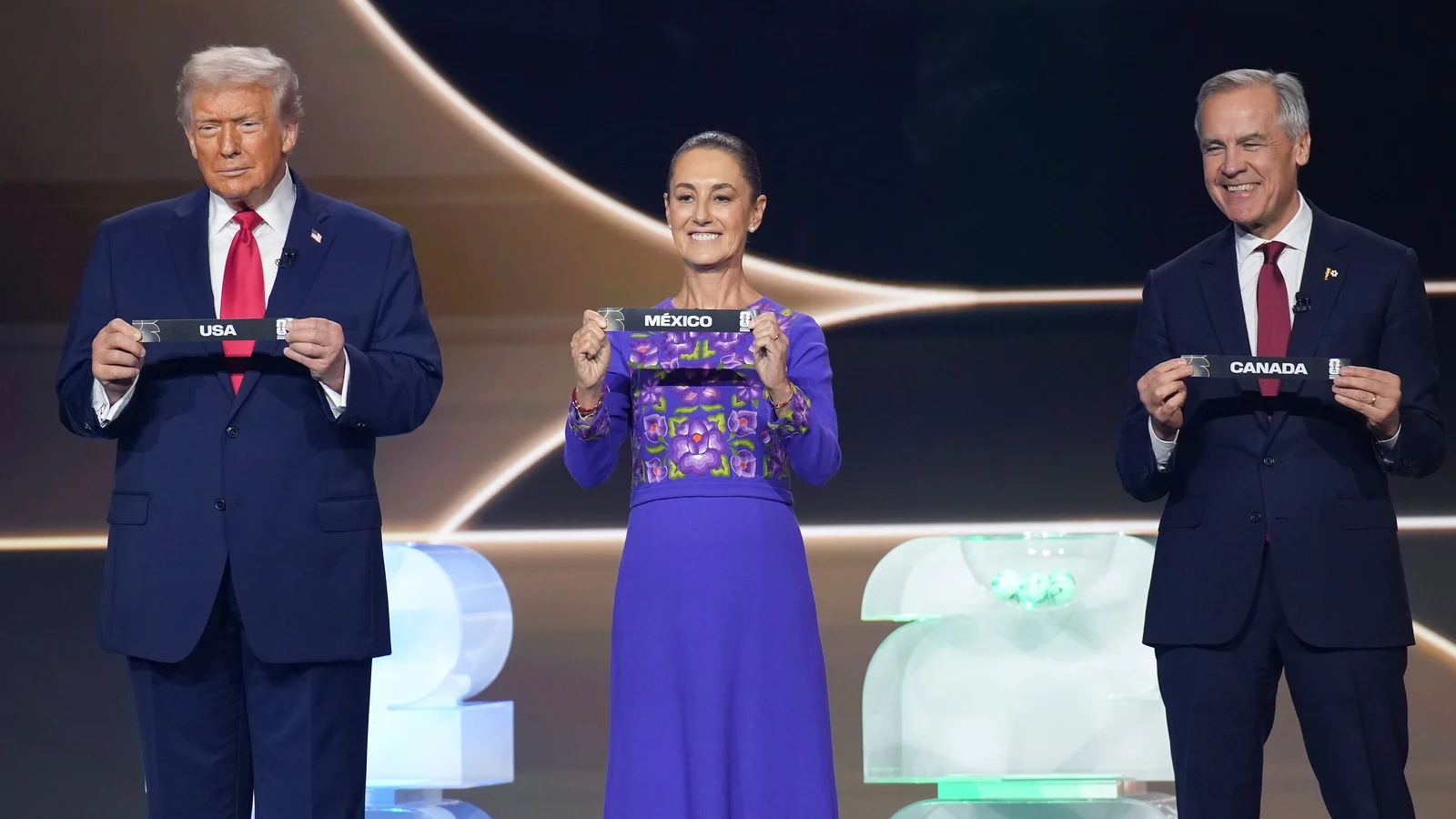
There was a gust of wind through the flags outside the hall where the 2026 World Cup draw was held — a small, bracing reminder that sport and diplomacy often mix in the most public of places. Inside, amid the hum of cameras and the tang of coffee, U.S. President Donald Trump, Canadian Prime Minister Mark Carney and Mexican President Claudia Sheinbaum slipped away from the pageantry for roughly 45 minutes to talk about trade, borders and a partnership that binds three economies, three cultures and millions of lives.
A sideline encounter with weighty consequences
It would be easy to call it a courtesy meeting, the kind of handshake diplomacy that accompanies international events. But the stakes were plain: CUSMA—known to many as USMCA—was on the table. Audrey Champoux, a spokesperson for Mr. Carney, told reporters the leaders “agreed to keep working together on CUSMA.” It was a succinct statement that belied how much is riding on that agreement.
“This wasn’t a cup of tea,” a Canadian aide later told me, lips tight with the memory of the brisk exchange. “It was a first step back into a track that’s been uneven for years.”
The three nations are co-hosting the 2026 World Cup—an event that will, in practical terms, require unprecedented logistical cooperation across borders. Yet the political landscape is pricklier: tariffs that President Trump imposed on certain Canadian and Mexican exports, threats of renegotiation of trade terms, and fiery rhetoric about migration and drug trafficking have strained relations. Mexico’s president, according to the account of the session, reaffirmed that any suggestion of unilateral military action on Mexican soil would be unacceptable. “Air strikes on Mexico will never happen,” President Sheinbaum has declared emphatically in public forums, and that line of red was not crossed in private either.
Underneath the applause: trade, tariffs and uneasy coordination
Trade between the three countries is not small talk. Across the continent, supply chains for autos, food, energy and components form a living web. Economists often point out that annual trade across the North American triangle exceeds a trillion dollars, supporting millions of jobs on both sides of the borders. The USMCA, which replaced NAFTA on 1 July 2020, was meant to modernize those ties. Yet in recent months, the U.S. administration has signaled it wants tweaks, and slapped tariffs on goods that fall outside the trade pact. Those moves have rattled businesses on both sides of the border.
“When steel tariffs go up, factories in Hamilton and Monterrey feel it the next month,” said Dr. Ana Morales, a trade analyst at a Washington think tank. “This meeting was partly about reminding each other that the economic costs of discord are tangible—jobs, investments, confidence.”
If politics color trade, they also color perception. Earlier this year, Mr. Trump’s off-the-cuff remark that Canada should consider becoming the 51st state provoked outrage and mockery in Ottawa. In other rounds of public sparring, Mr. Carney’s crisp dismissal—“Who cares?”—in response to a question about when he last spoke to Mr. Trump made headlines and highlighted how personal politics have sometimes tripped up pragmatic cooperation.
Migration, drugs and a line that won’t be crossed
Border security was never absent from the conversation. Migration remains an issue that generates headlines—and human stories. Hundreds of thousands of encounters at the U.S.-Mexico border have been recorded in recent years, and the push-and-pull of economic opportunity, climate displacement and cartel violence means migration rates are unlikely to tumble overnight.
Mr. Trump’s past rhetoric—suggesting he would be “OK” with air strikes on Mexican soil to target traffickers—met with fierce rebuke from Mexico. “We are neighbors, not targets,” said Héctor Ríos, a Mexico City soccer coach who watched the draw unfold on television. “We want cooperation but respect above all.”
That demand for respect was felt in Washington’s corridors too. “Sovereignty is not a bargaining chip,” President Sheinbaum reportedly emphasized during the meeting. “If we are to work together, we must do so as equals.”
A prize, a partner, and a controversy
When the day turned to evening, President Trump was presented with FIFA’s first-ever Peace Prize, a decision that ignited debate. Human rights organizations had urged FIFA not to bestow the honor, arguing that the choice risked politicizing an organization that has long sought to position sport above the partisan fray. Supporters of the award lauded what they called diplomatic engagement and assistance in preparing a continent-spanning tournament.
“This prize recognizes people who contribute to unity,” said Gianni Infantino, FIFA’s president, as cameras flashed. “The 2026 World Cup is itself a symbol of shared commitment.”
But beneath the formalities, critics were candid. “FIFA’s job is football. Political endorsements like this blur lines and undercut accountability,” said Lucia Mendes, a human rights advocate based in Geneva. “Awards matter because they confer legitimacy.”
Local color and unexpected moments
Outside the venue, fans and locals offered a more textured chorus. A vendor from Tijuana who has sold scarves at international matches for decades shrugged as he stacked pennants. “We sell the same scarves to Americans, Mexicans, Canadians,” he said, hands stained with ink from tickets. “People come for the game. Politicians can talk until the final whistle.”
In Ottawa, a small café near Parliament buzzed with conversation about the summit. “It’s theatre, but theatre with consequences,” said Amrita Singh, a policy student studying trade law. “A bad deal or new tariffs could be a real setback.”
Why you should care—and what comes next
Why should a soccer draw and a brief meeting matter to someone in Lagos, Lagos; Lagos, Portugal; or Lagos, Nigeria? Because globalized economies knit us tighter than any timetable suggests. A disruption in North American trade ripples through supply chains: cars, food, digital services. And a deterioration in regional cooperation on migration and narcotics enforcement can map onto routes that affect transit countries and global criminal markets.
- CUSMA/USMCA affects tariffs, automotive rules, digital trade, and labor standards for three of the world’s largest economies.
- Border encounters measured in the hundreds of thousands each year reflect deep human flows that cannot be solved by rhetoric alone.
- Sporting events like the 2026 World Cup create logistical pressure-cookers that demand real coordination—or face costly failure.
So what next? Expect talks to continue. Negotiations over trade terms do not resolve in an afternoon, and the optics of a co-hosted World Cup make a cooperative failure a political headache for all three leaders. Watch for working groups, technical committees, and perhaps the most consequential: the listening that turns partisan statements into practical policy.
Will we get a renewed pact that stabilizes supply chains and respects sovereignty, or more headline-driven brinksmanship? The answer will unfold over months—measured in briefings, spreadsheets and, perhaps inevitably, in the quiet of another sideline conversation.
As the draw finished and the stadium emptied, a young soccer fan from Montreal sighed and smiled. “We’ll cheer for our team,” she said. “But I want to know if my father keeps his job at the plant. That’s the real score.”
In international affairs, as in sport, the scoreboard at the final whistle is what counts. The leaders’ 45 minutes in Washington were a small piece of a longer match. The real test will be whether they can translate the handshake into durable, respectful results.