When History Is Used Like a Punchline: A Washington Meeting That Reverberated Across the Pacific
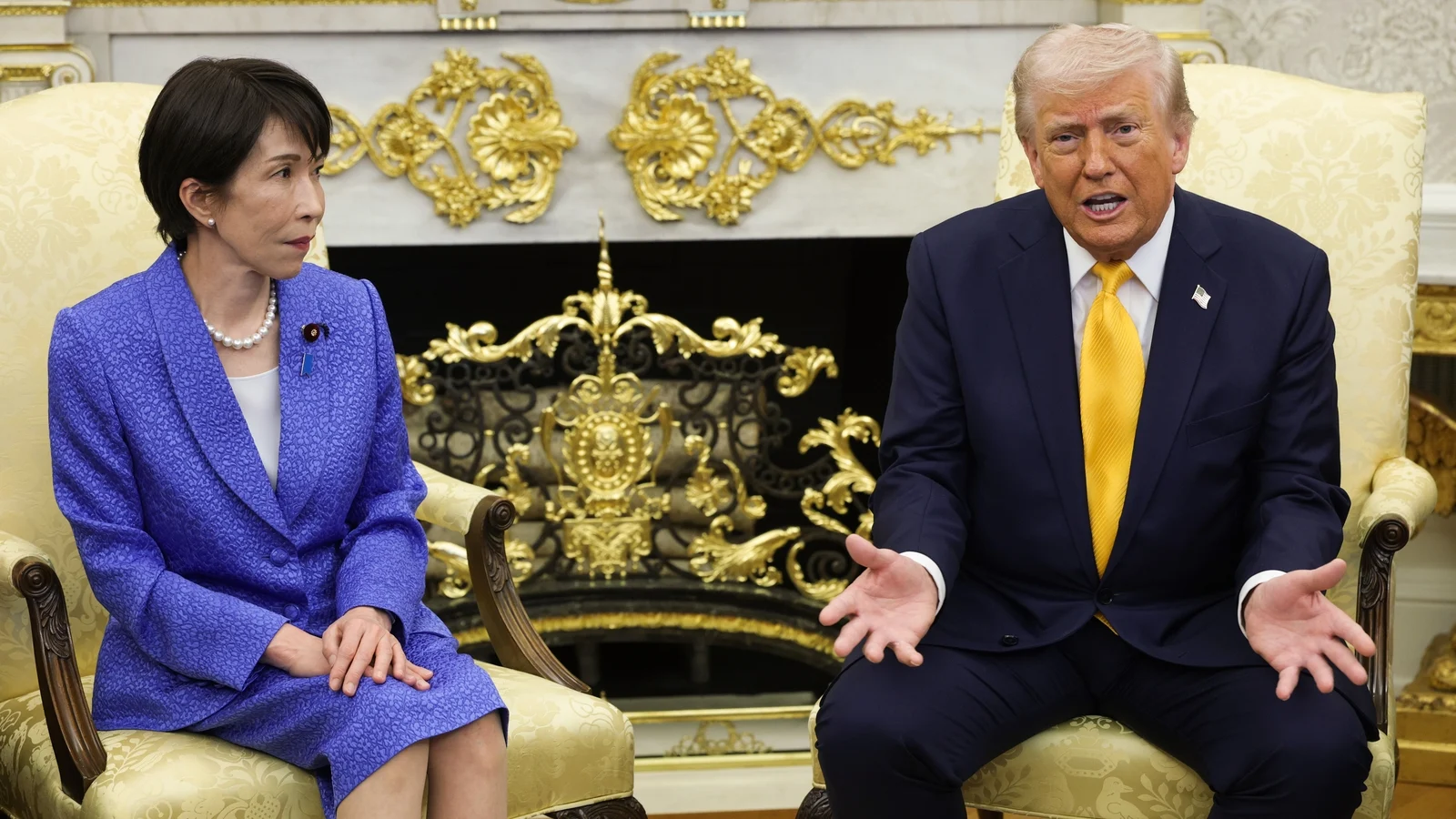
The Oval Office can be a theater. On a late afternoon in Washington, it felt like one: bright sunlight pouring over the Resolute Desk, flags standing stiffly behind two chairs, and a conversation that leapt from diplomacy into the dangerous terrain of historical memory.
At the center of that moment was a one-liner—searing, offhand, and immediately viral. The former US president, defending recent American strikes on Iran, invoked the attack on Pearl Harbor as an emblem of military surprise. “We wanted surprise. Who knows better about surprise than Japan?” he asked, tossing the line across the polished room. “Why didn’t you tell me about Pearl Harbor?”
Beside him sat Japan’s prime minister, Sanae Takaichi. Cameras caught the brief, unmistakable flicker of unease: an involuntary widening of eyes, a stiffening of posture. For a moment, the weight of a century of history seemed to lodge between them.
Why Pearl Harbor Still Hurts
Pearl Harbor is not an abstraction. On December 7, 1941, Japanese planes descended on the US Pacific Fleet moored in Hawaii and changed the map of the 20th century. Official counts list 2,403 Americans killed that day; thousands more were injured. The attack propelled the United States into World War II and led to a brutal Pacific campaign that culminated in the atomic bombings of Hiroshima and Nagasaki in August 1945—attacks that resulted in some of the worst civilian casualties in human history, with estimated deaths in Hiroshima around 140,000 and in Nagasaki roughly 70,000 by the end of 1945.
President Franklin D. Roosevelt called December 7 “a date which will live in infamy.” For many Americans and for many in the Pacific, that phrase still carries a visceral ache—an ache that reverberates in memorial museums, in classroom histories, and in the lives of survivors and their descendants.
From a Joke to a Diplomatic Headache
Words have power, and political rhetoric can reshape relationships in a single paragraph. In Tokyo, the response was a mixture of bemusement, discomfort, and cautious diplomacy—both in the corridors of power and on the sidewalks outside train stations.
“She handled it very carefully,” said one Tokyo commuter, a woman in her 30s who asked not to be named. “If Takaichi had laughed, it would have been seen as disrespectful. If she had scolded him, it would have led to a public spat. No one wins.”
A small shopkeeper near Ueno Station, wiping his hands on an apron, offered a different note. “When you’re carrying history that severe, you don’t see it as a punchline,” he said. “I felt a chill. It’s not funny to remind people of death in that way.”
Not everyone thought the remark was intended to wound. “Maybe it was meant as an absurd little jibe—an attempt to lighten a heavy conversation,” suggested a foreign policy analyst in Tokyo. “But in diplomacy, the margin for casualness is tiny.”
Context Matters: Alliances, Memory, and the Politics of Surprise
Beyond the immediate optics, the incident pulls into focus several broader trends. First, the US-Japan alliance—born from the ashes of war and solidified in the San Francisco system of treaties—remains one of the most consequential partnerships in the Indo-Pacific. Roughly 50,000 US service members are stationed in Japan, and the two countries coordinate closely on security, trade, and regional stability.
Second, Japan carries an unusually potent historical memory of the war. The country’s politics intersect with questions of constitutional pacifism, military normalization, and how to memorialize the past. Speakers in public debates often invoke the trauma of 1945 when arguing about the future of Japan’s defense posture. That context means any foreign official who invokes wartime analogies risks reopening old wounds.
Finally, the moment raises a timeless ethical question: can historical suffering be used as rhetorical shorthand to justify contemporary violence? “Invoking Pearl Harbor in this way flattens complex historical pain into a tool for present politics,” said Dr. Mai Sakamoto, a historian of East Asian memory studies. “It makes the tragedies of the past instrumental to current policy in a way that can alienate as much as it persuades.”
Voices from the Street
On the streets of Tokyo, the reactions were personal and varied—testaments to how living memory and national identity intermix.
-
“My grandfather survived the air raids on Osaka,” an elderly woman told me. “He never spoke of it. When I hear leaders use those days like a joke, it disrespects the silence he kept for so long.”
-
“I get that leaders like to make points with memorable lines,” said a university student studying international relations. “Still, there’s a responsibility that comes with being in the room. Not every audience receives a quip the same way.”
-
“We’re watching Washington with concern,” said an Iranian-Japanese teacher. “When big powers quarrel and talk of ‘surprise’ and strikes, ordinary people worry about escalation.”
What This Moment Reveals About Leadership
There is an old journalistic axiom: context is king. A leader who invokes history without acknowledging its weight risks not only diplomatic friction but also a fraying of trust. In an era when social media amplifies every unscripted moment, offhand lines can become lasting headlines.
Ask yourself: if you were sitting across from a counterpart whose nation had been the target of a devastating attack, how would you frame your defense of current policy? Would you trade clarity for a punchline? Would you prioritize domestic applause or long-term relationship management?
Beyond the Soundbite
Rhetoric aside, the episode invites a larger conversation about how nations remember trauma and how those memories shape foreign policy. It asks whether leaders will treat history as a classroom—to learn from—or as theatre—to be borrowed from for effect.
Diplomacy is, at its best, a series of small acts that build trust: invitations, apologies, quiet reassurances. At its worst, it is one-off theatrical gestures that score in the moment and erode credibility later. The Pearl Harbor remark may have been meant as a jest. For many, it was a reminder that jokes can sting—and that history, once scarred into a people’s consciousness, does not easily accept being repurposed.
Final Thought
Moments like this matter because they reveal how fragile the architecture of international relations is. A single quip, spoken in a room polished by centuries of ceremony, can ripple from Washington to Tokyo to Tehran and back again. It prompts us to ask: in a world still haunted by the worst atrocities of the last century, how should leaders speak so that they heal more than they wound?