When Words Walk the Tightrope: Trump’s Claim That Putin and Zelensky Are “Serious” on Peace
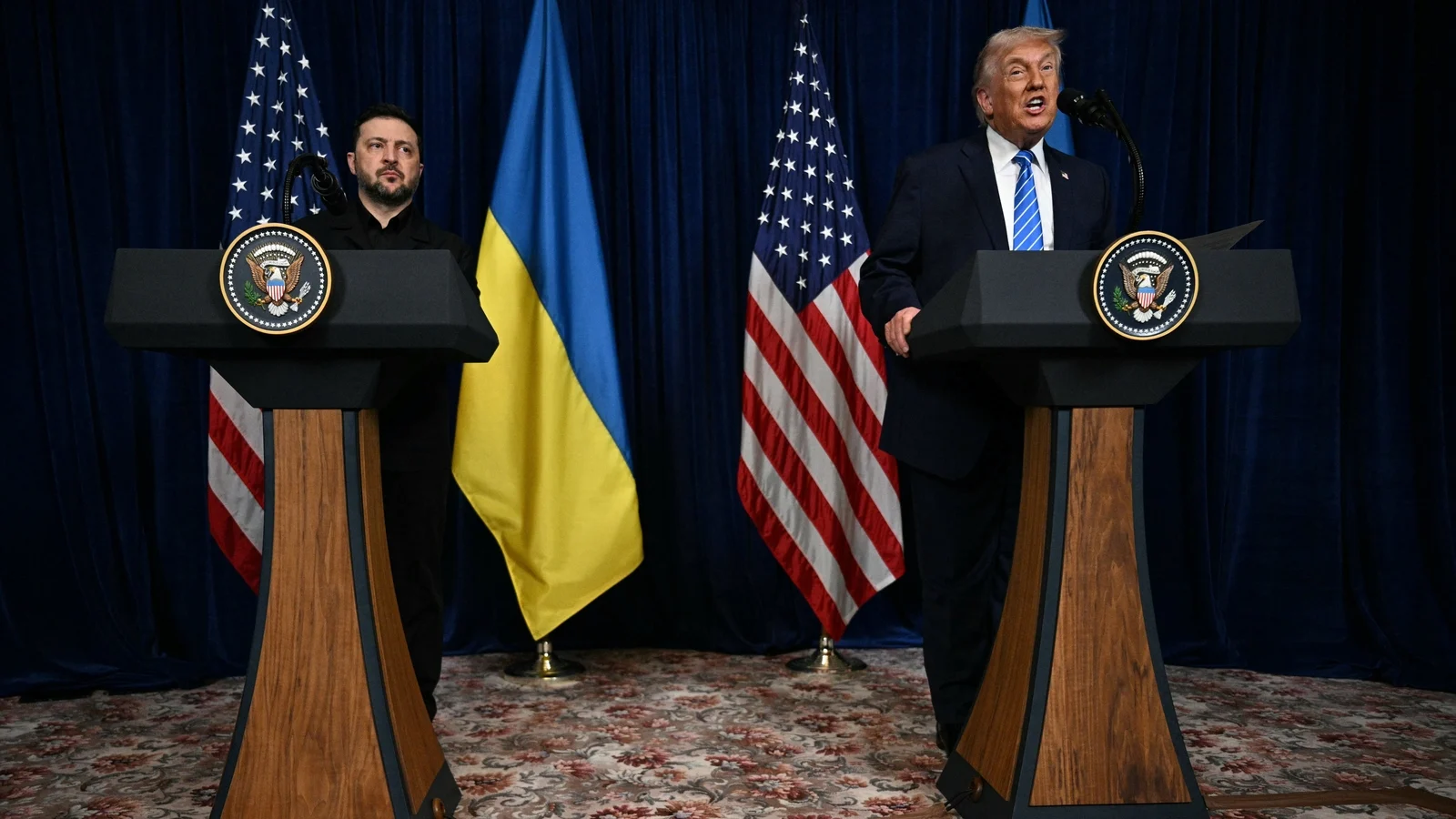
There is something uncanny about the sound of a peace plan emerging — not from diplomats’ quiet rooms but from the mouth of a former U.S. president speaking to a packed crowd. “Both Zelensky and Putin are serious on peace,” he said. The line landed like an unexpected chord in a song everyone thought they already knew: a note that seems to promise conclusion, but leaves the melody unresolved.
Walk the streets of Kyiv today and you encounter a city living in two times at once: the present urgency of daily life and a future that refuses to be taken for granted. In a small café just off Maidan Nezalezhnosti, steam from espresso cups fogs the window as patrons glance at their phones. “We’ve learned to measure every statement in action,” said Oleksandra, a teacher who fled fighting in eastern Ukraine and returned last year. “A promise without security is just a lullaby.”
What Was Said — and Why It Matters
The remark that both leaders are “serious” on peace has rippled through capitals and kitchen tables alike. On the surface, it’s a generous appraisal. If true, it would mean something seismic: that two figures at opposite ends of a bloody conflict — Volodymyr Zelensky, the Ukrainian president who rallied a nation under bombardment, and Vladimir Putin, the Russian president who ordered the full-scale invasion in 2022 — have shifted toward negotiation rather than escalation.
But words are only the opening salvo. “You can say ‘serious’ and still be thousands of miles apart on the terms,” said Dr. Elena Markov, a political scientist at the Kyiv School of Public Policy. “The devil, as ever, is in the guarantees, verification, and sequencing.”
Numbers That Ground the Conversation
What gives weight to the stakes are not only the leaders’ statements but the scale of human cost. Since the full-scale invasion in February 2022, millions have been uprooted: families scattered across Europe, whole towns reduced to rubble, lives paused and restarted in other cities or countries. Humanitarian agencies have documented widespread civilian casualties and infrastructure damage on a scale that will take years — perhaps decades — to repair.
International support has not been trivial. Western countries have provided equipment, training, and humanitarian aid totaling tens of billions of dollars, and Ukraine’s economy has been propped up by loans and grants even as its industrial base was battered. Yet even generous assistance cannot buy trust or rewrite the calculus of security that keeps negotiators awake at night.
Voices From the Ground: Skepticism, Hope, and Weariness
“If there’s peace tomorrow, I’ll celebrate like everyone else,” said Mykola, a 52-year-old bus driver from Kherson. “But I’ve seen too many ceasefires that held only in name. My neighbor lost his home in 2022, and no ‘peace’ can return what was taken.”
Others hear the words and allow themselves a small breath. “We need any opening that can stop the artillery and the children’s hospitals being evacuated,” said Anna, a mother of two who volunteers with a relief organization. “But we also know peace that leaves war criminals untouched only stores the next tragedy.”
In Moscow, reactions were predictably varied. Some commentators framed the comment as a diplomatic olive branch, while hardliners dismissed it as noise. Analysts point out the domestic political calculus in Russia that makes any offer palatable to Western audiences hard to sell at home.
Experts Weigh the Odds
“This moment should be read as an opportunity, not a guarantee,” said Michael Harrow, a conflict resolution specialist who has mediated peace talks in the Balkans and the Caucasus. “Negotiations succeed when there’s leverage, credible guarantees, and international monitoring. Absent those, we’re back to bargaining over casualties.”
Harrow notes that peace processes require sequencing — ceasefire first, withdrawal second, then a roadmap for security, reparations, and political settlement. “Rushing to sign a paper for the optics of peace can leave unresolved grievances that fester.”
What Would a “Serious” Peace Look Like?
Imagining a realistic blueprint means confronting uncomfortable trade-offs. For Ukraine, territorial integrity is non-negotiable for many. For Russia, the political face-saving measures it may demand can be existential. International law, accountability for alleged war crimes, and the role of NATO or other security guarantees add layers of complexity.
Any viable plan would likely include:
- Ceasefire mechanisms monitored by impartial international observers.
- Gradual and verifiable withdraw of forces, with phased security arrangements.
- Humanitarian corridors and a plan for reconstruction funding tied to benchmarks.
- Transitional justice measures to address alleged violations without derailing negotiations.
Each point is simple on paper, fiendishly hard in practice.
The Political Theater — and the Human Cost
Politics plays like theater on this stage. Domestic audiences in both countries will judge leaders less on diplomacy and more on perceived strength or betrayal. “Elected leaders must translate peace into something their citizens understand and trust,” said Dr. Kovacs, a European security analyst based in Budapest. “That means sliding past slogans to deliver secure borders and safety for families.”
For people on the ground, the arithmetic is intimate. A grandmother in Odesa counts the days until she can sleep without hearing rockets in the distance. A young man rebuilding a bakery in Chernihiv worries about where the grain will come from next year. These are the small ledger entries that any peace plan must account for if it’s to be more than paper and promises.
Questions That Remain — For Leaders and for Us
So what should we watch for in the coming weeks?
- Concrete steps: Are there back-channel talks? Are neutral parties like the UN or another state being invited to verify progress?
- Timing and sequencing: Is a ceasefire being negotiated first, or are parties skating straight to political declarations?
- International buy-in: Are major powers prepared to offer security guarantees and reconstruction aid linked to milestones?
And for the reader: what does peace mean to you? Is it an immediate end to gunfire, or a long project of justice and rebuilding? How much compromise between justice and stability is acceptable in the name of stopping more bloodshed?
Conclusion: Hope, But Vigilant
There is power in the notion that leaders could be ready to talk. Yet hope must be vigilant. For Ukrainians returning to neighborhoods scarred by shelling, for refugees arranging lives in distant cities, and for soldiers who have seen friends fall, talk of peace without the architecture to sustain it feels like a fragile thing.
“We want leaders to be brave enough to secure peace, and honest enough to share the price,” Oleksandra said, stirring her coffee. “Courage is not only leading to a table. It’s staying there and doing the hard work.”
In the end, a single sentence — “they are serious” — cannot remake what years of conflict have unmade. But if those words lead to concrete steps, verified actions, and the hard work of reconciliation, perhaps then they will have meant more than rhetoric. Until then, the world watches, waits, and wonders whether this chord is the prelude to the final movement, or simply another refrain in a long, sorrowful song.