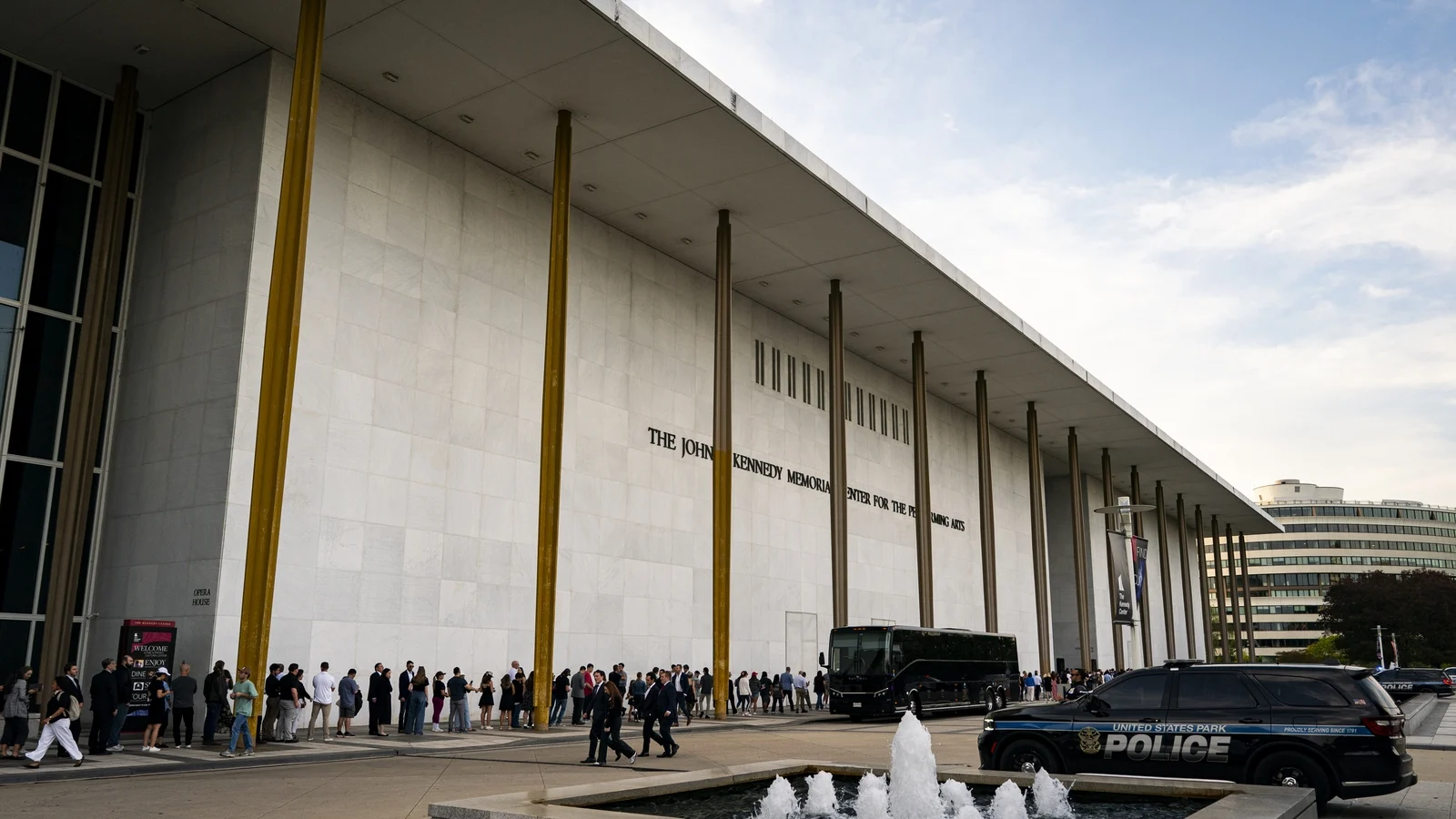
A Name on the Façade and a Debate on the Stage
On a crisp evening in Washington, where the city’s monuments often feel like a chorus of carefully kept memories, one institution suddenly found itself at the center of a very modern quarrel: who gets to put their name on America’s cultural landscape?
Last week the board that now runs the John F. Kennedy Center for the Performing Arts announced — through a terse post on social media — that the venerable institution will henceforth be called the Trump‑Kennedy Center. The declaration arrived not as a ribbon‑cutting but as a rhetorical flourish: a White House spokeswoman praised the move, calling it recognition for the “incredible work” done to restore and renovate the building. But beneath the congratulatory tone lay a thicket of contention.
Conflicting Voices, One Big Question
The announcement was immediate and polarizing.
“The board voted unanimously,” the White House statement read, a claim that landed like a gavel’s rap in partisans’ ears. Within hours, a board member who serves ex officio insisted she had been muted during the vote and denied the process had been on the agenda. “This was not unanimous. I was muted on the call and not allowed to speak,” she wrote on social media, adding that the move had not even been scheduled for discussion.
Across the river and around the country, critics were quicker to frame the decision as a symbolic overreach. “The Kennedy Center is a living memorial to a fallen president,” wrote a member of the Kennedy family, invoking the law that established the center as a tribute to John F. Kennedy. “It can no sooner be renamed than someone can rename the Lincoln Memorial.”
On the Ground: Reactions from the Front Row
Walk the center’s halls and you’ll find people processing the news in quieter, more human ways.
“I grew up coming here with my parents — we saw Leonard Bernstein, we queued for holiday shows,” said an usher who has worked at the center for a decade. “This place carries other people’s lives. You don’t just stick a new label on that without asking everyone who cares.” Her voice was gentle but edged with fatigue; unions representing performing arts staff here have already raised concerns about governance and morale.
A violinist who performs with regional ensembles and has played the pavilion twice a season for years leaned into the symbolic weight of names. “Names carry a promise,” he told me. “When a building is called a memorial, it’s a contract with history. It’s not a billboard.”
Legal Lines and Congressional Gatekeepers
Names matter not only emotionally but legally. By federal statute the Kennedy Center was established as a living memorial to President Kennedy — a point raised by opponents of the rebranding almost immediately. That matters for two reasons: symbolic sanctity and statutory process. The law that created the center doesn’t disappear simply because a newly constituted board decides to rebrand.
Most observers note that any formal renaming would face a further hurdle: Congress. Even if the board insists on a new moniker, federal legislation would likely be required to alter the institution’s title officially. That means the name change would not only reopen debates about taste and memory; it would become a legislative question, with all the partisan theater that implies.
Politics, Patronage and the New Board
The controversy didn’t emerge in a vacuum. Earlier this year, the presidency reshaped the center’s leadership, installing allies and removing long‑time figures who had stewarded its artistic mission. The new leadership moved quickly to assert control: the previous chair was ousted, a new board installed, and the center’s longtime president replaced with a politically connected figure.
“It’s a classic move,” said a cultural policy scholar at a Washington university. “Control the board, control the agenda. But the arts are not a private enterprise. They sit at the intersection of public memory, civic life and cultural diplomacy. Changing the name of a federally recognized memorial is not the same as changing the name on a stadium.”
What’s at Stake Beyond the Letterhead
On the surface, this is a tussle over branding. But it’s really about how a society keeps and negotiates memory. The Kennedy Center has been, for decades, a place where Presidents and prime ministers have applauded virtuosos and where the country staged its cultural self‑image. Is a memorial a static shrine or a living, alterable thing? Are public symbols safe from political renovation?
Consider the global implications. Across continents, governments and leaders have been re‑naming streets, dismantling statues, or erecting new monuments to reflect changing political winds. In Hong Kong and Kyiv, in Bogotá and Berlin, battles over public memory have both unified and fractured communities. The debate in Washington echoes those struggles — only here the monument is a performing arts center that hosts everything from state ceremonies to experimental dance.
Art, Power and Funding
There’s also a fiscal argument in play. The administration and supporters have pointed to the center’s deferred maintenance and budget shortfalls, framing the rebranding as part of a larger campaign to save a deteriorating public asset. The current director has emphasized fundraising efforts and a push to renovate.
“We want a center that can welcome audiences for the next fifty years,” a board spokesperson told reporters in a briefing. “That requires investment and sometimes, bold decisions.” Bold for whom? For the institution’s artistic community, those decisions feel perilous when they come without consensus.
Invitation to the Reader
So what do you think? When the civic stage is altered by political winds, who gets a say — artists, elected officials, the families tied to a memorial, or the public at large?
Think of the last time you visited a place that felt like a promise: a museum, a memorial, a theatre where history and art folded into one. How would you feel if someone rebranded it in the middle of the night?
Closing Image: A Curtain Not Yet Dropped
For now, a name hangs in the air like an unresolved note. Behind the ornate doors of the center, rehearsals continue, lights are still practiced, and the orchestra still tunes. The center’s staff — electricians, stagehands, box office clerks — will keep doing the work that makes the place sing, even as politicians and lawyers argue about the marquee.
Whatever happens next, this moment exposes a broader question for democracies around the world: how do we protect common places of memory from becoming footholds for partisan identity? Or is that inevitability — the idea that our shared spaces will inevitably reflect the leaders of our time — itself the new American theater?
- “A building is not just brick and mortar,” said a longtime patron. “It’s people’s stories.”
- The center opened in the early 1970s and has hosted presidents, diplomats, and countless artists over five decades.
- Any official renaming would likely require an act of Congress, complicating the board’s unilateral announcement.