Dawn Sirens and a City That Keeps Breathing
Just after midnight, when most of Kyiv’s lights were already stamped out and the cold had a bite to it — the mercury hovering around -8°C — the air raid sirens began their long, wailing announcement: stay down, take cover, wait. For hours, the sound folded through apartment blocks, over the Dnipro, and into the bones of people who have learned the rhythms of war better than any calendar.
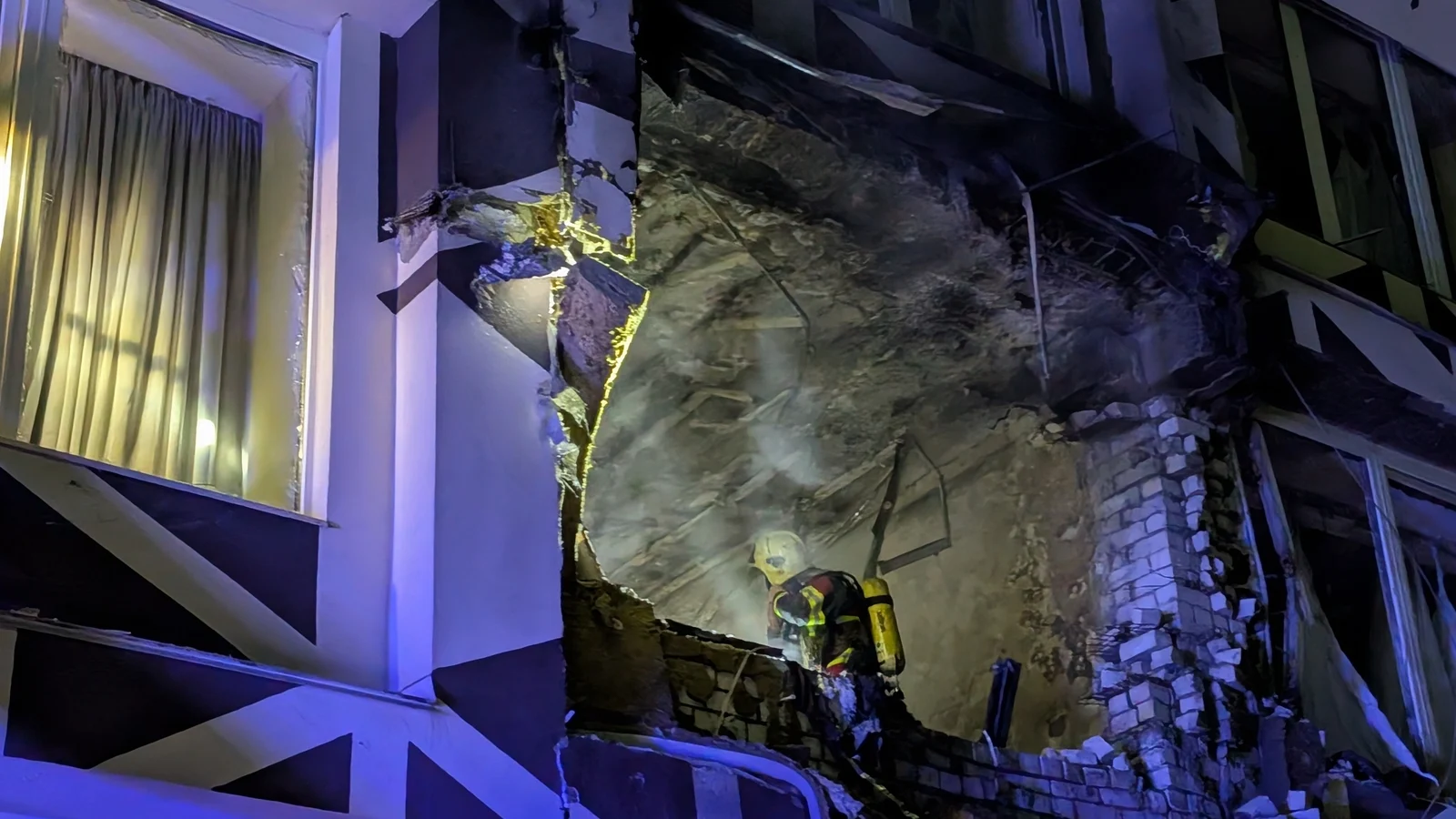
By morning, images circulated of a private medical clinic reduced to a blackened shell. Rescuers eased patients onto stretchers and carried them past scorched walls. Authorities reported two fatalities in the wider Kyiv region — one person who died in the clinic and another man in his 70s, killed in pre-dawn strikes on the nearby city of Fastiv. Three others were wounded at the clinic, firefighters said.
“We heard the blast and at first thought it was thunder,” said Kateryna, a nurse who rushed to the scene. “Then we smelled smoke and saw the ceiling falling. People were coughing and shaking. I kept thinking: I have to help. There were babies. There were old people. You cannot explain that feeling.”
Power Outages, Cold Homes, and the Human Chain
Beyond the immediate casualties, the strikes introduced another slow cruelty: the lights went out. Local officials reported power cuts in several districts; backup generators and emergency systems were pressed into service to keep water and heating running. For a city already accustomed to improvisation, it became another test of endurance.
“You know what it is to boil frozen pipes at midnight? To wrap a child in every blanket in the house?” said Mykola, a resident of a Kyiv suburb. “We keep the kettles hot, we keep the radios close. But this is fatigue for the soul. How long can people live like this?”
Kharkiv in Darkness: An Assault on Daily Life
Several hundred kilometres east, Kharkiv — Ukraine’s second-largest city with more than a million residents — endured its own night of terror. Mayor Ihor Terekhov reported that five missiles had struck, inflicting “very serious damage” on energy infrastructure. He framed the attack bluntly: it was not merely a military strike, he said, but an attempt to “break us with fear and darkness.”
Damage to substations and distribution lines does something that shelling cannot: it takes away the comfort of everyday life. Heating goes, water pressure drops, and hospitals must reroute patients and surgeries. In winter, that cascade becomes life-threatening.
An energy analyst based in Lviv, who asked not to be named for security reasons, said the targeting of utilities has been a grim calculus of war. “Disrupting energy is strategic. It undermines morale, halts logistics, and forces a population to lobby leaders to seek immediate ceasefires. But humanitarian pressure does not replace sovereignty,” they said.
Diplomacy Under Fire: Paris, Preparations, and a Fragile Momentum
Perhaps the most bitter note of the morning was the timing. These strikes came on the eve of a diplomatic summit in Paris where European leaders hoped to push for a breakthrough on a peace framework Kyiv says is 90% ready. Security advisers from at least 15 countries — including Britain, France, and Germany, alongside NATO and EU representatives — had gathered in Kyiv in recent days to lay groundwork for talks.
“We are trying to iron out the final details,” said one Western security official involved in the preparatory talks. “But every missile fired makes a negotiated settlement harder. It hardens positions on both sides.”
Negotiators face an elemental impasse: Russia insists on territorial concessions, seeking control over the eastern Donbas and other occupied areas — roughly 20% of Ukrainian territory today — while Kyiv refuses terms that would leave it vulnerable to future aggression. The diplomatic tightrope is thin; each explosion tips it a degree further from compromise.
What’s at Stake in Paris
- The territorial question: whether Ukraine would cede control of occupied regions.
- Security guarantees: how to ensure any deal prevents a repeat invasion.
- Reconstruction and reparations: how to rebuild cities and infrastructure.
- Verification and enforcement: who polices the accord and how.
Drones, Denials, and the Fog of War
The conflict’s sky has its own language now: drones. Kyiv has stepped up strikes targeting energy infrastructure inside Russia — a move Ukraine frames as striking at the financial arteries that sustain Moscow’s war machine. Moscow has fired back with daily reports of downed drones, even releasing footage of wreckage near a residence it said belonged to President Vladimir Putin; Kyiv and Western officials have been skeptical of that specific claim.
And then there was another headline-grabbing moment. When reporters asked US President Donald Trump about the reported strike near the Russian leader’s residence, he told them, “I don’t believe that strike happened.” The statement added another layer to an already confused narrative where each side broadcasts its version of events and reality becomes a patchwork quilt of claims, videos, and denials.
“In conflicts like this, disinformation is a weapon as powerful as ordinance,” said Dr. Marta Ivanenko, a scholar of information warfare at a European university. “Narratives shift loyalties, justify actions, and sometimes, tragically, they obscure accountability.”
Behind the Scenes: Leadership Moves and a War That Evolves
Amidst the explosions and the diplomacy, Kyiv is also reshaping its security apparatus. President Volodymyr Zelensky announced plans to replace the head of the SBU, Vasyl Maliuk, moving him to a role focused on combat operations. The change follows a string of high-profile SBU operations — from audacious drone strikes on Russian airfields to reported attacks on a Russian submarine and the Kerch bridge, which links Russia to occupied Crimea.
“We need results that degrade the occupier’s capacity, not just signals,” a Ukrainian official said. “The president is reorganising so that intelligence and asymmetric operations deliver concrete outcomes on the battlefield.”
What This Means for Ordinary People
For the people who live through these nights, politics and strategy are layered on top of simpler fears: staying warm, keeping family together, making sure the elderly neighbour has fuel, feeling safe enough to sleep. The war has carved new routines from old lives.
So what should the outside world take away from another morning of air raid sirens? Perhaps this: wars are not just statistics or frontlines, they are the daily arithmetic of survival. They test institutions — health, energy, diplomacy — and they force ordinary citizens into extraordinary resilience.
As the diplomats board planes to Paris and advisers shuttle between Kyiv and capitals across Europe, ask yourself: what does a just peace look like when the very infrastructure of normal life — heating, water, hospitals — can be weaponised? And who pays for the repair not just of buildings and bridges, but of trust?
Tonight, the sirens might wail again. Tomorrow, a summit will sit under the weight of what happened before dawn. Between those beats, people will carry on: boiling water, wrapping children in blankets, and hoping someone in a room full of leaders remembers what it feels like to be cold and scared and alive.