Four Years Later: Kyiv’s Winter of Memory, Resistance and the Long Work of Rebuilding
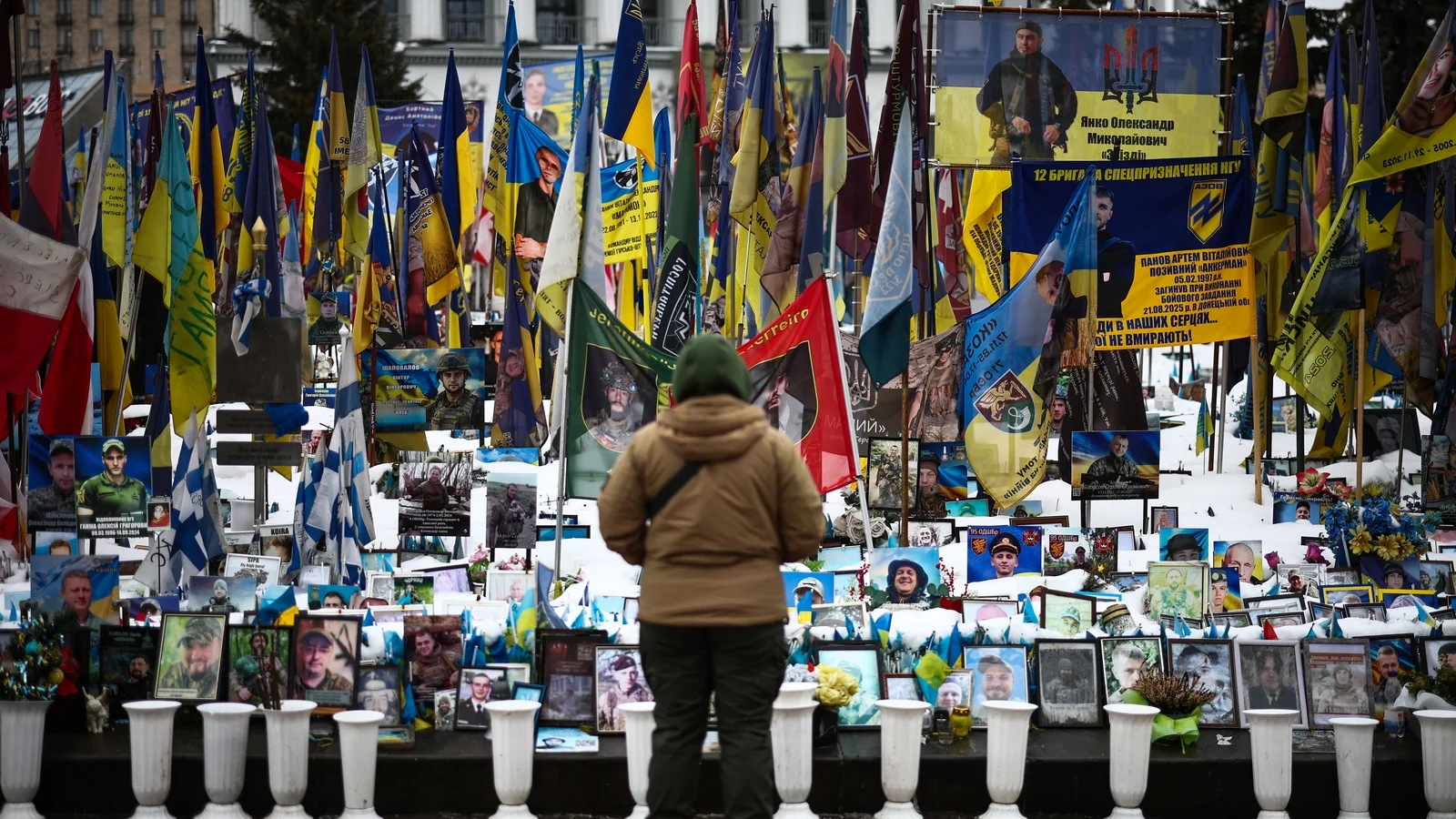
On a raw February morning, I stood beneath a sky the color of sheet metal watching a thin line of people fold themselves into the cold outside a small square in central Kyiv. They carried single stems of daffodils and bundles of plastic-wrapped bread — offerings in a culture that measures grief as much in food and flowers as in flags and speeches.
It has been four years since Russia’s full-scale invasion reshaped the map of Europe and rewrote the daily lives of millions. What began in the pre-dawn hours of 24 February has grown into the most destructive conventional conflict on the continent since 1945. The shape of that destruction is visible in cracked facades, in flattened blocks of flats, in rivers of sandbags along promenades and in the long, patient queuing at generators and bakeries.
Memory: small rituals, vast losses
“We come because memory is a kind of armor,” Svitlana, a pensioner with a woolen hat pulled low over her ears, told me as she laid her flowers down. “If we do not remember, who are we protecting?”
She is right to be protective. The United Nations records cited today put civilian deaths at roughly 15,000 since the invasion’s outset; other tallies count hundreds of thousands of combat casualties on both sides. These are not just numbers. They are fathers, nurses, teachers, teenagers with the future chipped away.
President Volodymyr Zelensky marked the anniversary with a sober address, reminding the world that the Russian president’s early calculation — that Ukraine could be taken swiftly — had failed. “He did not break the Ukrainians,” Zelensky said. “We will do everything to achieve peace — and to ensure there is justice.”
On the streets: stories of endurance
A once-bustling coffee shop near the Maidan that used to steam with espresso now warms just a handful of people. “We sell soup and hope,” said Marcin, the barista who is now also the shop’s unofficial community coordinator. “When the power goes, the kettle is more important than Wi-Fi.”
For many Ukrainians, this winter has been the harshest yet. Repeated missile and drone strikes have targeted power plants and heating networks, leaving millions to endure freezing temperatures in poorly heated apartments. “You learn new rhythms quickly,” said Olena, a nurse who works night shifts and sleeps by a charcoal heater. “You bundle, you check the batteries for the lamp, you help your neighbors. It’s survival, but it’s also how communities are remade.”
Resistance and the New Geography of Security
From the outset, Ukrainian resistance has been fierce, improvisational and stubbornly effective. Early attempts to seize Kyiv faltered. By summer 2022, Russian forces had been pushed back from several key regions, and symbolic victories in Kherson and Kharkiv shifted the tone of the war even as the frontlines hardened elsewhere.
What followed was a transformation not only on the battlefield but in political alliances across Europe. NATO, long dormant on matters of existential defense on the continent, expanded in 2023 with Sweden and Finland joining. European governments have significantly increased defense budgets, and a steady flow — hundreds of billions of dollars and euros — in Western military aid has kept Ukraine’s military capacity afloat.
“This conflict is rewriting Europe’s idea of security,” said Dr. Marta Nowak, a defence analyst based in Warsaw. “Countries that once thought geography protected them now view defense spending as essential infrastructure — like roads or hospitals.”
The limits of aid and diplomacy
Money and weapons have been decisive, but politics complicates everything. An intended new EU sanction package and a proposed €90 billion loan aimed at shoring up Ukraine’s finances have been delayed in Brussels, with Hungary publicly blocking the measures. These disputes underscore a worrying truth: alliances can be robust in rhetoric and fragile in detail.
At the same time, diplomacy is not idle. Talks brokered by the United States have been intermittently revived, yet an endgame remains elusive. Russian demands — particularly over control of Donbas — and Kyiv’s insistence that any deal must be accepted by Ukrainians themselves— make easy solutions impossible.
Destruction and the Cost of Rebirth
Walk through many Ukrainian towns and you will see whole axes of the city reduced to rubble, churches with facades peppered by shrapnel and libraries half-empty. The World Bank has estimated reconstruction costs at close to €500 billion — a figure so large it reads like the price of a future economy rather than the bill for past violence.
“Reconstruction is more than concrete,” said Sergei Ilyin, an urban planner coordinating rebuilding projects in the east. “It is restoring education, health, civic life. It will take a generation to knit this country back together — if the funding, security and political will align.”
One small rebuilding project I visited attempts to stitch life back into a bombed neighbourhood: a community bakery where volunteers teach job skills and where families gather around wood-fired ovens to bake bread. “Bread is practical,” said one volunteer, “but it’s also a proclamation: we’re staying.”
Technology, tactics and the new face of warfare
Drones and missiles have become the war’s grim punctuation marks. Airborne reconnaissance, swarm drones and precision strikes have proved decisive in recent phases of the conflict. For many residents of cities like Kharkiv and Dnipro, daily life now includes the sound of air-raid sirens, the shadow of a drone crossing the sun and the ritual checking of emergency kits.
“Firepower is not enough,” warned an unnamed Western military officer I spoke to in Kyiv. “Resilience, intelligence, logistics — and the will of the people — have turned the tide again and again.”
Beyond the Frontlines: What This Means for the World
What happens in Ukraine matters far beyond its borders. Energy security, the meaning of sovereignty, the viability of international law — all are being tested. The return of a polarised United States into the presidential politics complicates EU strategies and raises questions about the durability of Western support. Meanwhile, authoritarian governments watch closely, taking notes about how democracies respond under stress.
Are we witnessing a new kind of geopolitics where regional conflicts become stress tests for global institutions? Can post-war reconstruction become a model for climate-resilient rebuilding? These are the questions policymakers and citizens may need to answer in the coming years.
What comes next?
As officials prepare another commemoration in Kyiv and leaders from Brussels visit to show solidarity, Ukrainians will continue the quiet, difficult work of tending to the wounded and planning for a future that is still, mercifully, theirs to define.
“We don’t want glory,” Svitlana told me as she adjusted her scarf against the wind. “We want our streets back, our children’s laughter, the right to say we lived, loved and built here. Isn’t that what you want for your home too?”
In a world that often treats history as a sequence of headlines, the small acts — a bouquet on a bench, a scholar teaching urban planning in a ruined school, a soldier returning to plant a sapling — are the slow history of how a country survives. Four years into a war that many hoped would be short, Ukraine’s story is still being written, line by patient line, by those who choose to stay and by those who continue to stand with them.